

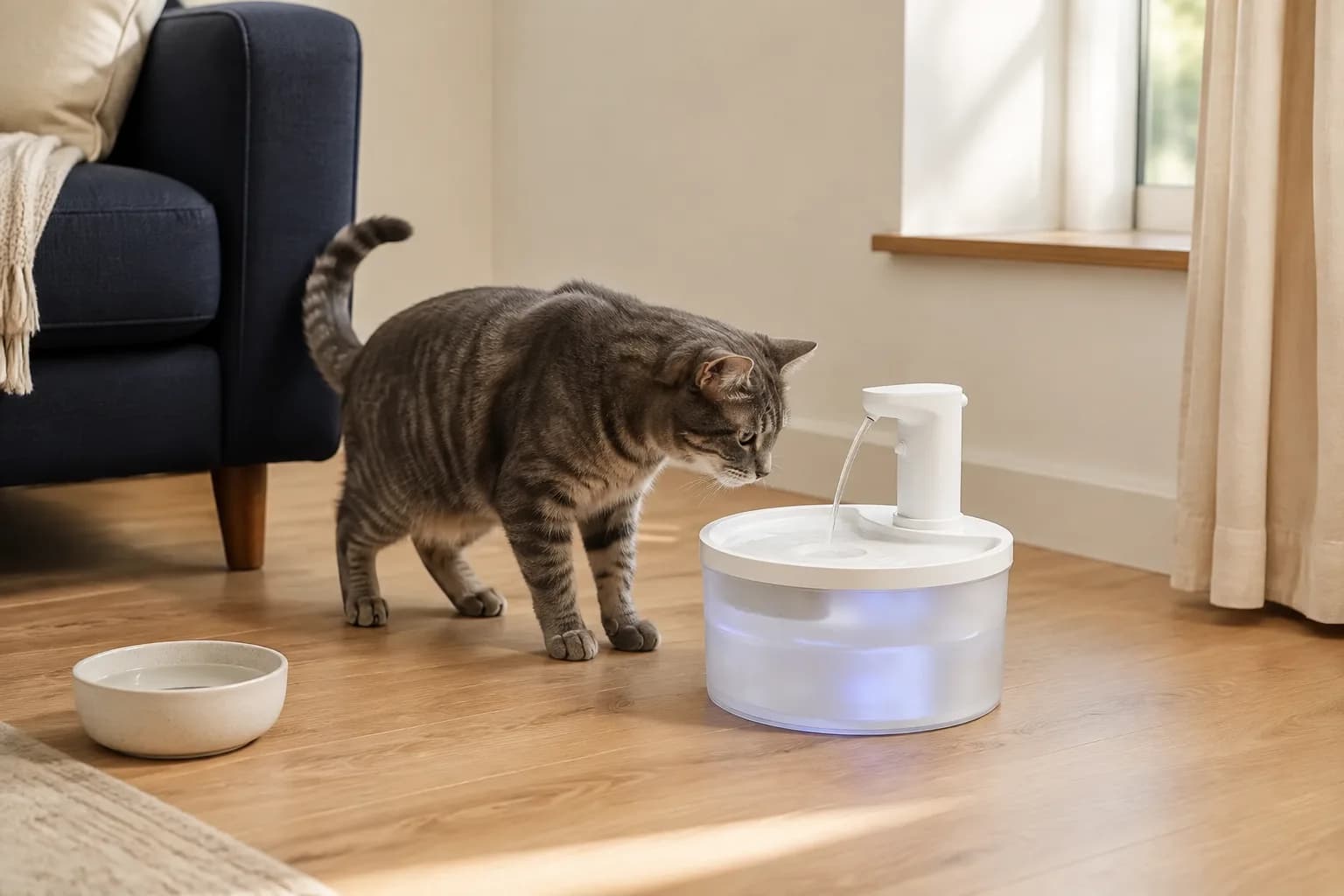
Put two cat water fountains side by side and they can look equally good in a product photo. The differences become easier to judge when you refill them, reach into the corners, remove the pump or fit a replacement filter. Even a stronger-looking stream may be one your cat chooses to ignore.
A good cat water fountain should be easy to clean completely, use a pump you can access and replace, offer a water-flow style your cat accepts, and have filters or spare parts you can still buy later. Material, capacity, battery size and sensor features matter, but they come after those basics.
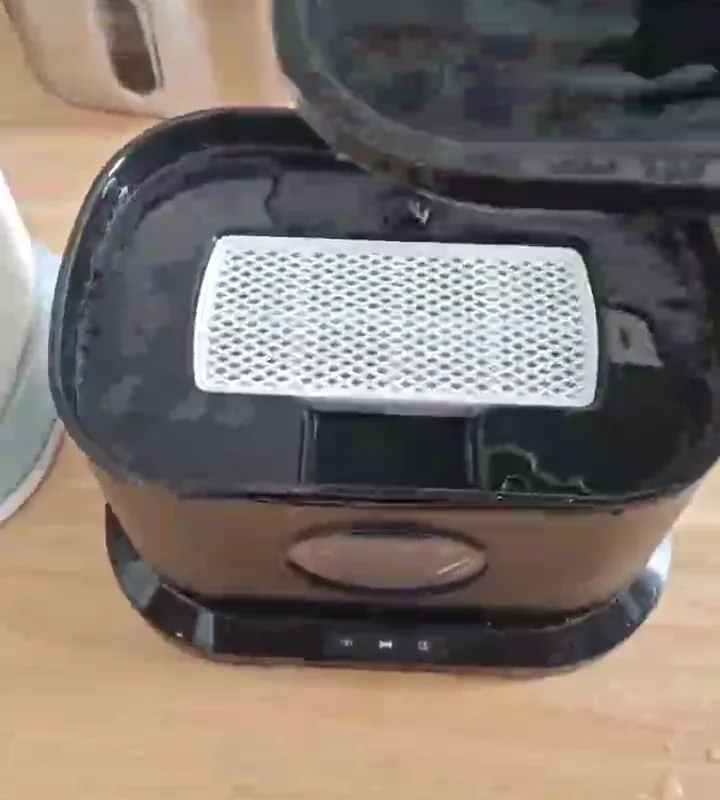
I would start with cleaning and replacement parts, not material. In Fountelio's assembly footage, lifting the tray exposes the filter, but the pump remains underneath. That difference is easy to miss in a product photo. Placement and operating mode come next.
What Should You Look for When Choosing a Cat Water Fountain?
Choose a cat water fountain your cat will use, with wet surfaces you can reach, a serviceable pump and replacements you can obtain. Compare flow, usable capacity and the power arrangement against your household routine. Then decide whether sensing, a particular material or an extra outlet style earns its place. Neither a larger tank nor a smarter label compensates for difficult maintenance.
Which 9 Factors Matter Most When Comparing Cat Water Fountains?
Use these nine checks to compare otherwise suitable models. Start with the cat and the maintenance routine, then narrow the features.
- Cat acceptanceRepeated voluntary use, with another water source available.
- Cleaning accessAll wet surfaces within reach, including hidden channels.
- Pump serviceabilityAn accessible intake, impeller and compatible replacement.
- Material and constructionActual component materials, finish and handling weight.
- Flow and noiseWater presentation and sound as the reservoir level changes.
- Usable capacityWater available above the minimum operating level.
- Power architectureWall connection, charging routine and internal pump arrangement.
- Sensor behaviorTrigger range, angle, run time and unintended activation.
- Filters and spare partsExact fit, replacement cost and a credible supply route.
Will Your Cat Actually Use a Water Fountain?
A fountain is an option, not a guaranteed improvement over a bowl. Some cats use moving water readily; others prefer still water. Keep an alternative available and judge repeated voluntary drinking rather than a first sniff, a paw in the stream or one attractive product video.
In a randomized crossover study by Robbins et al. published in the Journal of Feline Medicine and Surgery, 16 healthy laboratory cats were enrolled and 14 completed comparisons of still, circulating and free-falling water. Average intake did not differ significantly between systems, although three cats showed individual preferences. This small, controlled study does not settle every home situation or establish disease prevention.
Cornell's hydration guidance also notes variation in fountain preference and the contribution of food moisture. A cat eating wet food may drink less visibly than one eating dry food. An equipment purchase is not a substitute for assessing a concerning change with a veterinarian.
Trays and outlets change where water lands and where a cat can approach, without proving that it will drink more. Keeping those surfaces clean is a separate question.
How Easy Is the Fountain to Take Apart and Clean?
An easy-to-clean cat water fountain lets you reach every wet surface without an awkward sequence of hidden clips or inaccessible tubes. Cleanability is a geometry problem before it is a material problem. A polished reservoir can still contain a narrow channel that your brush cannot reach.
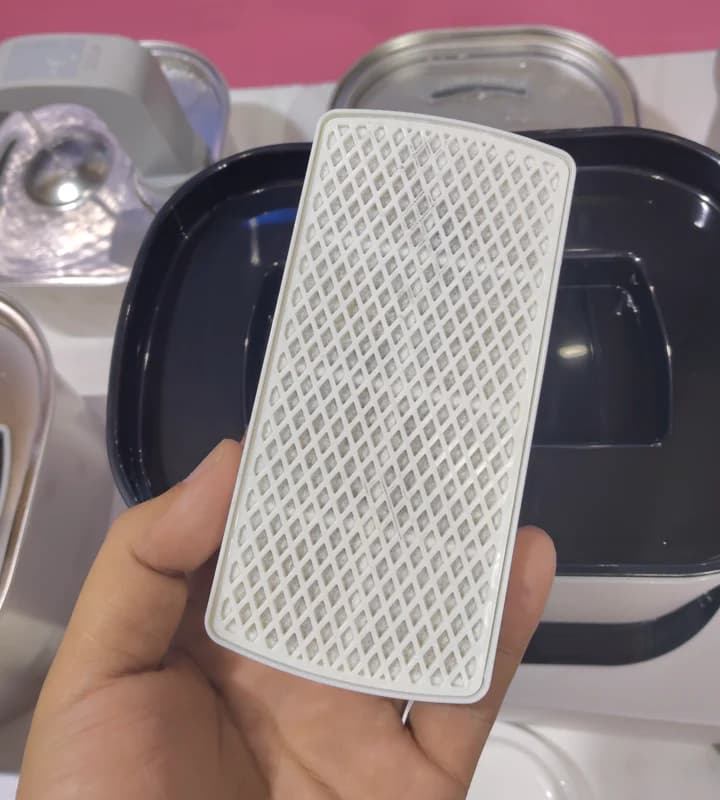
The photographs below show a filter seated and lifted out, in separate demonstrations. Neither reveals the whole water path. Follow it through these five areas when reviewing a sample.
The five-zone cleaning check
- Drinking surfaceReach the tray underside, rim and outlet opening.
- ReservoirReach corners, seams and the area behind the window.
- Water channelCheck tubes and concealed passages between pump and tray.
- Pump chamberFind the intake, cover and accessible impeller area.
- Removable partsRemove, rinse and refit seals, filter holders and spouts.
Follow the model's cleaning instructions and disconnect power before disassembly. Do not immerse a charging base or electronics unless the instructions expressly permit it. A dishwasher-safe reservoir does not make the assembled fountain dishwasher safe.
Is the Pump Easy to Access, Clean, and Replace?
Check whether the pump can be removed, its intake cleared and its intended service parts opened. Then check the replacement specification. A pump that fits inside the reservoir may still have the wrong connector, flow characteristics or electrical requirements. Physical resemblance is not enough.
The Glacier Point owner's manual separately describes cleaning the impeller and its well. Removing a module and opening its service parts are separate checks; follow your model's instructions for tools, cleaners and intervals.
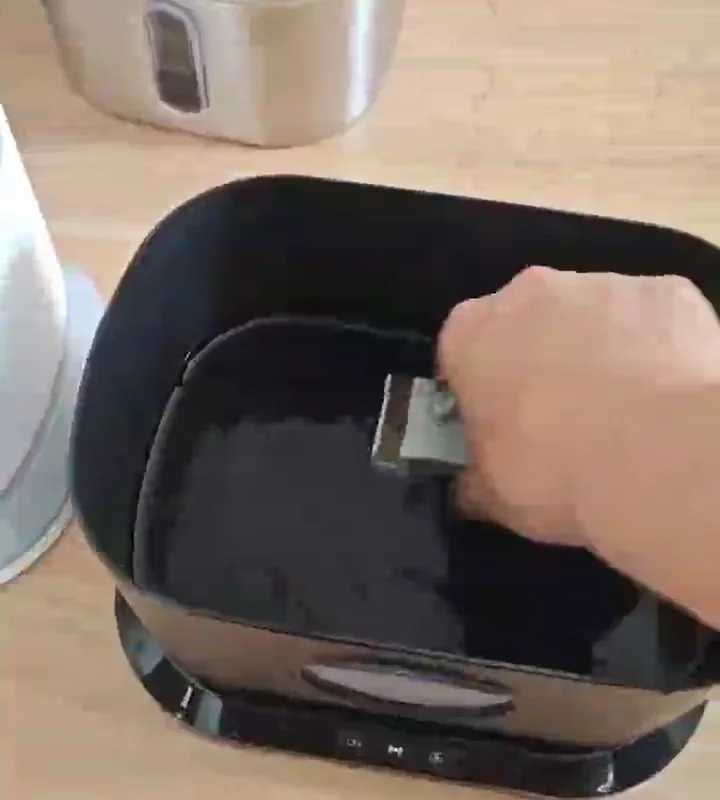
Hair around the intake, deposits in the pump chamber and a poorly seated part deserve attention when flow or sound changes. Do not keep operating below the specified minimum level to investigate noise. Check the manual and seller's troubleshooting advice first.
Which Material Should You Choose: Plastic, Stainless Steel, or Ceramic?
Choose the material after inspecting the construction. Plastic, stainless steel and ceramic offer different handling, appearance and maintenance trade-offs. None guarantees a clean water path. Ask which parts use the advertised material: a steel reservoir may still have a plastic tray, filter holder, pump and seals.
| Check | Plastic | Stainless steel | Ceramic |
|---|---|---|---|
| Handling | Often lighter; check stability | Often heavier than plastic | Often heavy; check filled weight |
| Finish and shape | Broad molding and color options | Metal presentation; inspect seams | Glazed finish; inspect every wet surface |
| Wear to inspect | Scratches, clouding and deformation | Edges, joints and surface damage | Chips, cracks and glaze damage |
| Water visibility | Translucent housings are possible | Usually needs a window or level check | Usually needs a level check |
| Shipping | Check protection against distortion | Check protection against dents | Check impact protection and breakage |
Compare the plastic fountain range and stainless steel range with the trays removed. The material is easy to see from outside; the filter holder and route to the pump need a closer look.
Terms such as 304 stainless steel, BPA-free and food-grade need a defined component scope and relevant documentation. Do not extend a reservoir claim to electronics or every accessory. Ceramic is included here as a buying comparison, not a claim that Fountelio supplies a ceramic platform.
Which Water-Flow Style and Noise Level Will Work Best?
Compare the drinking surface and the complete sound, not just the pump label. Pump hum, vibration against the floor, water impact and low-level gurgling are different noises. A model that sounds quiet when full can sound different as its reservoir approaches the refill line.
A lower-impact stream landing on a raised dome presents water differently from a taller free fall or a multi-directional outlet. A more visible splash may suit one product brief while a restrained flow suits another. Try the available setting in the intended room.
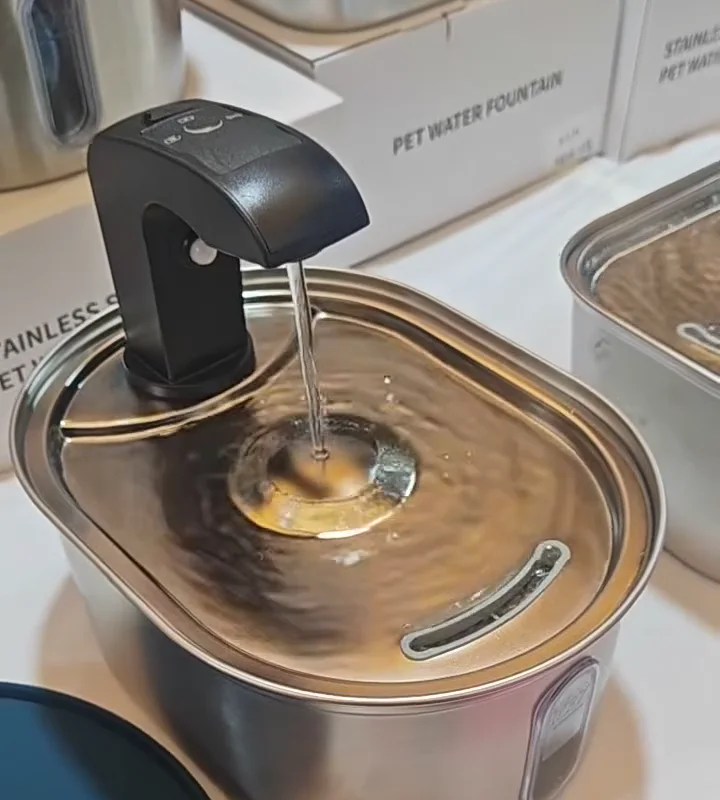
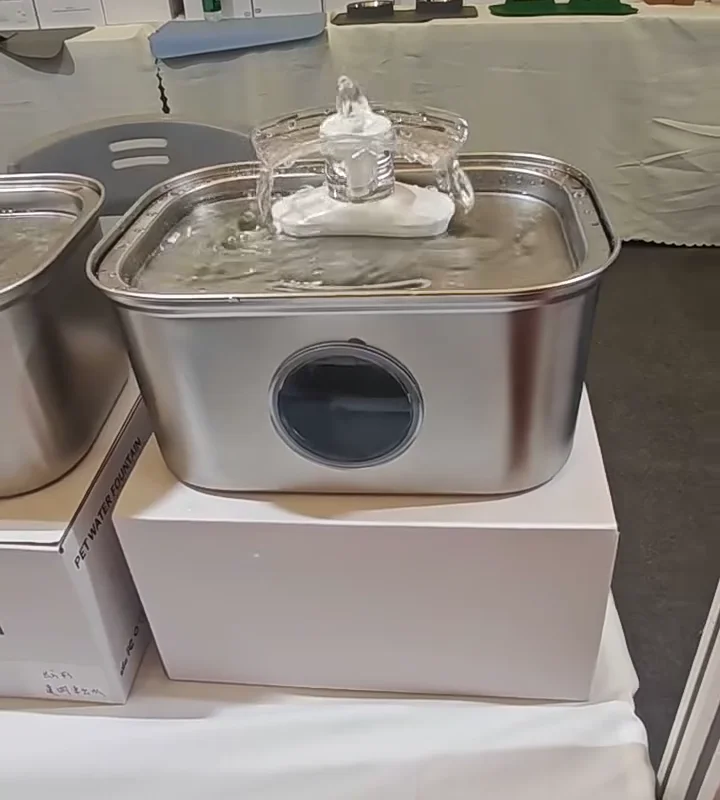
These separate demonstrations show water paths, not a controlled sound comparison. The stills cannot tell you which would sound quieter in your room.
To compare sound, request recordings at normal fill and near the minimum permitted operating level. Keep the room, microphone position and surface the same. Background music, automatic microphone adjustment and an unspecified decibel number make comparisons unreliable. Never ask for a dry-running demonstration.
What Capacity and Drinking Area Does Your Household Need?
Choose capacity around refill access, household size and the volume usable above the minimum operating level. Nominal capacity is the advertised tank figure; it does not automatically describe water that can be circulated before refilling. Ask how the manufacturer measured it and whether internal components were fitted.
Conceptual illustration. Component displacement and the stated capacity method must be checked for the exact model.
A 3.2L label therefore does not promise a particular number of days between visits. Water below the pump's operating limit, inaccessible pockets and component displacement can affect the useful volume. Food moisture, drinking, evaporation and cleaning also prevent a simple tank-size-to-days calculation.
Check the window or translucent wall in ordinary room lighting. Can you see the minimum mark without lifting the tray? Is there room to lift a filled reservoir at the sink? For several cats, consider multiple accessible water locations as well as usable capacity, consistent with the AAFP/ISFM environmental guidelines.
How Do Plug-In, Cordless, and Wireless-Pump Designs Differ?
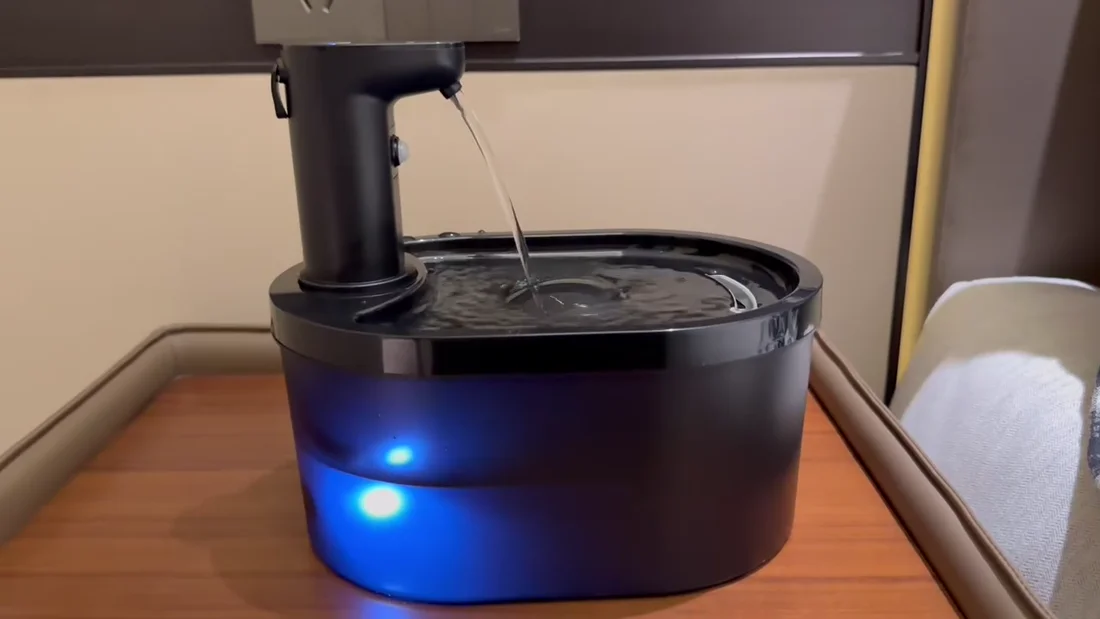
Plug-in and cordless describe how the fountain receives power. Wireless pump describes how power is delivered to the pump inside the reservoir. These terms are related, but they are not interchangeable. A rechargeable fountain can still contain a conventional wired pump, and a wireless-pump platform can offer different power configurations.
| Design | Normal operation | Advantage | Trade-off to check |
|---|---|---|---|
| Plug-in | Connected to external power | No routine battery recharge | Outlet location and cable routing |
| Cordless / rechargeable | Battery-powered between charges | More placement freedom | Charging access and actual runtime |
| Wireless pump | No conventional pump cable through the reservoir | Different internal arrangement | Pump/base compatibility and service access |
Fountelio's rechargeable plastic platform and wireless-pump platform illustrate the distinction. The latter has a rechargeable radar version and a USB continuous-flow configuration without radar. Do not transfer battery or sensing claims between them.
Before comparing battery claims, I want to know which mode produced the quoted runtime. Battery capacity alone does not determine runtime: pump load, activation frequency, sensor behavior, battery condition and control logic all matter. A mAh figure cannot supply those missing conditions.
Do You Need Continuous Flow, Infrared Sensing, or Radar Sensing?
Choose sensing when its behavior suits the location and the cat's use. Continuous flow is straightforward to observe. Infrared and radar models can trigger operation on approach, but useful specifications include range, angle, activation duration, cooldown and available modes. The word smart tells you none of these.
Continuous flow
Check power needs and steady sound. Water keeps circulating during normal operation, without waiting for an approach trigger.
Infrared sensing
Verify the actual sensing zone and modes. Do not assume a particular range just because another infrared fountain uses it.
Radar sensing
Verify coverage in the intended room and watch for unintended triggers. A wider sensing area is useful only if it behaves as needed.
A useful demonstration continues after the first trigger. Watch when flow stops and how soon it can restart. Ask whether people passing, moving curtains or activity beyond the drinking position can activate that model. These are questions to test, not assumed sensor behavior.
Fountelio's CWF-W1 rechargeable radar specification lists approximately 2 to 3 metres and a 150° angle. Its USB version has no radar. A quoted runtime of about 30 days in radar use does not describe continuous-flow runtime.
Can You Get the Right Filters, Pumps, and Spare Parts Later?
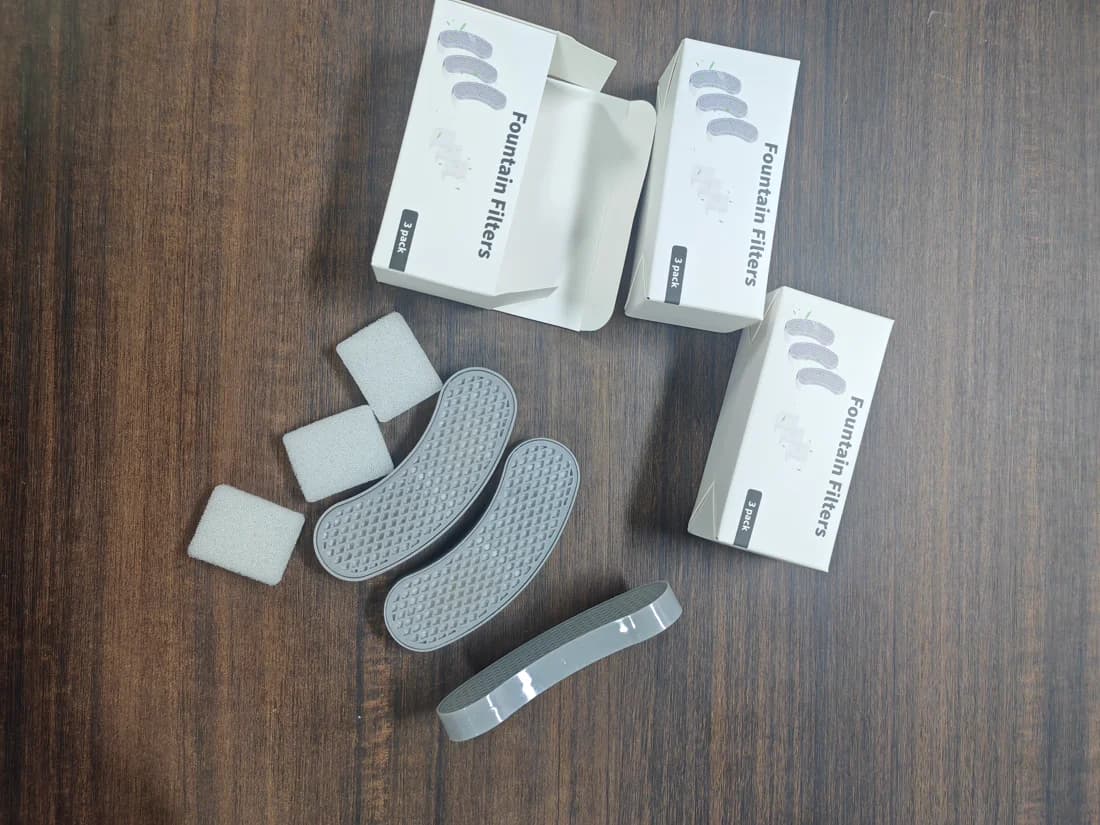
Check the replacement supply before buying the fountain. Five-layer filtration is not automatically better than three-layer filtration. Ask what the media contain, what each layer is intended to do, the cartridge dimensions, replacement guidance and the route for buying the correct refill.
A filter fitting loosely or obstructing the water path is not interchangeable just because its outline looks close. Confirm the part code and model revision. Inspect seals, silicone pieces and outlet parts too; a missing inexpensive piece can make an otherwise usable fountain inconvenient to maintain.
Compare the total maintenance cost: filter pack price, shipping, availability and any service needed for a battery or pump. Ask whether a battery is user-replaceable rather than assuming it is. No filter removes the need to clean the reservoir and water path.
Save the manual and model label. A part code is more useful than round white fountain when ordering replacements. If a cartridge or pump changes, check compatibility with earlier units, especially when buying fountains at different times.
How Can You Diagnose an Ambiguous Fountain Specification?
Turn each attractive label into a question about scope, conditions and verification. If an answer cannot be tied to the exact model, it is not yet a useful comparison. This applies to a retail listing as much as an OEM quotation.
| Listing says | What remains unclear | Ask for |
|---|---|---|
| 3.2L capacity | Nominal, installed fill or usable volume? | Fill method and minimum operating level |
| 30-day battery | Which mode and activation pattern? | Runtime conditions and charging guidance |
| Wireless | Battery power or internal pump architecture? | A view of the reservoir and power system |
| Smart sensor | Infrared or radar; what timing? | Type, range, angle, duration and cooldown |
| 304 stainless steel | Which components are steel? | Component breakdown and relevant documentation |
| Ultra-quiet | Water level, distance and background noise? | Comparable recordings or a defined test method |
| Five-layer filter | Which media and replacement format? | Media functions, part code and supply options |
| Low-water alert | Visual reminder, sound or shut-off? | Exact indicator behavior; separate confirmation of protection |
For example, the blue-to-red indicator on Fountelio's cordless plastic platform is a refill reminder. That description alone does not establish an audible alarm or automatic shut-off. Treat those as separate functions requiring confirmation.
Which Cat Water Fountain Is the Best Fit for Your Situation?
The best fit depends on your daily constraint: cleaning access, lifting weight, outlet location, sound or several cats needing water. Compare models that meet it, keeping the cleaning and spare-parts checks alongside these choices. They are starting points, not rankings.
- A simpler cleaning routine
- Start with an open reservoir, few removable pieces and accessible pump parts.
- Lower weight or more color options
- Compare plastic housings, checking stability and surface finish.
- A metal finish
- Compare stainless housings without assuming their hidden channels are easier to clean.
- Placement away from an outlet
- Compare rechargeable models and plan where recharging will happen.
- A quieter sleeping area
- Inspect the landing surface, vibration and behavior near the refill level.
- Several cats
- Plan accessible water stations and usable volume rather than one large shared tank alone.
What Cat Water Fountain Buying Mistakes Should You Avoid?
Avoid deciding from appearance, nominal capacity or a smart label before checking maintenance and operating conditions. Keep the familiar bowl while the cat tries the fountain, and confirm replacement supply before ordering. An attractive product can still be poorly suited to daily use.
A steel finish can get mistaken for easy cleaning, a larger tank for more usable water, or one quiet recording for quiet operation at every permitted level.
Cordless does not identify the pump; a sensor label does not explain its timing; layer count does not identify filter media. Check replacement pumps, filters and battery service separately.
How Should You Introduce a New Water Fountain to Your Cat?
Give the cat a choice and keep the introduction calm. The aim is repeated voluntary use, not an immediate reaction. This approach follows the emphasis on familiarity, choice and separate resources in the feline environmental guidelines.
- Place the fountain without carrying or forcing the cat toward it.
- Allow inspection before or during quiet operation.
- Keep the familiar clean water bowl available.
- Choose an accessible location away from litter and separate from food.
- Watch for voluntary drinking over time, not just curiosity.
If drinking changes markedly, or dehydration is suspected, contact a veterinarian rather than relying on new equipment. Cornell advises prompt veterinary contact for dehydration concerns.
What Should Brands and Sourcing Teams Ask a Cat Water Fountain Supplier?
Ask for answers against a named model and configuration before approving the sample. A sample that looks right can still leave cleaning instructions, replacement supply or sensor behavior unresolved. These questions turn a general product discussion into a brief both parties can check.
- Which exact platform and model does the quotation cover?
- Which components are plastic, steel, silicone or electronic?
- Is capacity nominal or usable during operation?
- What is the minimum operating water level?
- Can you show full disassembly and pump cleaning?
- Which pump and replacement-filter specifications apply?
- How does it sound at normal and low operating levels?
- What sensor type, range, angle and modes are included?
- Under which conditions was battery runtime measured?
- Which model-specific compliance and packing documents are available?
Fountelio's quality-control overview explains model-specific documentation. Use the manufacturing process and OEM and private-label requirements to prepare the production brief after the configuration is clear. Do not apply one model's material, battery or compliance claims to an entire range.
What Is the Final 9-Point Checklist Before You Buy?
Before buying, confirm that the cat has a choice of water sources, every wet area is reachable, and the pump and consumables have a service route. Check the remaining specifications against the actual model and instructions. Ask the seller to resolve any blank below.
- The cat can try it while another water source remains available.
- Every wet area can be reached for cleaning.
- The pump's intended service parts are accessible.
- Material claims identify the components they cover.
- Flow and sound suit the room at permitted water levels.
- Usable volume and the refill boundary are clear.
- Power supply and pump architecture are understood separately.
- Sensor coverage and operating modes are specified.
- Compatible filters and parts have a purchase or service route.
What Are the Most Common Questions About Choosing a Cat Water Fountain?
Are Cat Water Fountains Better Than Water Bowls?
Not for every cat. Research does not establish a universal increase in drinking. The useful choice is a clean water source the individual cat reliably accepts.
Is Stainless Steel Always Better Than Plastic?
No. Weight, color, construction and cleaning access involve different trade-offs. Judge the complete product rather than the material name alone.
How Often Should a Cat Water Fountain Be Cleaned?
Follow the model's instructions and clean sooner when hair, slime, deposits, reduced flow or increased noise appear. The pump chamber needs attention separately from the visible reservoir.
Is a Cordless Fountain the Same as a Wireless-Pump Fountain?
No. Cordless describes battery operation. Wireless pump describes the internal pump arrangement. Check both independently.
How Large Should a Cat Water Fountain Be?
Consider refill routine, usable water above minimum, household size and other water stations. The largest tank is not automatically the most practical.
Does a Five-Layer Filter Make a Fountain Better?
Not by itself. Media function, fit, replacement guidance and ongoing availability matter more than the layer count alone.
Should I Remove the Old Water Bowl After Buying a Fountain?
Not immediately. Keep another clean source available while the cat becomes familiar with the fountain and shows repeated voluntary use.
What Should Decide Your Final Choice?
The best cat water fountain is the one your cat accepts, you can clean completely, and you can keep running with available filters and replacement parts. Choose the architecture first; choose the finish and extra features second.
If two models still look equally suitable, compare the task you will repeat most: refilling, washing or recharging.
For a sourcing order, resolve unclear specifications during sample review rather than carrying assumptions into production.
About This Guide
This guide combines published feline research and veterinary guidance with Fountelio product specifications and observations from its assembly and flow footage. Health and behavior statements are sourced separately from manufacturing observations. The five-zone cleaning check and specification diagnostic are practical inspection aids, not validated scoring systems.
Tony Kong's recommendations concern product structure and sample evaluation, not veterinary advice. The opening image is an AI-assisted lifestyle illustration; the photographs within the article are Fountelio product photos and video frames. They show components and water paths, not comparative laboratory results or evidence of health benefits. No independent veterinary review is claimed.
Sources & References
- Robbins et al., JFMS, 2019: quantified water intake from still, free-falling and circulating bowls. Controlled research supporting the limits on water-intake claims.
- Cornell Feline Health Center: Hydration. Dietary moisture, individual preferences and when veterinary help is appropriate.
- Ellis et al., 2013: AAFP and ISFM Feline Environmental Needs Guidelines. Resource access, placement and choice.
- Glacier Point Pet Fountains: owner's manual. A manufacturer example of separate impeller and pump-well maintenance, not a universal protocol.