

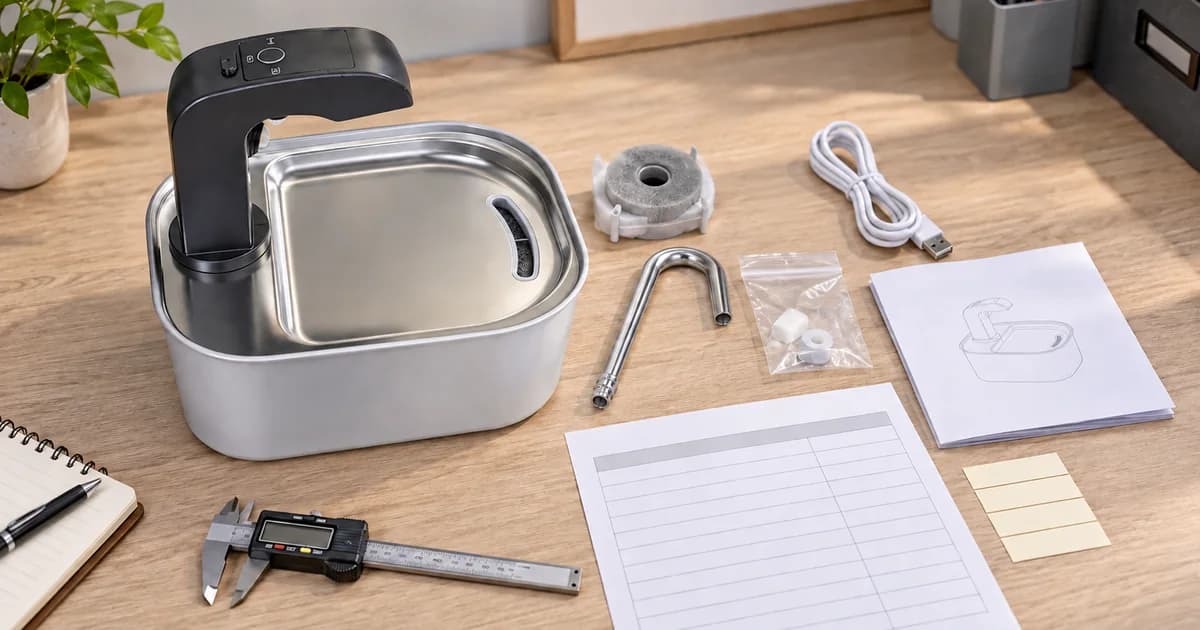
A sample can look promising and still leave the buyer with no reliable production decision. The fountain runs, but nobody records the water level or mode. A logo looks “slightly wrong,” but the feedback does not identify the approved artwork or position. An accessory appears to be missing, although it was never included in the agreed pack-out.
When a cat water fountain sample order arrives, identify the exact unit and review scope first. Then inspect it under repeatable conditions, record each result with evidence, verify any requested change, and state exactly which product, branding, pack-out or packaging details are approved for the next stage.
This guide begins after the sample has arrived. The earlier private-label sample brief explains what to specify before sampling; the later pre-shipment inspection guide explains how to compare a finished production lot with the approved reference. Here, the job is to turn one physical sample into clear, usable decisions.
Start With the Sample Identity and Review Scope
Before switching on the fountain, give the physical sample a reference that can survive the rest of the project. Record when it arrived, who reviewed it, the supplier reference, model or platform, visible version details and any sample number written on the unit or package. Photograph the unopened pack and the product label where present.
Next, compare the received unit with the agreed sample brief. Is this a standard product sample, a branded proof, a packaging proof or a pre-production reference? A neutral unit can answer product questions without proving the final logo. A printed box can show artwork without proving transport performance. If the intended scope is unclear, mark that uncertainty before anyone writes “approved.”
- 01Sample ID
Name the physical unit and received date.
- 02Version
Record the model, power system, outlet and finish.
- 03Review scope
Mark what this sample is meant to prove.
- 04Evidence
Connect each finding to a photo, video or note.
We use this separation because one sample often carries several unfinished workstreams. The useful question is not “Do we like it?” It is “Which decisions can this exact sample support?”
Cat Water Fountain Sample Checklist: What to Check
Review the sample in separate blocks so a strong result in one area does not hide an open issue elsewhere. Begin with identity and visible condition, then move through assembly, operation, care access, branding, pack-out and packaging only where those items belong to the sample scope.
| Review block | What to inspect | Evidence to keep |
|---|---|---|
| Identity and condition | Sample ID, exact model/version, review scope, finish, transit damage and visible labels | Overall photos, label photo, received date and the agreed sample brief |
| Parts and assembly | Housing, tray, outlet, pump/module, filter holder and component fit | Part layout photo and notes on any contact or gap |
| Flow and operation | Startup, intended modes, flow pattern, stability and shutdown behavior | Short video labeled with mode and water level |
| Power-specific functions | Charging, battery, sensor or continuous-flow behavior only where applicable | Version-specific test result; mark non-applicable items |
| Materials and surface | Visible finish, edges, scratches, joins and the material scope stated for the selected configuration | Photos under clear lighting; keep supplier material or compliance records separate from appearance evidence |
| Filter and replacements | Installed filter format, holder fit, model/revision match and replacement-pack reference | Cartridge, holder and part-reference photos checked against the supplier record |
| Cleaning and handling | Only the disassembly allowed by the manual, accessible wet areas, filter access, reassembly and another operating check | Photos before and after disassembly, plus the result after reassembly |
| Branding | Actual logo file, size, location, color direction and surface result | Measured photo tied to the artwork revision |
| Pack-out | Manual, filter, cable, outlet parts and every accessory on the agreed contents list | Contents photo and manual revision checked against the product configuration |
| Packaging | Sample protection, movement, surface contact and the status of final retail packaging | Sample-parcel and pack-out photos; final artwork or retail-pack proof only where supplied |
For the current Fountelio range, identify the filter by platform, exact model and revision rather than by appearance alone; the replacement-filter compatibility page records the current crescent and rectangular formats. A visual finish check can document scratches, edges or print quality, but it cannot establish material composition or compliance certification on its own.
Use not applicable only when the selected version genuinely does not have that function. Use not tested when a relevant check has not yet been performed. If a manual, print proof or final retail box was not supplied in this round, record it as pending or outside this sample scope and keep it open for later confirmation; do not turn a temporary omission into a permanent “not applicable.”
Inspect the Sample Under Repeatable Conditions
A finding is useful only when the buyer or supplier can understand how it was produced and attempt the same check again. Record the operating mode, fill level, filter preparation, assembly, support surface, approximate test duration and relevant room conditions. You do not need a laboratory for every observation; you do need enough context to distinguish a product issue from a setup difference.
| What you are checking | Record these conditions | Avoid vague feedback such as |
|---|---|---|
| Water flow | Outlet, mode, water level, filter installed or removed, and time after startup | The stream looks weak |
| Operating sound | Mode, water level, surface, distance, assembly and whether the sound is water, pump or vibration | It is a little loud |
| Sensor response | Applicable version, selected mode, approach direction, distance and repeated result | The sensor is unreliable |
| Charging | Cable, power source, starting indicator/state, charging time observed and behavior after disconnecting | The battery seems bad |
| Fit and assembly | Parts used, order of assembly, contact point and whether reassembly changes the result | The lid does not fit well |
| Logo result | Artwork revision, intended size/position, lighting, measured location and surface | The logo is not right |
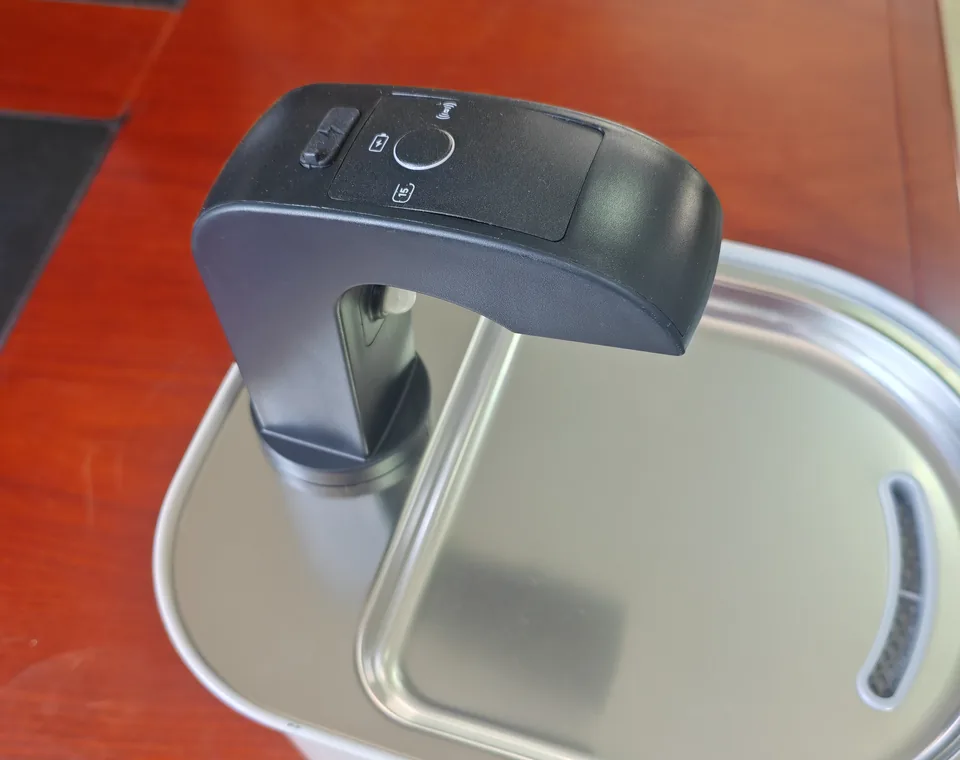
For sound, a short phone recording can help locate a rattle or intermittent noise, but it is not automatically a calibrated noise measurement. For runtime or durability, a brief home trial does not prove a lifetime claim. State what you actually observed.
Test the Product Platform You Actually Received
The sample checklist must follow the selected configuration, because similar-looking fountains can require different checks and included parts. Cordless describes battery-powered operation, while Wireless Pump describes the pump and reservoir architecture; one label should not be used as a substitute for the other. Three current Fountelio examples show why version control matters.
A cable does not prove an adapter should be in the box
The current cordless plastic fountain platform lists a 1.5 m USB-C to USB-A cable and states that a wall adapter is not included. If the agreed packing list follows that configuration, finding a cable without an adapter is not a missing-part failure. Compare the sample with the confirmed contents, not with an assumption formed from another appliance.
Wireless pump does not mean every version has radar and battery functions
The wireless-pump platform includes a rechargeable radar version and a lower-cost USB continuous-flow version. The USB version runs continuously while connected to power and does not include radar sensing. A feedback sheet for that unit should say “Not applicable — USB continuous-flow version” for radar and battery checks.
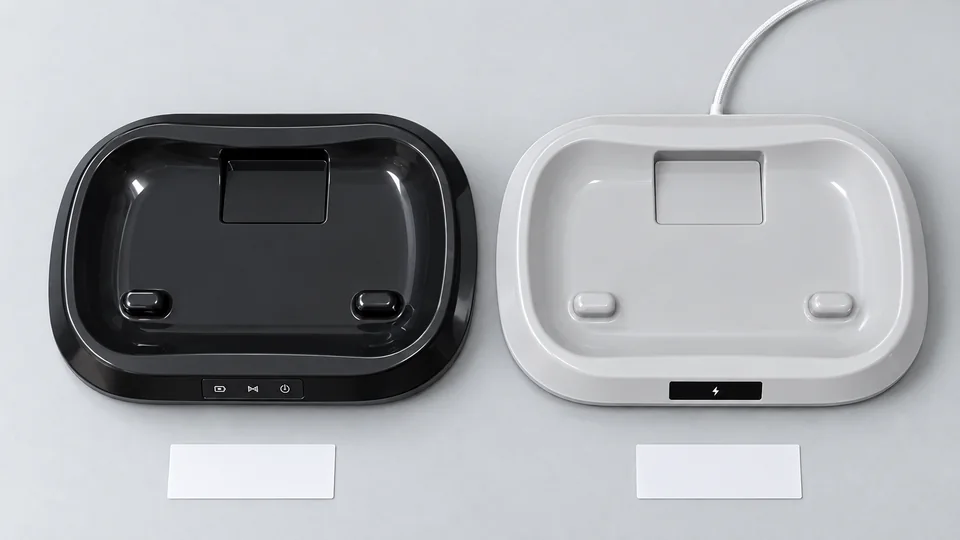 Rechargeable radarBattery · sensor-triggeredUSB continuous flowCable · no radar
An outlet change can require more than a visual recheck
Some standard stainless steel fountain configurations pair a selected outlet with a matching drinking tray. If the outlet changes after the first review, recheck the related tray fit, assembly and visible water pattern. “Approve the body, change the spout later” is not enough when the change affects connected parts.
How Do You Turn Sample Comments Into Actionable Feedback?
Write each comment as a traceable difference between the agreed requirement and the observed result. Name the sample, the exact area, the conditions, the evidence and the requested next action. Keep one issue per row so it can be answered and rechecked without decoding a long message thread.
| Vague comment | More useful record | Why it works |
|---|---|---|
| The flow is weak | Sample S-02, continuous mode, mid-level fill, approved outlet A: stream becomes intermittent after two minutes; see Video 02 | The supplier can repeat the setup and inspect the relevant path |
| The logo is wrong | Logo artwork V3 is 8 mm right of the approved marked position on the front housing; see Photo 04 | The file, position and measured difference are identifiable |
| The box is damaged | Front-right corner crushed on arrival; inner protection stayed in position and product shows no visible damage; Photos 01–03 | Transit condition is separated from product condition |
| A part is missing | Approved pack list V2 includes one filter and one USB-C cable; filter present, cable absent | Completeness is checked against an agreed reference |
| The product is noisy | On a hollow wood cabinet, vibration is audible; on a solid floor after reassembly it is not; Video 05 | The record distinguishes surface vibration from a persistent pump finding |
Annotate images when location matters, but keep the original file as well. Use filenames that include the sample ID and issue row. If a comment changes the requirement rather than corrects a deviation, label it as a new buyer revision so both sides can review its cost, timing and related checks.
Use a Sample Feedback Sheet That Can Be Rechecked
A practical feedback sheet connects the requirement, test conditions, observed result, evidence, requested action and later verification in one row. It should also allow “not applicable,” “not tested” and “outside this sample scope.” Those states are more accurate than forcing every cell into Pass or Fail.
Download the blank cat water fountain sample feedback sheet (CSV) ↓
The file is deliberately blank. Add project-specific checks only after confirming the model and sample purpose. Do not send a score without the observations behind it, and do not mark a correction closed until the agreed proof or replacement sample has been reviewed.
What Does Sample Approval Actually Approve?
Sample approval should name the approved reference and its boundaries, rather than imply that every unfinished part of the retail product is ready for production. A functional sample can be accepted for flow, assembly and cleaning access while the printed logo, manual and final box remain open.
| Area | Possible decision | What the decision allows |
|---|---|---|
| Product configuration | Approved: model, outlet, tray, filter and power version | Use this named configuration as the product reference |
| Function | Approved under recorded modes and conditions | Carry the selected functions into the production specification |
| Branding | Pending physical print proof | Do not release bulk logo application yet |
| Manual | Content corrections open | Update and reapprove the document before printing |
| Retail box | Structure reviewed; artwork pending | Keep artwork release as a separate gate |
| Transport performance | Not established by sample delivery | Follow the agreed packaging validation plan where required |
The reviewed item meets the agreed requirement.
A defined part can move forward while named items remain pending.
The supplier can correct the finding against the same review reference.
The change is material enough to require another physical unit or proof.
Write the decision in a form that a production, artwork or purchasing colleague can understand later: “Approve Sample S-02 product configuration for bulk quotation; logo print, English manual V3 and printed retail box remain pending.” That is clearer than “Sample looks good, proceed.”
When Does a Sample Change Need Another Check?
Recheck every item directly affected by the modification, plus the connected functions or parts the change may disturb. A correction does not always require an entirely new sample, but a new photo is not always enough either.
| Change | Minimum related recheck | Possible evidence |
|---|---|---|
| Logo position or size | Surface result, measured placement and current artwork revision | Marked photo or physical print proof |
| Outlet or tray | Fit, stability, assembly and water pattern | Updated physical sample or operating video when adequate for the agreed decision |
| Filter or holder | Fit, lid closure, water path and flow behavior | Physical component review and operating check |
| Pump, power module or operating version | Pump operation, flow, sound, charging/power, modes, indicators and applicable sensor behavior | Updated unit plus version-specific results |
| Manual | Correct model, language, diagrams, accessories and operating instructions | Dated PDF proof and later printed proof if required |
| Inner protection or box size | Pack-out fit, movement, surface protection and agreed transport review | Pack-out proof; transport testing where the channel or risk requires it |
Agree the proof method before the supplier makes the change. A digital artwork proof may be enough for a spelling correction; it cannot show how ink looks on a curved or brushed surface. A short operating video may confirm a revised flow pattern; it cannot establish a long runtime claim.
Does an Intact Sample Box Prove the Packaging Is Ready?
No. One sample arriving intact is useful receiving evidence, but it is not a controlled transport-packaging test or proof that every distribution channel is covered. Courier handling, final retail pack, master-carton quantity and the shipped production configuration may differ from the sample parcel.
Inspect the sample parcel anyway. Photograph the outer condition, inner protection, movement, surface contact and accessory positions. Those observations can reveal obvious problems and improve the next pack-out. Keep the conclusion narrow: “this sample arrived without visible damage” is supportable; “the package has passed e-commerce distribution” is not.
The International Safe Transit Association test-procedure directory separates procedures by packaged-product and distribution context. If the buyer, marketplace, retailer or project risk calls for formal testing, choose and document the applicable program rather than improvising one drop and calling it validated. Our retail and e-commerce packaging guide explains the packaging decisions that should be stable before release.
How Fountelio Uses Buyer Sample Feedback
At Fountelio, we get the most useful sample feedback when it identifies the unit, the observed condition and the requested decision in one place. That lets the product, artwork or packing question go to the person who can answer it, rather than leaving “please improve” open to interpretation.
For a revision, we prefer the buyer to preserve the original observation and add the corrective evidence beside it. The older result should not disappear when a new photo arrives. If the change affects a connected item—such as an outlet and tray—we expect the recheck to cover that relationship.
We also separate a product approval from an approval to print packaging or begin bulk production. The project record should say which reference moves forward, which files are current and which items remain open. That discipline is simple, but it is what makes the sample useful after it leaves the meeting table.
Cat Water Fountain Sample Order FAQs
What should buyers check when a cat water fountain sample arrives?
Confirm the exact sample and scope, then inspect condition, assembly, platform-specific functions, cleaning access, branding, pack contents and packaging where included. Record the conditions and evidence for every finding.
Does a working sample mean it is ready for bulk production?
Not automatically. State which product functions and configuration passed, then close or separately approve branding, manual, packaging and any other open production details.
Should every sample use the same checklist?
No. Keep common identity, appearance and pack-out fields, but add only the charging, sensor, battery, wireless-pump or continuous-flow checks that apply to the selected version.
How should a buyer report sample noise?
Record the mode, water level, surface, assembly, distance and whether the sound appears to come from water, pump or housing vibration. Attach a labeled video and repeat the observation after correct reassembly.
When is a new physical sample needed?
Use another physical sample when the change cannot be verified reliably through an artwork proof, photograph, measurement or video, or when it materially changes the product reference. Agree the evidence needed for each correction.
Can a sample shipment be used as a packaging drop test?
No. Its arrival condition is useful evidence but does not reproduce a defined transport procedure. Use the channel and project requirements to decide whether formal packaging testing is needed.
Sources & Product References
This guide uses Fountelio's current published product configurations for the three model-specific examples. ISTA is cited only to explain the difference between a delivered sample parcel and a defined transport-testing program.
- Fountelio Cordless Plastic Cat Water Fountains: current cable and adapter scope.
- Fountelio Wireless Pump Cat Water Fountains: rechargeable radar and USB continuous-flow versions.
- Fountelio Stainless Steel Cat Water Fountains: outlet and matching-tray configuration notes.
- ISTA test-procedure directory: official distribution-testing program overview and selection route.
About This Guide
Written by Lance, Director at Fountelio, from a sourcing and buyer-communication perspective. Fountelio manufactures and supplies cat water fountains and has a commercial interest in the topic. Product examples reflect current published configurations and should be reconfirmed for the selected sample and order.
The hero and base comparison are editorial composites built from current Fountelio product references; the operating close-up shows a real product configuration. They illustrate review questions, not certificates, laboratory results or evidence for a reader's order. The feedback template is an editable project aid rather than a universal inspection standard or contractual approval form.