

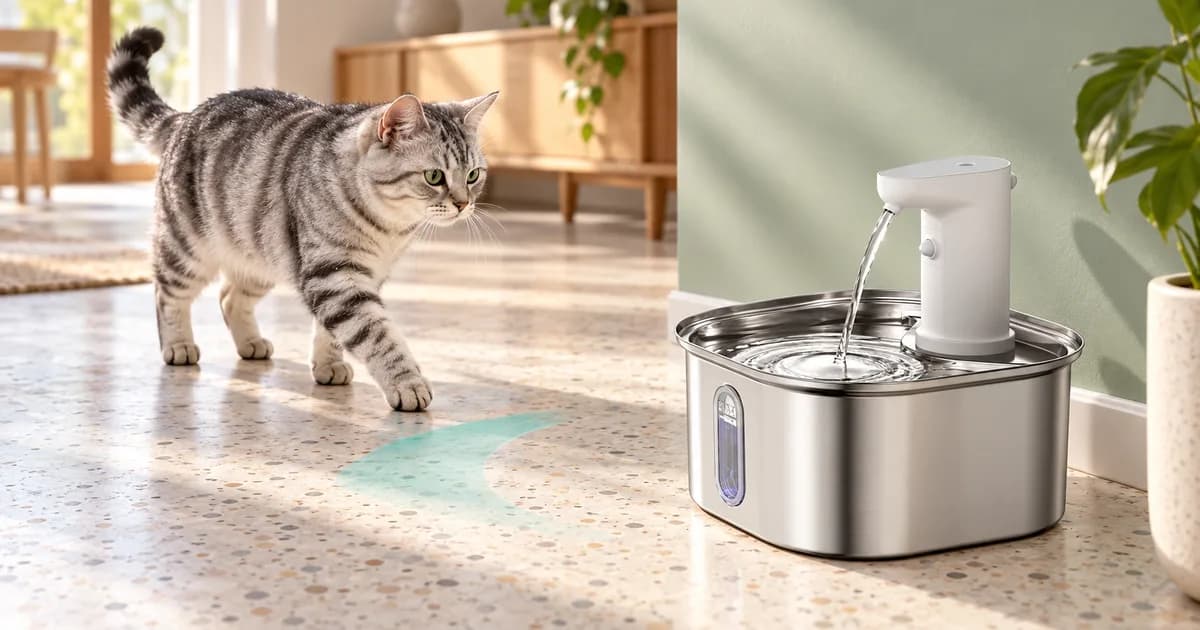
A motion sensor cat water fountain starts water flow when its sensing system detects activity that meets the model's trigger conditions. That may be a cat approaching the tray, but it is not proof that the cat is drinking. Infrared and radar systems, their detection areas and their timing can differ.
Motion sensor describes flow control. Cordless describes battery operation. Wireless pump describes the pump's internal power arrangement. A fountain can combine these features, but none automatically includes the others, an app or drinking records.
I would ask to see what happens after the first successful trigger: when the water stops, whether another approach restarts it, and what happens when someone walks past. Those observations make a sensor specification useful, whether you are choosing one fountain or reviewing a sample for a retail range.
What Is a Motion Sensor Cat Water Fountain?
A motion sensor fountain uses detected activity to control water flow instead of relying only on a continuously running pump. In a recirculating model, the controller starts the pump when the required conditions are met. The flow may then stop after a defined cycle or continue according to the control logic.
This guide focuses on reservoir-and-pump fountains. Some motion-activated products connect to a household water supply and operate a valve, so their plumbing and operation need a separate review.
The phrase pet-activated makes the action sound simple. The sensor does not know whether the cat is thirsty. Nor does a pump activation, by itself, measure how much water a cat drank. Check any app or drinking-tracking claim separately.
How Does a Motion Sensor Cat Water Fountain Work?
In a sensor-controlled recirculating fountain, detection is one step in a sequence: the controller must accept the signal before it starts the pump. Power, selected mode and any waiting period can affect what happens next.
A recirculating sensor fountain
- Approach
Activity enters the sensing area
- Detection
The signal meets the trigger conditions
- Control
The selected mode permits a pump start
- Water flow
Water reaches the outlet
- Next cycle
Stop, continue or wait as specified
Three timings are worth separating. Response delay is the time between a qualifying approach and the start of flow. Run duration is how long that flow lasts. Retrigger behavior describes whether more activity extends the current cycle, starts another cycle or has to wait. There is no universal number of seconds for any of them.
A fountain can also include a timed cycle while sensor mode is selected. For example, PETLIBRO's instructions for WF115 / PLWF115 describe sensing plus periodic operation on battery, and continuous flow when plugged in. That is a named model's behavior, not a setting to assume on Fountelio or other fountains.
Infrared vs Radar Cat Water Fountain Sensors: What Is the Difference?
Infrared and radar use different sensing technologies, but the useful comparison is how the finished fountain responds in its intended location. Neither label guarantees a particular range, angle or better result for every cat.
Infrared is a family of technologies. Panasonic explains that passive infrared (PIR) detects changes in infrared radiation as an object with a different temperature from its surroundings moves. Active optical systems can instead use emitted and reflected infrared light, as shown in Texas Instruments' comparison of sensing techniques. Infineon's radar explanation describes transmitted radio signals and their reflections. These general principles do not identify Fountelio's infrared subtype or radar operating method, or establish a fountain's accuracy.
Fountelio's cordless product pages specify infrared sensing without identifying the exact infrared subtype. It would therefore be inaccurate to call those products PIR solely because that abbreviation appears in other fountain listings.
| Question | Infrared | Radar | What to check |
|---|---|---|---|
| What does the label tell you? | An infrared sensing system; subtype still matters | A radio-based sensing system | Technology and exact product configuration |
| How far and how wide? | Use the model's stated field | Use the model's stated field | Range, angle, reference direction and test conditions |
| Will a side approach work? | Depends on the implementation and approach | Depends on the implementation and approach | Observed front and side response in the intended layout |
| Can unrelated movement start it? | Possible if it meets the trigger conditions | Possible if it meets the trigger conditions | Normal passing activity, recorded separately from cat approaches |
| Does it imply battery power? | No | No | Power source and modes available on that power source |
How the current Fountelio platforms differ
| Selected platform | Sensing / power | Modes or field stated | Still verify on the selected version |
|---|---|---|---|
| Fountelio cordless plastic | Infrared; 4000mAh rechargeable | Sensor / Timer / Continuous | Exact timing, detection field and mode availability by power state |
| Fountelio cordless stainless steel | Infrared; 4000mAh rechargeable | Sensor / Timer / Continuous | Exact timing, detection field and mode availability by power state |
| Fountelio CWF-W1 rechargeable radar configuration | Radar; 5000mAh rechargeable base | Model-specific published specification: approx. 2 to 3m detection distance; 150° sensing angle | Actual room response and trigger/retrigger behavior; do not assume the infrared platform's three modes |
| Fountelio wireless-pump USB continuous-flow configuration | Connected USB power; no battery or radar | Continuous flow | Matching base/pump configuration; sensor checks are not applicable |
A nominal field is a specification to evaluate, not a promise of detection at every point in a geometric sector. Do not infer sensing through walls or furniture. A broader field may reach the cat earlier, but nearby household movement deserves the same attention.
Sensor Mode vs Timer Mode vs Continuous Flow
Sensor mode responds to qualifying activity, timer mode runs a defined cycle, and continuous mode keeps the pump running while the configuration supports it. A product may offer one, two or all three. The power source can change which are available.
Sensor
ActivityWhen the trigger conditions are met
Timer
CycleAt the controller's stated intervals
Continuous
OngoingWhile supported power and setup allow
| Mode | Flow behavior | Potential benefit | Verify before relying on it |
|---|---|---|---|
| Sensor, if fitted | Qualifying activity starts flow; timing follows the selected model's controller | Can reduce pump operation between visits | Field, run duration, retrigger logic and any additional timed cycle |
| Timer, if fitted | The selected model's controller starts and stops scheduled cycles | Flow does not depend on an approach | Interval, duration and whether the user can change them |
| Continuous, if fitted | Pump keeps running with the selected model's supported power setup | Visible flow without waiting for a trigger | Required power source, water level and interruption behavior |
Fountelio's two 4000mAh infrared platforms list all three modes. Their feature list alone does not answer every battery-versus-connected-power question. Read the selected manual and try each permitted setting. The CWF-W1 rechargeable radar configuration and its separate USB continuous version should not inherit this three-mode description.
During a demonstration, watch beyond the first start. After switching modes, establish which setting is active before judging the next cycle. A timer starting while the cat is absent can be expected behavior rather than a false sensor trigger.
Is Every Motion Sensor Cat Water Fountain Cordless?
No. Motion sensing controls activation; cordless operation supplies battery power; a wireless pump describes the internal pump arrangement. App connectivity is another separate feature. Use the terms below to unpack a listing that calls the same product smart, automatic and wireless.
| Term | What it describes | What it does not establish |
|---|---|---|
| Motion sensor | Activity-based flow control | Battery power, app control or drinking measurement |
| Cordless | Operation from a battery without staying plugged in | Sensor technology or internal pump design |
| Wireless pump | No conventional pump cable running through the reservoir | Battery operation, radar or Wi-Fi |
| Timer mode | A controller-defined operating cycle | Adjustable scheduling or an app |
| Continuous mode | Ongoing flow during supported operation | Availability on battery |
| Smart fountain | A broad marketing description | Any particular sensor, app or tracking function |
| App-controlled | Functions accessed through an app | Motion activation or measured water intake |
Is a motion sensor fountain the same as a wireless-pump fountain? No. Motion sensing is control logic; a wireless pump describes how power reaches the pump without a conventional cable through the reservoir. Fountelio's rechargeable CWF-W1 combines both, while its USB continuous version retains the pump architecture without radar. The wireless pump versus cordless guide explains the hardware distinction in more detail.
Why Doesn't the Sensor Trigger Every Time?
A missed start can come from the mode, power, approach path or timing logic; it does not immediately prove a faulty sensor. First separate failure to activate from activation without water reaching the outlet.
- Read the selected mode. A timer or continuous setting will not behave like a sensor-only cycle.
- Check power and assembly. Follow the manual for charge status, switched-on state and the matching base. Keep water within its permitted operating level.
- Find the sensing area in the instructions. Remove an obstruction from the intended area; do not guess its location from a dark window or the housing color.
- Repeat an approach inside the stated field. Keep the fountain orientation and route consistent. A position beside the tank can still be behind a directional sensor.
- Allow the specified reset or waiting period. Check what happens after flow stops before assuming every immediate second movement should restart it.
- Record the result and compare it with the manual. If the same supported setup remains inconsistent, send the seller the model, mode, power state and a video showing both the approach and the outlet.
If the motor starts but the outlet stays dry or weak, investigate water level, seating and the water path using the pump and weak-flow troubleshooting guide. An indicator alone may not tell you whether detection occurred; use its documented meaning. Do not open the electronic control module or run the pump dry to diagnose sensing.
Where Should You Put a Motion Sensor Cat Water Fountain?
Face the documented sensing area toward the cat's normal approach while preserving an easy route to and away from the tray. Test the orientation in the room, including unrelated foot traffic. The tank's footprint does not show its sensing field.
→
Try the usual front and side approaches separately. Do not force the cat into a cramped position simply to satisfy a sensor. For quiet locations, food and litter separation, stable surfaces and cable routing, use the cat water fountain placement guide.
Does Sensor Mode Save Battery or Electricity?
Sensor mode can reduce active pump runtime, but it does not guarantee a particular battery life or electricity saving. The sensing and control electronics may still draw power between activations.
Frequent visits, long cycles or repeated passing activity can keep the pump active more often. Battery capacity, pump draw, charging losses, selected mode and battery condition also affect the result. A 5000mAh label alone cannot tell you how many days a fountain will run or make a fair runtime comparison with a 4000mAh product.
Fountelio quotes up to about three weeks for cordless plastic, around 21 days for cordless stainless steel, and up to approximately 30 days for the rechargeable CWF-W1 in suitable radar-mode conditions. These are conditional platform claims, not a controlled comparison or continuous-flow runtime. Request the conditions that match the selected version before using a days-per-charge claim on packaging.
The fountain electricity and running-cost guide covers whole-device energy and local electricity rates. A lower duty cycle still leaves the same need to refill, clean and maintain the pump.
Is Sensor Mode Better Than Continuous Flow?
Choose sensor mode when approach-triggered flow suits the household; choose supported continuous flow when a steady stream is more useful. Neither is better for every cat, and neither provides a medical benefit merely because of its operating pattern.
A sensor model may suit a battery-powered station away from an outlet. It also creates starts and stops that you should observe around the cat. Continuous flow removes the need for a successful trigger, but brings ongoing pump operation and its associated power and sound. Check the actual unit rather than assuming either pattern is quieter.
Keep another clean water source available while assessing use. If a cat hesitates when the stream starts, try a supported steady-flow setting or a different suitable setup without forcing contact. The guide to leaving a fountain on all the time covers ongoing operation and backup-water planning.
What Should You Check Before Buying a Sensor Fountain?
Before buying, find out how the exact model starts and stops water and which modes work unplugged. Before choosing, check whether the seller can answer these practical questions for the exact version.
- Where is the sensing field, and will the cat's likely approach enter it?
- How long does water run, and what permits another activation?
- Which modes work on battery, and which need connected power?
- Can you reach the pump and filter for cleaning, and obtain the correct replacements?
- Do the included accessories match the power setup you need?
For example, Fountelio's cordless plastic platform includes a charging cable but excludes the wall adapter. A USB-C connection also does not describe the whole power specification; follow the supplied instructions. Compare capacity, materials and service access using the broader cat water fountain selection guide.
What Should Buyers Test on a Motion Sensor Fountain Sample?
Test the sensing sequence under recorded conditions, then check the modes and power states included in that sample. One successful hand wave proves very little about a cat's route, repeated activation or behavior after charging.
Start the record with sample ID, exact model and version, matching pump/base, manual revision and the agreed requirement. Note water level, selected mode, power state, surface, orientation and nearby movement. Keep these conditions steady while changing one part of the approach. I would keep the route and outlet visible in the same recording so the supplier can relate the start of movement to the start of water.
| Check | Condition or action | Record |
|---|---|---|
| Identity and configuration | Match labels, base/pump and manual to the sample brief | Sample ID, version, sensor type and any mismatch; color alone is not identification |
| First activation | Use the specified sensor mode and power state; approach within the claimed field | Route, observed distance, response and water delivery, with video reference |
| Approach direction | Repeat front and relevant side routes; document any rear route being assessed | Direction and conditions for successful or missed activation; do not treat an outside-field route as a required pass |
| Repeated activity | Observe a full cycle, departure and re-entry as the instructions permit | Run duration, restart/extension behavior and elapsed waiting time |
| Unrelated movement | Keep placement fixed while a person passes along a documented route | Whether flow starts; separate this from intended cat-trigger observations |
| Timer, if fitted | Select the timer setting and observe its stated cycle | Interval and duration actually observed; pending if the cycle was not completed |
| Continuous, if fitted | Use the power source required for continuous flow | Stable flow and any interruption, with observation duration |
| Battery and charging, if fitted | Follow approved charging instructions; compare permitted power states | Indicators, mode availability and restart setting; a short check is not battery-life validation |
| Water, noise and reminders | Stay within permitted water levels; listen during start and operation | Water sound, pump hum or vibration; documented reminder behavior without a dry-run test |
| Reassembly | Disconnect power, clean/reassemble only as instructed, then repeat a supported start | Any change in flow or response; correct seating of matching components |
| Claims and instructions | Compare observations with the manual and proposed retail wording | Claims requiring correction, responsible person and retest evidence |
Mark a genuinely absent function NOT APPLICABLE: radar on the USB continuous-flow version is an example. Mark an included function that has not been evaluated NOT TESTED. A missing instruction or an unfinished charging check is not a reason to call the function inapplicable.
Agree acceptance criteria for the selected model before testing. This table does not impose a universal number of attempts, sensor success percentage or test duration. A repeatable in-room observation is useful evidence, but it is not a calibrated sensor-field certification.
Use the sample-order checklist and feedback template to attach these observations to changes and approval scope. If a control module, base, housing around the sensor or firmware changes, identify which earlier results need repeating. Supplier confirmation that a change was made is not the buyer's completed retest.
What Sensor Specifications Should a Supplier Provide?
Ask the supplier to identify the exact version and explain its trigger sequence, power requirements and the conditions behind its sensor claims. Public feature summaries may leave some of that detail for the manual or sample discussion.
| Specification group | What should be clear | Why the buyer needs it |
|---|---|---|
| Identity | Model/version, sensor type, matching base and pump | Prevents features moving between similar-looking configurations |
| Detection field | Published range/angle, orientation and applicable conditions where specified | Connects placement and approach to the claim |
| Control sequence | Run duration, retrigger/waiting behavior, available modes and any periodic cycle | Explains both expected starts and expected pauses |
| Power and charging | Permitted modes by power state, battery capacity where fitted and charging specification | Avoids assuming every mode works unplugged |
| Runtime and reminders | Conditions behind a battery claim; meaning of each low-water indicator | Separates a stated runtime from a guarantee, and a reminder from shut-off protection |
| Documentation | Manual revision, retail claims, unresolved items and agreed verification method | Keeps the approved sample and customer instructions consistent |
When a specification is not exposed, record the open question rather than inventing a value or demanding an adjustable setting the product does not have. "Smart sensor" needs a technology description; "30-day battery" needs operating conditions; "wireless" needs a statement about which part is wireless.
Fountelio's platform-specific quality checks include sensor response, charging and modes where applicable. The inspection scope follows the selected configuration. For a private-label program, approve the final manual wording alongside the behavior demonstrated by the sample.
Motion Sensor Cat Water Fountain FAQs
Do motion sensor cat fountains only run when a cat is nearby?
Not necessarily. A cycle may continue after the cat leaves, and some products add timed operation between approaches. Check the exact mode instructions. Water starting without a visible cat can be a scheduled cycle or a response to other activity rather than a fault.
Is every cordless fountain motion-activated?
No. Cordless identifies battery operation, not the control method. Check the available modes separately and ask which work on battery. Likewise, motion activation does not guarantee cordless use. A fountain's power source, sensor and pump arrangement each need their own description.
Is radar better than infrared for a cat water fountain?
There is no universal winner. Compare the finished model's stated field, actual approach response, timing and unintended activation in the intended setting. A longer published range alone is not a quality ranking, and an infrared label does not identify every detail of its sensing system.
Can a person walking past trigger the fountain?
Possibly, if that person's movement meets the product's detection conditions. Test ordinary foot traffic separately from the cat's approach and record the route. Do not assume a motion sensor identifies cats specifically or can distinguish someone passing from an animal intending to drink.
Why does my cat fountain sensor work from the front but not the side?
The side route may enter a different part of the field or remain outside it. Orientation, the selected mode and restart timing can also matter. Use the model's instructions and repeat the approach under the same conditions before deciding the sensor is defective.
Does sensor mode guarantee longer battery life?
No. It can reduce active pump time, but total use also includes sensing and control electronics. Activation frequency, cycle duration, pump draw, battery condition and other features affect runtime. Compare claims only when the model, operating mode and test conditions are identified.
Choose the Behavior You Can Verify
Start with the cat's approach, then follow one complete operating cycle. Establish what triggers water, what stops it and what allows it to start again. That is more useful than choosing the longest range or the largest battery number.
For a retail or private-label order, carry those observations into the sample record and instructions. Approve the demonstrated configuration and close the unanswered timing or power questions before treating the sensor feature as ready for customers.
About This Guide
Written by Tony Kong, R&D Engineer at Fountelio. This guide combines current Fountelio platform specifications, supplied product footage, engineering references and named-model support documentation. The sample method is practical buyer guidance, not a published laboratory protocol. The hero is a product-referenced illustration; diagrams explain control and approach, not measured sensor coverage.
Sources & Product References
- Panasonic: PIR Motion Sensors PaPIRs Quick Digest. General passive infrared detection; not identification of the sensor fitted to a Fountelio model.
- Infineon: Understanding FMCW radars. Radio-signal and reflection principles; not evidence that CWF-W1 uses FMCW or shares the reference system's accuracy.
- Texas Instruments: Techniques for PIR-based motion detection. General PIR, optical and radar concepts; not specifications for Fountelio fountains.
- PETLIBRO WF115 / PLWF115: continuous and battery-powered modes. A model-specific example of power-dependent flow and periodic operation.
- Fountelio cordless plastic specifications. Infrared sensing, three modes, battery and charging accessories.
- Fountelio cordless stainless steel specifications. Infrared platform and mode availability.
- Fountelio wireless-pump platform specifications. Separate rechargeable radar and USB continuous configurations.