
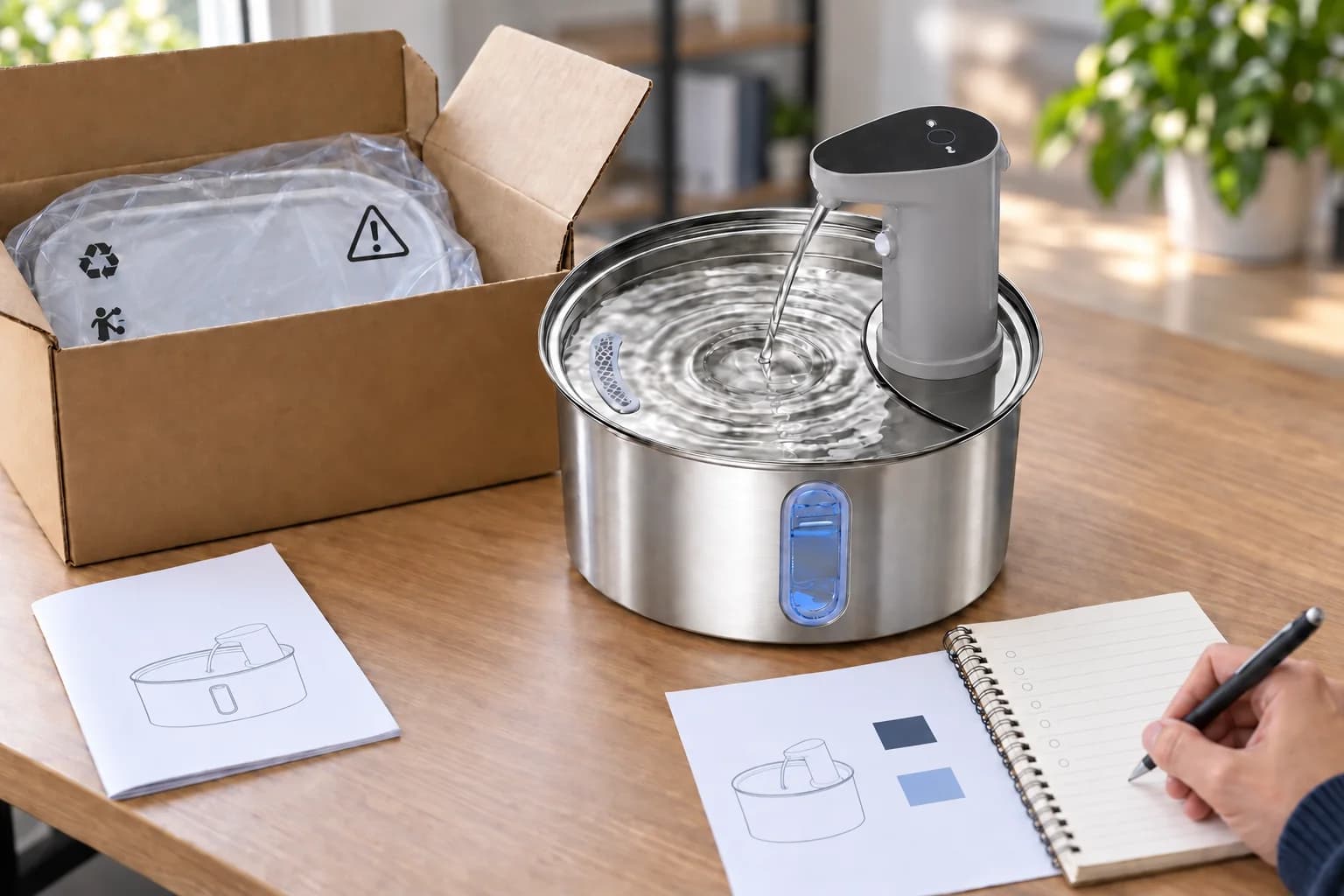
A buyer may begin a private-label project with a simple request: “Can you put our logo on this fountain and send a sample?” The logo is only one part of the product that eventually reaches the shelf. The selected model, pump, filter, outlet, power version, finish, packaging, manual and accessory pack can all change what the final order actually is.
Before requesting a private-label sample, define what that sample is supposed to prove. At minimum, identify the exact product configuration, branding requirement, packaging direction, target market, included accessories and the criteria you will use to approve or revise it. A sample that is not tied to a clear brief is easy to approve and difficult to reproduce.
Not every detail has to be finished before the first sample. Final retail artwork, final color proof, market documentation or carton marks may come later, depending on the sample’s purpose. The practical task is to separate what must be fixed before sampling from what can remain open without changing the product being evaluated.
What Should You Decide Before Requesting a Sample?
- Decide what the sample must prove. Product selection, logo appearance, packaging proof and production approval are different jobs.
- Identify the exact product first. Branding a screenshot or a loose category description does not define a model.
- Separate the minimum quantities. Product, logo, color and printed-packaging thresholds may differ.
- Plan packaging before approval. The direction should be clear even when final artwork comes later.
- Keep one approval record. Connect the sample, revisions, artwork and pack-out to the same version.
What Do You Mean by a “Private-Label Sample”?
A “sample” can refer to several different decision stages. A standard unit may help a buyer judge the product itself. A logo proof answers a narrower branding question. A packaging proof shows the box and pack-out. A pre-production sample is intended to represent the configuration moving toward production. These stages can be combined, but they should not be confused.
In the projects we handle, the useful starting question is what decision the buyer expects to make after receiving the sample. If the answer is “choose between two fountain platforms,” finished retail artwork may add delay without resolving that decision. If the answer is “approve the complete retail program,” a neutral product in a plain box is incomplete.
| Sample stage | What it should prove | What it does not prove yet |
|---|---|---|
| Standard product sample | Basic product, configuration, flow, pump, fit and cleaning access | Your branding or final retail pack |
| Branded sample / logo proof | Logo size, position, color direction and appearance on the selected surface | Final packaging unless it is included in scope |
| Packaging proof | Box structure, artwork placement, manual direction and pack-out | Product function testing by itself |
| Pre-production / approval sample | The agreed configuration that should guide production approval | Unreviewed future component or artwork changes |
Do not ask whether a supplier can “make a sample” until both sides agree on what that sample should demonstrate.
Start With the Product Before You Start With the Brand
Logo placement depends on the object receiving the logo. Select the product platform, then identify the exact model and version before deciding how the brand should appear. Otherwise, artwork may be prepared for a surface, housing or configuration that is later replaced.
Choose the product platform
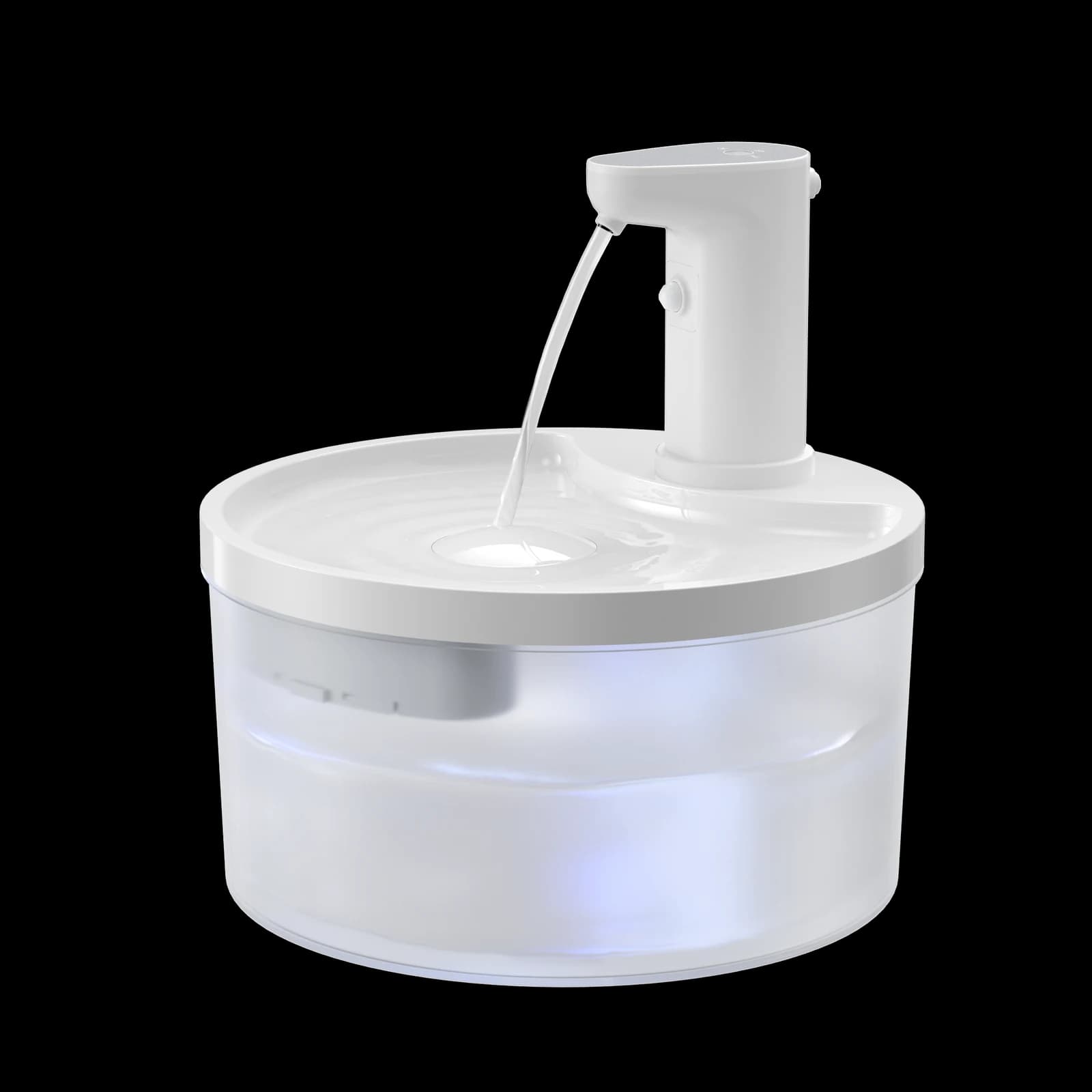
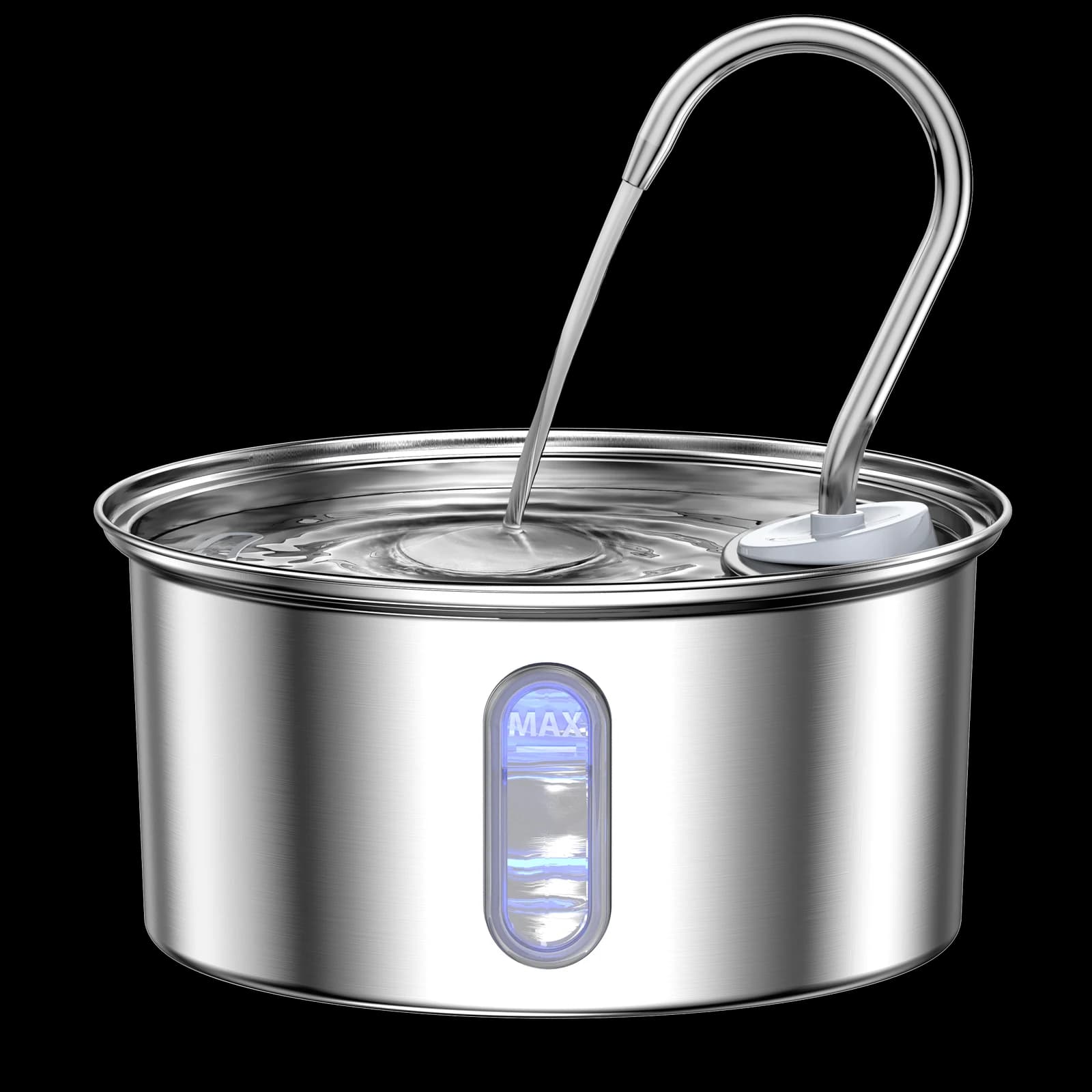
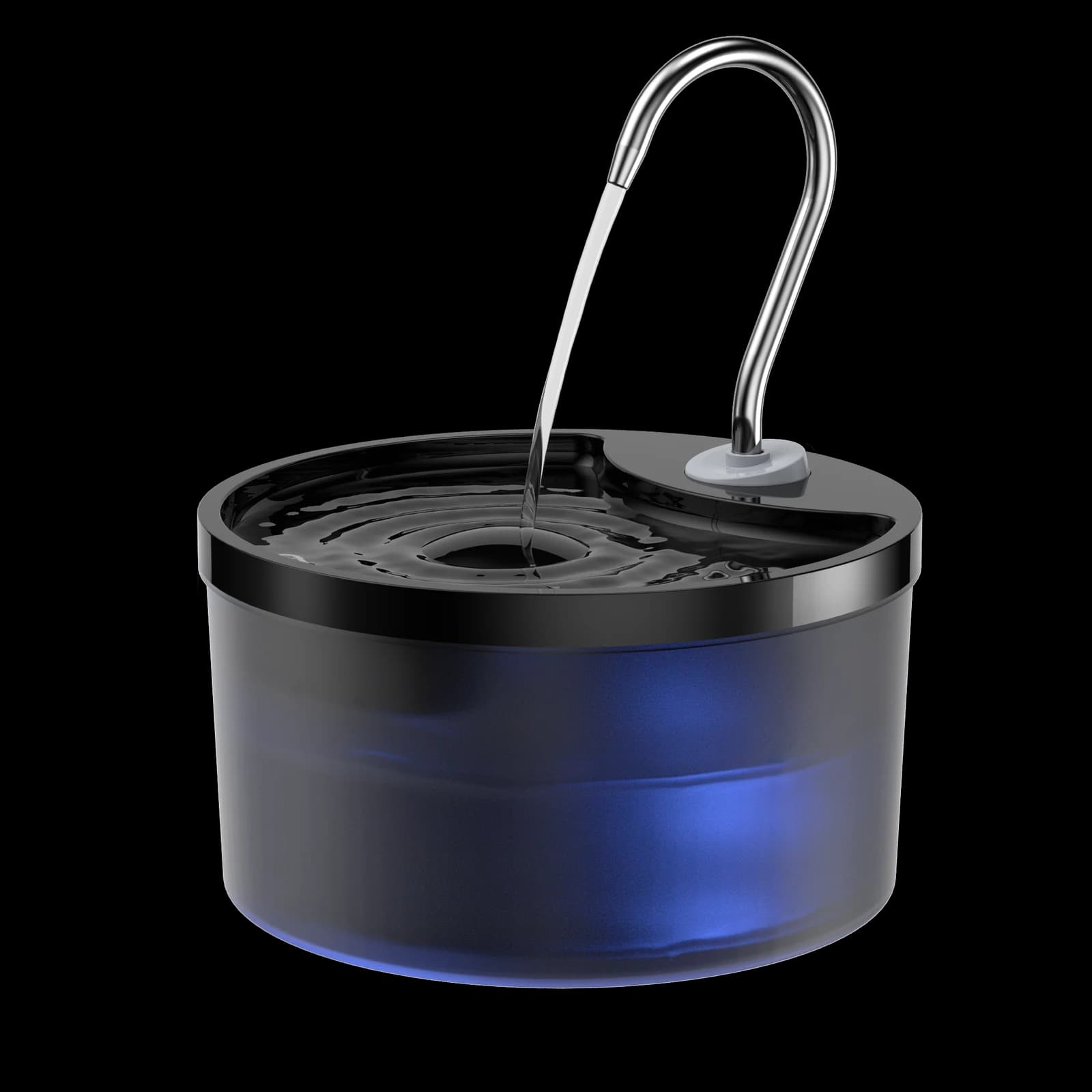
Fountelio’s current platform groups are plastic, stainless steel, cordless plastic, cordless stainless steel and wireless pump. Those labels are starting points rather than complete sample specifications. Use the cat water fountain platform overview to narrow the construction and operating direction before discussing private-label details.
For an existing-platform project, the practical order is to narrow the platform and configuration first. Branding, packaging and the level of sample required can then be discussed around that identifiable product.
Identify the exact model and version
Record the model code and the configuration details that distinguish the sample: shape, stated capacity, materials by relevant part, pump or water-moving architecture, filter, outlet, power version, sensor or operating modes where present, and finish. Not every field applies to every model, but the fields that do apply should point to one reproducible version.
A photograph helps communication, but it does not identify an internal pump, filter revision or power configuration. Reference a model, not a screenshot. If the supplier itself is still being evaluated, use the broader manufacturer-selection checklist before relying on the sample process.
What Should a Private-Label Sample Brief Include?
The brief should connect the physical product to the commercial program you are trying to approve. It does not need to be a long technical contract. It needs enough specific information that the supplier can prepare the intended sample and the buyer can recognize whether the result answers the original request.
When we receive an early brief, unanswered questions are normal. The problem is leaving a decision unmarked. Write “open—confirm after functional sample” rather than allowing the supplier and buyer to make different assumptions.
1. Product model and configuration
Identify the platform, model, shape, capacity basis, version, pump and filter where relevant, outlet, operating mode, color and finish. If the brief contains alternatives, state which choices require separate samples or quotations.
2. Target quantity and project stage
Explain whether the request is an evaluation sample, market trial, first commercial order or preparation for a longer product range. Quantity context can affect the available branding method, packaging plan, sample purpose and quotation assumptions. It does not create a universal MOQ.
3. Target market and sales channel
Name the destination market and whether the product is intended for e-commerce, a marketplace, retail, distribution or direct sale. These details can affect packaging protection, manual languages, barcode direction, pack presentation and the party responsible for market requirements. Keep product-specific compliance questions separate from a generic certificate request.
4. Logo artwork, method and position
Provide the logo file, preferred color, intended surface, approximate size and whether branding applies to the product, packaging or both. Vector artwork such as AI, EPS or SVG is generally easier to scale and prepare for production; an editable PDF may also be useful. Raster artwork is not automatically unusable, but its resolution and background can limit preparation.
Branding methods and available positions depend on the selected model, surface and order scope. Ask the supplier to confirm the workable area before treating a mock-up as a production proof.
 Proposed logo area
File · color · surface · position
5. Color and finish
State whether the sample should use a standard available color or test a custom direction. Where relevant, provide a color reference such as a Pantone value and identify whether it applies to the housing, printed mark or packaging. Matte, gloss and stainless finishes are construction-specific; options vary by model and cannot always be combined.
6. Retail packaging direction
Discuss whether the program is using a neutral box, one-color kraft packaging or a full-color retail box, and whether it is intended primarily for e-commerce or shelf retail. Identify the manual, inner protection, barcode direction, accessories and outer-carton marking questions that belong to the pack.
We often see packaging discussed only after a product sample has been accepted. That can create another round of size, insert and pack-out decisions. Plan the direction early, while allowing final artwork to follow when the first sample’s purpose is product evaluation.
BRANDArtwork direction
MANUALLanguage
where applicable
7. Included accessories and consumables
List the intended pack contents: filter quantity, cable or adapter where applicable, outlet components, manual and any other verified accessory. If replacement filters are part of the commercial program, identify their compatible reference and whether their retail pack is inside or outside the first sample scope.
8. Documentation and market information
Give the supplier the destination and channel, then ask which available documents apply to the exact model and configuration. Do not request “all certificates” or assume that one document covers every version. The manufacturer guide’s documentation check explains the model-specific scope in more detail.
9. Sample approval criteria
Decide before the sample arrives what will be reviewed. Depending on its purpose, that may include model identity, appearance, finish, logo, flow or function, noise behavior, assembly fit, cleaning access, filter fit, included items, packaging fit and printed content. The first sample does not need every possible test; it needs criteria that match the decision it was commissioned to support.
Define the decision before reviewing the sample.
Private-Label Sample Brief
Use the brief to distinguish fixed inputs from planned later approvals. An “open” field should still have an owner, a decision stage and a clear statement that it does not alter the product currently being evaluated.
| Field | Specify before sampling | Can remain open initially |
|---|---|---|
| Product | Platform, model and major configuration | Minor cosmetic choices that do not change the sample’s purpose |
| Branding | Logo file, intended position and branding direction | Final production print proof |
| Color / finish | Standard or custom direction for the selected model | Final color approval where a later proof is planned |
| Packaging | Packaging type, channel and pack-out direction | Final graphics if dimensions and structure are still being confirmed |
| Manual | Required language and content direction | Final typesetting |
| Accessories | Intended included parts and consumables | Accessory-pack artwork |
| Market | Destination and sales channel | Final product-specific document review |
| Approval | What the sample must prove | Detailed bulk-inspection instructions |
Send the brief with the reference image or model page, artwork files and any marked-up placement drawing. Ask the supplier to return a short confirmation of the sample scope. That confirmation should expose disagreements before time is spent preparing the wrong proof.
Product MOQ, Logo MOQ and Packaging MOQ Are Not the Same
“What is the MOQ?” is incomplete because the minimum may apply to different parts of the program. A supplier may have one threshold for the selected product, another for logo application, another for a custom color, and a separate print run for retail packaging. New tooling or structural changes have their own commercial conditions.
In quotation discussions, we separate these figures so a buyer can see which commitment creates the quantity. This matters when the first product order is smaller than the printed-packaging run or when a stocked neutral unit is available below the branding threshold.
| Scope | Current published example | Planning implication |
|---|---|---|
| Standard product | Model and stock dependent | Confirm the exact model and available quantity |
| One-color product logo | 10 cartons per model | Common carton quantities usually produce about 160–240 units |
| Custom printed retail box | 1,000 packaging pieces | The fountain order may be smaller; unused boxes can be reserved for repeat orders |
| New mold / custom product | Project-specific | Requires separate engineering and commercial review |
These are current Fountelio examples, not universal industry MOQs. Confirm the selected model, carton quantity and packaging program before ordering. See the current OEM and private-label options for the source values.
Should You Finalize Packaging Before the First Sample?
Not always. Packaging direction should be discussed before the product sample is approved, but final packaging artwork often makes more sense after product dimensions, accessories, protection and sample corrections are stable. A functional sample should not be delayed by finished graphics that are not needed for the product decision.
Separate packaging direction from final packaging artwork. The early brief can identify box type, channel, likely pack-out, manual languages and protection requirements. The later proof can confirm the dieline, graphics, printed content and final contents after the product configuration stops moving.
For a complete retail-program sample, packaging may need to arrive in the same approval round as the product. For an early platform comparison, it may be enough to record the packaging direction and the later approval gate. Timing depends on what the sample is intended to prove.
How Should You Review the First Sample?
Review the sample against the written brief rather than against memory. Begin by confirming identity: model, version, finish and any label or reference number. Then review the product, branding, pack-out and packaging as four separate areas so a good logo does not distract from a wrong configuration—or a correct product from missing contents.
| Review area | What to check | Decision |
|---|---|---|
| Product | Correct model, configuration, finish and agreed flow or function | Approve or revise the product reference |
| Branding | Logo file/version, size, position, color and visible result | Approve or revise the branding proof |
| Pack-out | Filter, manual, cable or adapter where applicable, outlet parts and other agreed items | Approve or correct the contents list |
| Packaging | Protection, structure, fit and available artwork direction | Approve, revise or keep open with an owner |
Model · finish · function
Approve / ReviseLogo · size · position
Approve / ReviseFilter · manual · parts
Approve / ReviseProtection · fit · artwork
Approve / ReviseRecord conditions when they affect the observation. For example, operating mode, water level and assembly can change how a fountain sounds or flows. This article keeps the review at project level; the consumer-facing fountain selection guide covers broader product-use decisions.
Record Every Sample Revision
A private-label project can generate corrections in email, chat, artwork PDFs, marked photographs, quotations and sample notes. When those records do not point to one current version, an old logo file can be paired with a new sample, or an accessory correction can disappear between the product and packaging discussions.
In the projects we handle, one of the easiest ways to lose a detail is to spread corrections across messages and artwork files. The buyer and supplier should maintain one clear approval record that identifies the model, version, date, logo file, packaging artwork, accessory list and confirmed corrections.
A correction email is not the same as an approved product record. Consolidate accepted changes into the next sample or proof reference, then mark which configuration is approved for production. This is practical project control, not a claim that every supplier uses a regulated change-control system.
What Can Wait Until After the First Sample?
Some work is more accurate after the first sample has resolved product questions. Delaying it can avoid photographing, printing or purchasing against a version that will change. The decision remains project-specific: if the first sample must represent a shelf-ready program, fewer items can remain open.
| Can often wait | Why |
|---|---|
| Final retail artwork | Product dimensions, protection and pack-out may still change |
| Final product photography | The approved final configuration should be photographed |
| Large replacement-filter purchase | Compatibility and pack format should be confirmed first |
| Final master-carton marks | Shipment details may still be open |
| Full custom-packaging print run | Box dimensions and complete pack-out should be stable first |
Mark each delayed item in the brief with its later approval point. “Not included in this sample” is clearer than silence and prevents an early approval from being interpreted as approval of unfinished artwork or pack details.
Common Private-Label Sampling Mistakes
Most sampling problems begin with an undefined reference or a decision made in the wrong order. Watch for these seven patterns:
- Choosing the logo position before choosing the exact model.
- Assuming a standard sample automatically represents the future private-label production version.
- Treating product, logo and printed-packaging minimums as one number.
- Finishing retail artwork before product dimensions, protection and pack-out are stable.
- Failing to identify filters, included accessories or replacement consumables.
- Sending only low-resolution artwork when scalable artwork is available.
- Approving changes through scattered messages without one consolidated approval record.
The remedy is not a longer email chain. Use a short sample brief, identify open decisions and update one approval record when the sample or proof changes.
How Does Fountelio Prepare a Private-Label Sample?
At Fountelio, we prefer to separate the product decision from the artwork decision. Buyers first narrow the platform and configuration. Branding, packaging, quantity and the level of sample required can then be discussed around that product.
The current published workflow is: select the platform, confirm the configuration, submit branding, confirm MOQ and cost, review the sample or artwork, move to production, then complete packing and shipment. Before production, the current process asks buyers to confirm the selected model, logo position and print color, retail packaging artwork, included accessories, manual content and shipping or carton marks.
Those steps do not mean every project needs the same sample sequence. A stocked trial order, an existing-platform private-label project and a new tooling request create different open decisions. Review the current private-label project scope, manufacturing process and quality-control approach, then confirm the exact project in writing.
Private-Label Cat Water Fountain Sampling Questions
Do I need final packaging artwork before ordering a sample?
Not always. Packaging direction should be known early, but final artwork can follow after product dimensions, protection and pack-out are stable when the first sample is primarily functional.
Should I request a neutral sample or a branded sample first?
A neutral sample can be efficient while choosing the product. A branded proof becomes more useful after the exact model, surface and logo position have been selected.
What logo file should I send to the manufacturer?
Vector artwork such as AI, EPS or SVG is generally easier to scale and prepare for production. An editable PDF may also work. Confirm the file and color references the supplier needs for the selected process.
Is the private-label MOQ the same as the product MOQ?
Not necessarily. Product quantity, logo application, custom color, printed packaging and tooling may each have a different threshold or commercial condition.
Should the first sample include retail packaging?
Only when packaging is part of what the sample must prove. A product-selection sample may use neutral packing; a retail-program approval may need the box, manual, protection and complete pack-out.
How many sample rounds are normal?
There is no universal number. Use enough rounds to resolve the defined product, branding and packaging changes before production approval, and record what each round represents.
What Should You Send Before the Sample Is Prepared?
Send an identifiable product reference, the sample’s purpose, branding direction, target quantity, destination market, packaging direction, included items and approval criteria.
Mark what is fixed and what remains open. Confirm the sample stage both sides are discussing, separate product and packaging minimums, and keep one revision record. The goal is not to finish every retail detail on day one. It is to ensure the sample answers a defined question and can become a reliable reference for the next decision.
About This Guide
Written by Lance, Director at Fountelio. Lance works with buyers on product selection, OEM requirements, sample direction and commercial project communication. This guide reflects that manufacturer and sourcing perspective.
Fountelio manufactures and supplies private-label cat water fountains and has a commercial interest in this topic. This is a manufacturer and sourcing guide, not independent supplier research. Fountelio-specific platform, MOQ, packaging and workflow examples reflect the current published site and must be reconfirmed for the selected model and project.
The hero is an AI-assisted editorial scene based on verified Fountelio product and packaging references. Explanatory visuals use verified product assets and simplified HTML diagrams. They explain sample-planning relationships; they are not production, audit, certification or test evidence.
Sources & References
- GS1: Global Trade Item Number (GTIN): the official product-identification standard relevant to barcode and retail-packaging planning.
- European Union: general product compliance: official guidance on identifying applicable product rules and the responsibilities of manufacturers, importers and distributors.
- Fountelio OEM & Private Label: current customization levels, logo MOQ, packaging MOQ, timing, sample/artwork workflow and pre-production confirmation scope.
- Fountelio cat water fountain platforms: current product platform groups and model routes.
- Manufacturer evaluation guide: model/version control, sample references and documentation scope.
- Fountelio manufacturing process: current route from product reference through assembly, review and packing.
- Fountelio quality approach: current product, component, function and packing review scope.