

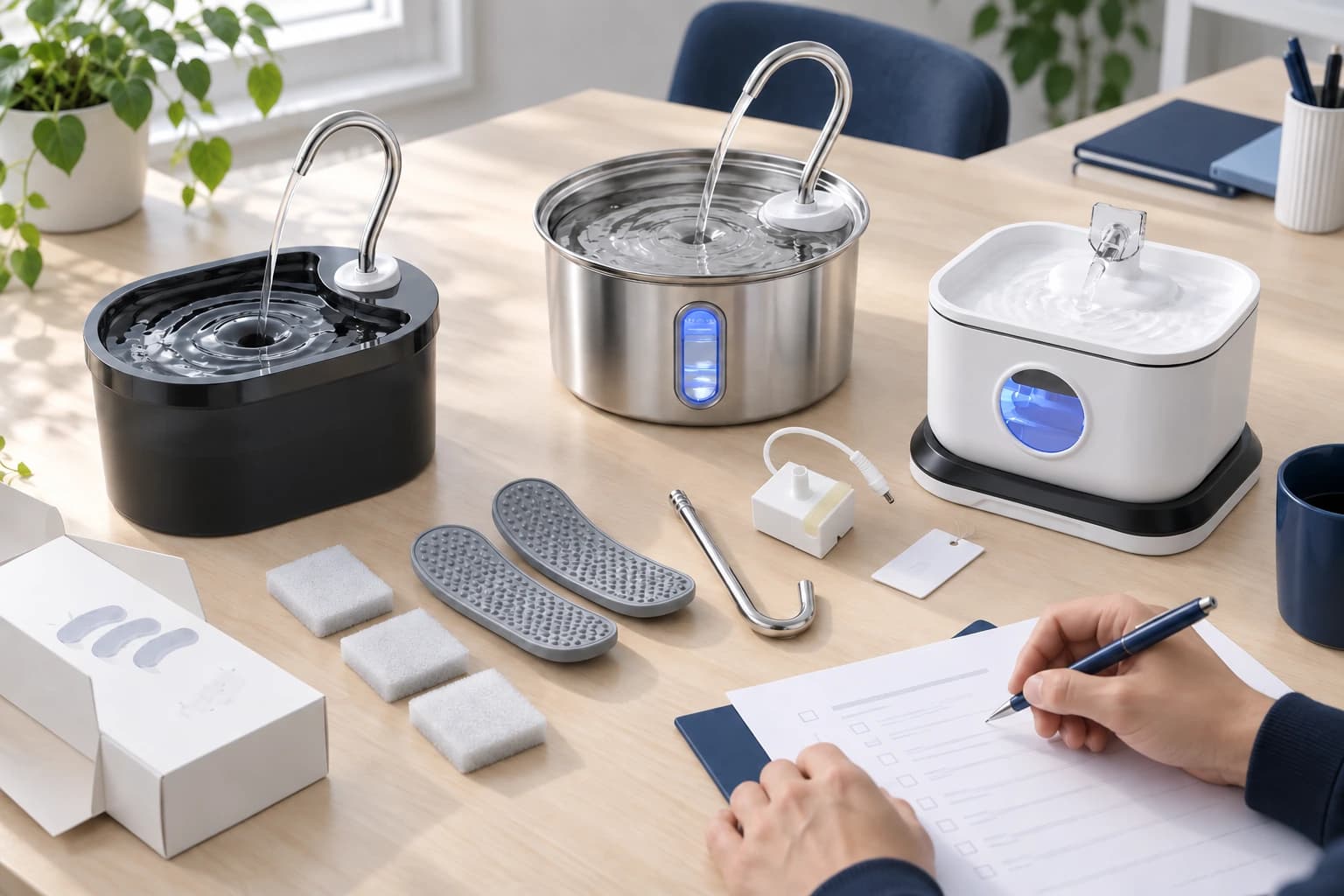
A factory photo, a long product catalog and a competitive quotation can get a supplier onto your shortlist. They do not tell you whether the fountain approved today can be reproduced six months later, or whether the same pump, filter, material and operating configuration will still define a repeat order.
Choose the manufacturer that can define, document and reproduce the exact product you approve, rather than relying on the lowest quote or the largest catalog. For a cat water fountain, that means identifying the reservoir, pump, filter, water-contact materials, power system, sensing architecture, packaging and replacement parts that belong to the specific model you are buying.
This guide does not assume that a factory is automatically better than a trading company or sourcing partner. What matters is whether the supplier can show who controls the product specification, production, quality decisions, component changes and after-sales supply, and whether those responsibilities stay clear after the first sample.
What Should You Remember Before Comparing Manufacturers?
- Fix the product brief first.Quotations are comparable only when they describe the same platform and configuration.
- Identify the exact version.Model code, pump, filter, materials, power, controls and accessories belong in one record.
- Approve a controlled reference.A sample needs dated specifications and open-point notes to guide production.
- Compare responsibility.Factory or trader status matters less than transparent control and accountability.
- Plan the repeat order.Component continuity and change communication matter after the first shipment.
Start With Your Product Brief Before Comparing Manufacturers
A manufacturer cannot quote the same product as another supplier if the product itself has not been defined. Begin with the job the fountain must do, the destination market and the decisions that would make one sample acceptable or unacceptable. A short, precise brief is more useful than a folder of reference photos.
Define the product platform
State the housing and reservoir form, nominal capacity, intended materials, pump architecture, whole-unit power source, flow or sensor behavior, filter arrangement and main outlet style. If more than one platform remains possible, ask for separate quotations instead of combining them into a single “cat water fountain” request.
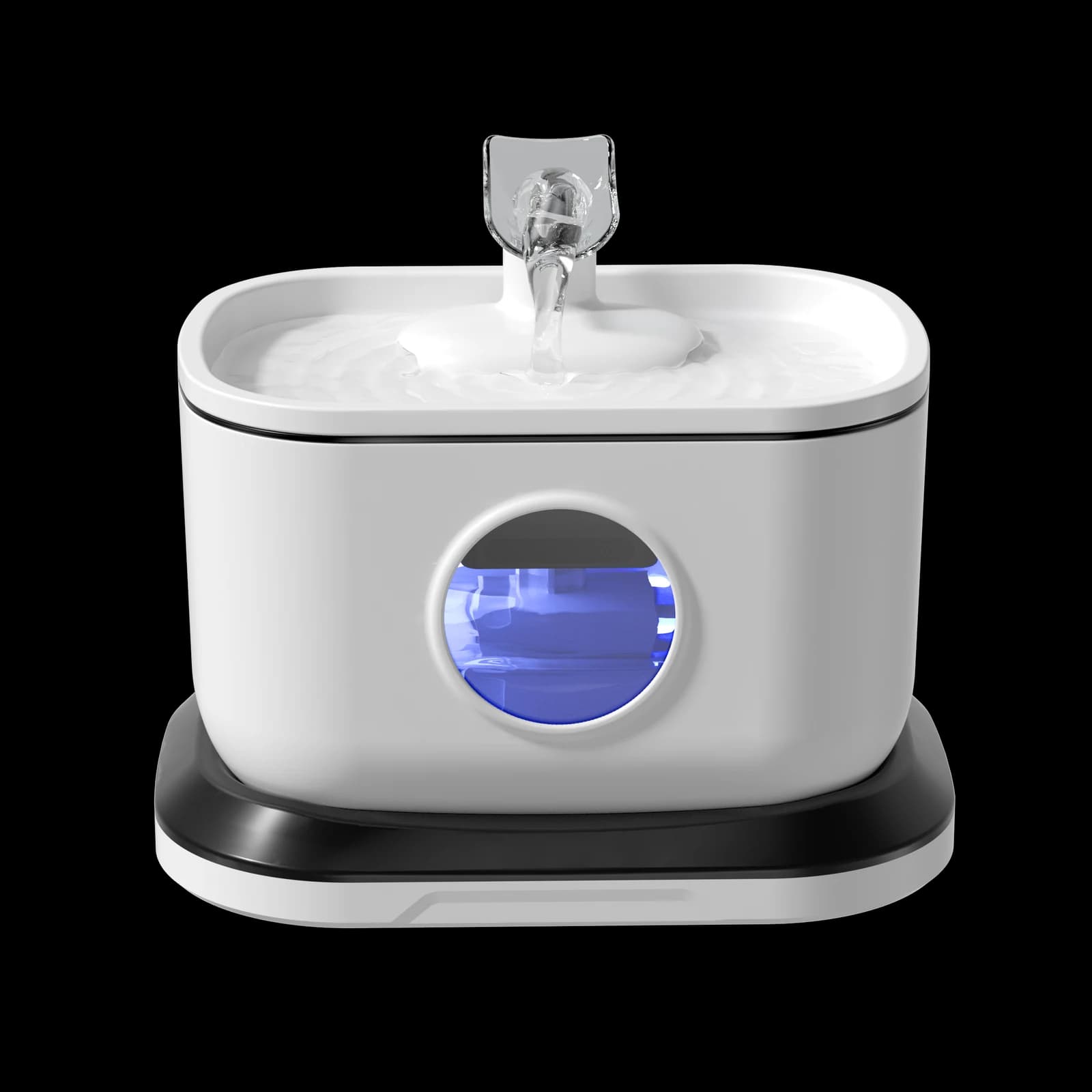
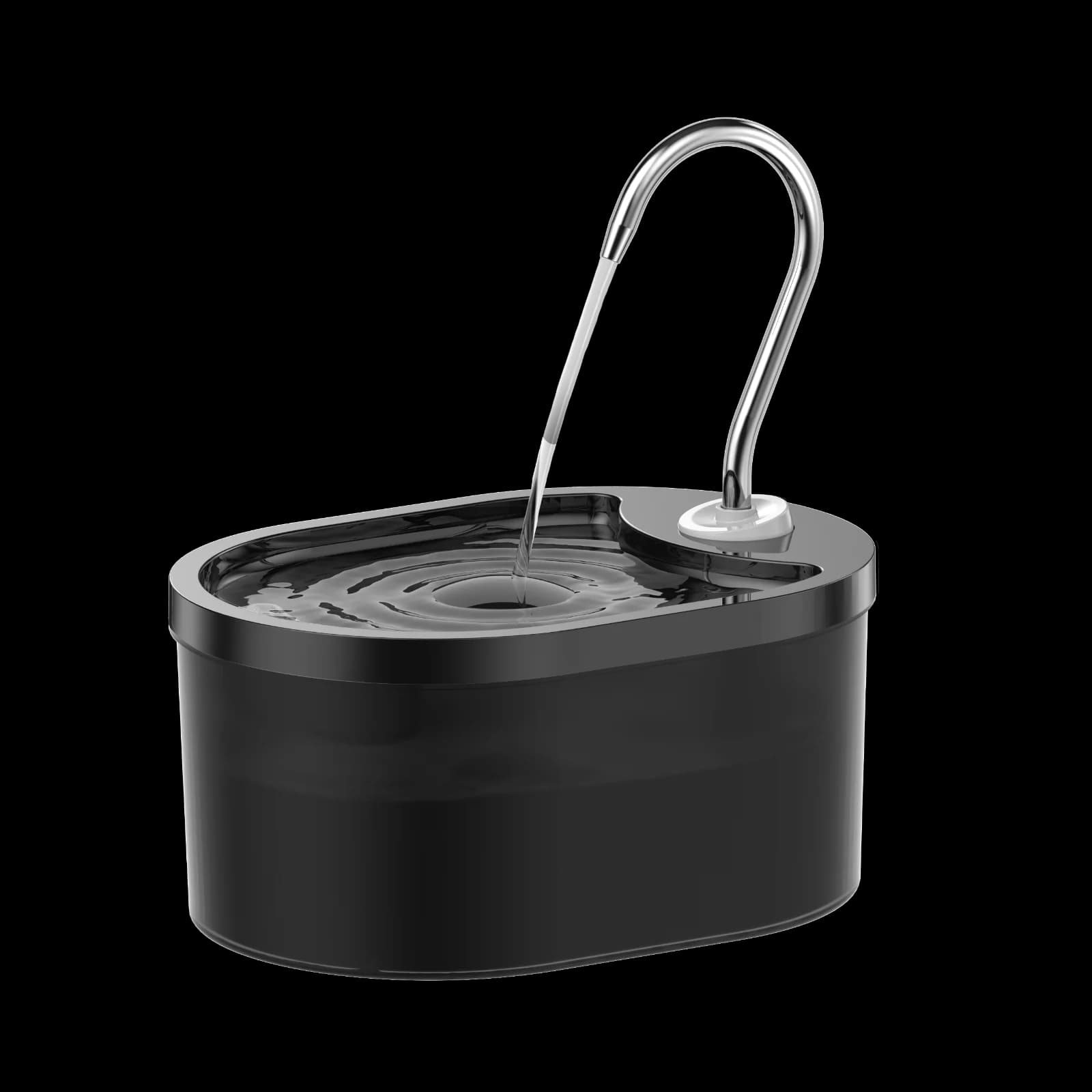
In the projects we handle, the fastest way to create confusion is to compare quotations before the product platform is fixed. A rechargeable stainless-steel model and a standard powered plastic fountain may share a category name, but they are not comparable sourcing briefs. Review the existing cat water fountain platforms to see how quickly architecture changes the product.
Specify the target market and sales channel
Identify the destination country or region, plug or charging expectations, retail or e-commerce channel, packaging constraints, language needs and the business that will hold importer or other market responsibilities. These details affect what documentation, labeling and pack protection should be discussed. Do not ask the supplier to “make it compliant everywhere.”
Separate must-haves from preferences
| Brief item | Must confirm | Can remain flexible |
|---|---|---|
| Product platform | Rechargeable stainless-steel platform | One of two approved exterior colors |
| Pump / flow | Confirmed pump architecture and operating mode | Preferred outlet appearance |
| Filter | Identified compatible cartridge | Alternative pack count |
| Market | Correct power input, label and manual scope | Secondary language order |
| Branding | Approved logo location | Optional color-matched print |
| Packaging | Channel-suitable protection | Preferred artwork finish |
The 10 Checks That Matter
1. Does the supplier understand the product category?
A useful manufacturer conversation goes beyond tank size and unit price. The supplier should be able to explain how the pump, outlet, filter, reservoir, power input and control mode work together on the model being quoted. Listen for model-specific answers. A broad catalog does not prove that the team can distinguish a rechargeable base from a plug-in platform, or a conventional pump cable from a wireless-pump architecture.
Ask the supplier to walk through one model from filling to operation, cleaning and replacement-part ordering. Category competence appears in the links between those tasks: the minimum water level affects pump operation; the filter holder affects compatible cartridge shape; the power state may affect available flow modes. Vague answers at this stage usually create more questions during sampling.
2. Is the exact model and version identified?
A product name and a catalog image are not enough. Request a stable model code plus the configuration details that distinguish versions: capacity, housing material, pump type, filter, outlet, adapter or charging arrangement, operating modes, color and included accessories. If a suffix, version code or production date changes the configuration, record it.
We often see buyer references built around a product photo rather than a model configuration. That works until the pump, filter, outlet or power version changes. The quotation, sample label, approval record and purchase order should point back to the same identifiable configuration.
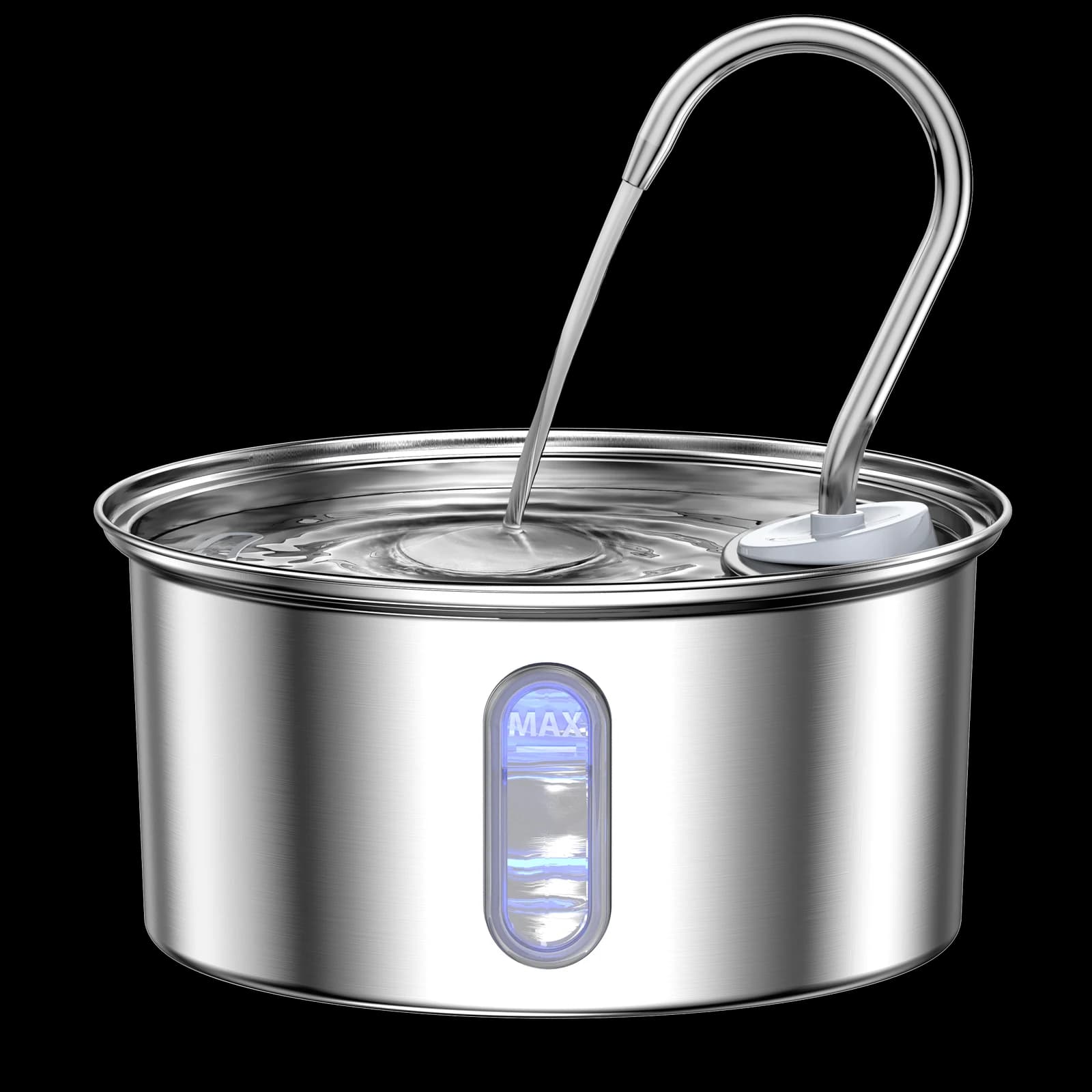
3. Do material claims identify the parts they cover?
“Stainless steel fountain” may describe an upper tray, a reservoir body, selected water-contact parts or the exterior appearance. Ask the supplier to name the material by component. The same rule applies to plastic grades, seals, viewing windows and decorative finishes. A broad material phrase should never substitute for a parts-level answer.
Check the claim against the physical sample and the approved specification. If a surface is coated, bonded or combined with another material, document that construction instead of simplifying it into a single-material claim. Our stainless steel versus plastic fountain guide explains why the complete assembly matters more than the headline material.
4. Are the pump, filter and replacement parts controlled?
The fountain is a system, not just a housing. Confirm the pump or water-moving module, filter shape and media description, foam pre-filter where used, outlet, tube, seals, adapter and other parts that affect operation. Ask which identifiers will appear on orders and how an approved part substitution would be communicated.
Continuity does not mean promising that a component can never change. It means knowing which parts are critical, how compatibility is checked, and what happens when a supplier or component version changes. Ask for current replacement-filter and service-part routes without assuming that “standard size” guarantees future compatibility.
5. Are power, sensing and pump architecture described separately?
Three different questions are often compressed into the word “wireless”: how the whole unit receives power, how power reaches the water-moving mechanism, and when water flows. Ask whether the fountain is plug-in or rechargeable, whether the reservoir uses a conventional pump cable or another pump connection, and whether operation is continuous, timed or sensor-triggered.
A rechargeable product can still use a conventional internal pump arrangement. A wireless-pump fountain can still require a plugged-in base. A radar or infrared sensor concerns control behavior, not pump architecture. The distinction is explained in our wireless pump versus cordless fountain guide. For sourcing, record each layer in the model specification instead of treating “wireless” as a complete technical description.
| Question | What it actually describes |
|---|---|
| Whole-unit power | How the complete fountain receives energy: for example, plug-in or rechargeable operation |
| Pump connection | How power reaches the water-moving mechanism inside the system |
| Sensor | What detects an approach or other input, where the model includes sensing |
| Operating mode | When the water-moving mechanism runs: continuous, timed or sensor-triggered |
How the fountain receives energy
Plug-in / rechargeableHow power reaches the water-moving mechanism
Conventional cable / model-specific alternativeWhat detects an approach or input
None / radar / infrared / otherWhen the water-moving mechanism runs
Continuous / timed / sensor-triggered6. Is the OEM scope defined before the quotation?
Separate existing-platform customization from engineering change. Logo application, color selection, manual preparation and packaging artwork may fit an existing platform. A new housing, altered water path, different electronics, tooling change or new control logic can require a different review, cost structure and development path.
At Fountelio, we separate existing-platform branding and packaging from changes that require tooling, structural work or electronics review. A buyer should ask every supplier to draw the same boundary in writing. Use the OEM and private label page to understand the scope Fountelio currently describes, then confirm the exact project rather than assuming every option applies to every model.
7. Does the approved sample become a controlled production reference?
A sample is useful only when the supplier records what it represents. The approval should identify the model and version, visible finish, operating behavior, component set, included accessories, packaging status and any deviations that remain open. Keep dated photos and notes with the approval record.
From our side of the table, a sample becomes useful when the approved configuration can be identified again during production and repeat orders. “Approved” should not mean that a loose, unlabeled unit sits on a shelf. Approve a configuration, not just a physical sample.
Controlled approval reference
8. Can the approved configuration be repeated in production?
Ask how the factory translates the approval into product, component, function, branding and packaging references. The goal is not a generic claim that every unit is “checked.” It is a traceable route from the approved sample and specification to the production version.
Review the supplier’s manufacturing process and quality approach for the model family involved. Look for platform-specific assembly and functional checks, identification of included components, and a final comparison against the approved reference. Ask how exceptions are recorded and who can approve a change.
9. Is market documentation scoped to the exact product?
Documentation depends on the product, destination market, electrical configuration, sales channel and the role each business holds in the supply chain. Ask the supplier to identify the exact model and configuration covered by any report, declaration, label file, manual or technical document. Never treat a logo on a PDF as proof that every version is covered.
The European Union’s product compliance guidance tells businesses to identify the rules that apply to the specific product and country. Its CE marking guidance also notes that CE marking applies only where relevant harmonized EU rules require it; it is not a universal product-quality badge. For products in scope, technical documentation needs to identify the product and the rules, standards, components and materials relied on. Buyers should obtain market-specific professional advice where required.
Identifiable configuration
+Destination + responsible business
+Rules assessed for that product and market
+Reports, declarations, labels and manuals in scope
10. Are repeat orders, spare parts and changes controlled?
The first order proves that one configuration could be supplied once. Repeat-order control asks whether the same reference can be reconstructed, which parts remain compatible, and how changes will be disclosed before production. Put the approved model, version and packaging references on the repeat-order confirmation.
For repeat orders, we prefer to confirm the approved model and configuration first rather than assume that an old product photo still represents the current version. Ask whether any pump, filter, material, electronics, artwork, carton or accessory has changed. If it has, request the effect on compatibility, documentation and the new sample or approval step.
Should You Choose a Factory or a Trading Company?
Choose the route that gives you clear control, communication and accountability for the product you are buying. A factory may control assembly directly but communicate poorly or outsource key parts. A trading company may coordinate several specialists well, but the buyer needs visibility into where decisions and records sit.
| Area | Ask for | What a clear answer establishes |
|---|---|---|
| Specification | Owner of the master model/configuration record | Who can confirm what is being produced |
| Production | Actual production location and responsible team | Where the product is assembled and controlled |
| Components | Who approves substitutions | Whether pump, filter or electronics can change silently |
| Quality | Reference, records and exception route | How the approved result is checked and deviations handled |
| Communication | Named commercial and technical contacts | Who resolves sourcing and product questions |
| After-sales | Replacement-part and repeat-order process | Who owns continuity after shipment |
Visit or review the factory information with the same discipline. Photographs can confirm that facilities and product handling exist. They do not replace model records, responsibility mapping or the evidence tied to your order.
How Should You Evaluate a Sample?
Evaluate the sample against the brief, then record the result in a way that production can reuse. Start with identity: model, version, color and configuration. Continue through assembly, filling, operation, cleaning access, power behavior, filter fit, supplied accessories and packaging. Note conditions when they affect what you observe.
We use samples to resolve open decisions, not merely to show that a fountain can run. A useful review identifies what is approved, what still needs correction and which evidence controls the next version. If branding and packaging are unfinished, say so rather than treating a working product sample as final approval of the full order.
| Review area | What to record | Approval question |
|---|---|---|
| Identity | Model, version, date and sample label | Can this configuration be found again? |
| Components | Pump, filter, outlet, seals, cable/base and accessories | Do they match the quoted scope? |
| Operation | Permitted modes, flow behavior and indicators | Does it behave as specified? |
| Use and maintenance | Filling, water-level view, disassembly and cleaning access | Can the user carry out normal tasks? |
| Branding | Artwork version, method, size and position | Is the visible result approved? |
| Packaging | Pack contents, protection, manual and label status | What remains open before shipment? |
| Exceptions | Deviation, owner and next action | Who closes each unresolved point? |
How Should You Compare Two Manufacturer Quotes?
Normalize the product and scope before comparing price. Place the quotations beside the same brief and mark every field that is missing, assumed or different. If one quote covers a rechargeable platform with a specified filter and retail packaging while another covers a plug-in base unit in plain export packing, the unit prices answer different questions.
| Comparison item | Ask both suppliers to specify | Why it matters |
|---|---|---|
| Exact model / version | Model code, pump, filter, power and sensor version | Prevents comparison of different configurations |
| Product MOQ | Minimum order for the exact model and whether it changes by color or configuration | Shows whether the quoted production scope fits the project |
| Branding MOQ | Minimum quantity for each logo, print or branding method | Separates product quantity from customization quantity |
| Packaging MOQ | Minimum printed-pack order and handling of unused packaging | Exposes packaging commitments beyond the product order |
| Tooling | Required tooling, scope, cost, ownership and approval route | Distinguishes existing-platform work from engineering change |
| Replacement filters | Compatible reference, pack format, price, MOQ and supply route | Clarifies after-sales continuity and total program cost |
| Spare pump | Exact compatible reference, ordering unit and availability | Avoids assuming that a visually similar pump will fit |
| Production lead time | Definition, starting point and conditions for the quoted configuration | Makes schedule claims comparable |
| Packaging configuration | Units per carton, protection, dimensions, weights, accessories and manual | Aligns freight, channel and pack-content assumptions |
| Incoterm | Named Incoterm, named place and applicable version | Defines which costs and responsibilities sit in the price |
| Documentation scope | Exact model, target market, documents included and responsible party | Prevents broad document claims from being applied to the wrong version |
The lowest unit price is not necessarily the lowest sourcing cost. Separate tooling, sample revisions, artwork, packaging, replacement filters, documentation work, freight basis, payment terms and the cost of resolving an unclear configuration can change the comparison. This is not an argument for choosing the higher quote. It is a reason to make the scope visible before deciding.
Which Red Flags Deserve a Second Look?
A red flag is a reason to ask for evidence, not an automatic verdict. Look closer when:
- One product photo is used for several quotations without a model or version code.
- The supplier cannot identify which parts a material claim covers.
- “Wireless” is used without separating whole-unit power, pump connection and control mode.
- The sample, quotation and packaging record describe different configurations.
- A pump, filter or adapter substitution can be made without written buyer review.
- Compliance language is broad, but reports or declarations do not identify the exact model and market scope.
- The quotation leaves branding, tooling, packaging or accessories to assumption.
- Repeat-order questions are answered only with “same as before” and no reference record.
Strong suppliers can have an incomplete first answer. The difference appears in how they close the gap: specific documents, identified owners and a traceable update are more useful than another broad assurance.
15-Point Manufacturer Evaluation Checklist
Use this checklist before committing to a sample program or purchase order. “Confirmed” should mean that you can point to the relevant model, document, sample or written answer.
| Check | Evidence to request | Status |
|---|---|---|
| 1. Product platform and intended use are fixed | Written product brief with platform and use case | □ |
| 2. Exact model and version are identified | Model code and configuration sheet | □ |
| 3. Capacity basis and operating water level are clear | Capacity specification and MIN / normal fill reference | □ |
| 4. Materials are stated by component | Parts-level material list or specification | □ |
| 5. Pump and water-path architecture are defined | Pump reference and water-path description | □ |
| 6. Filter and replacement compatibility are identified | Filter type, dimensions or compatible reference | □ |
| 7. Power, charging and control modes are separated | Power input, battery / charging details and mode description | □ |
| 8. OEM scope and engineering changes are separated | Written list of existing-platform options and engineering work | □ |
| 9. Sample approval has an identifiable reference | Dated sample ID, photos, specification and open-point record | □ |
| 10. Production uses the approved configuration | Production reference linked to the approved model and components | □ |
| 11. Quality checks and exception handling are explained | Inspection points, records and deviation-approval route | □ |
| 12. Target-market documentation scope is confirmed | Model-specific document list for the stated market | □ |
| 13. Branding, manual and packaging versions are controlled | Approved artwork, manual and packaging revision references | □ |
| 14. Component-change communication is defined | Written notification and reapproval process | □ |
| 15. Repeat-order and spare-part references are retained | Repeat-order record plus filter and pump references | □ |
How Does Fountelio Approach the Same Checklist?
Use the same checklist on Fountelio that you would use on any other supplier. Start with one of the five current platform groups, then define the model and configuration before discussing branding and packaging. The site separates product platforms, OEM scope, manufacturing stages and quality review so buyers can question each layer separately.
In the projects we handle, our aim is to turn the buyer’s brief into a configuration that can be recognized at sample review and referred to again for production. That includes clarifying product, component, function, branding and packaging references. Changes that require tooling, structural work or electronics review are separated from existing-platform customization.
This approach does not remove the buyer’s need to verify the exact order, destination-market responsibilities or documentation scope. Ask us to identify the model, open decisions and approved references in writing. The value of the process lies in what both sides can verify later.
Common Questions About Choosing a Cat Water Fountain Manufacturer
What is the most important first step when choosing a cat water fountain manufacturer?
Write a product brief that fixes the platform, configuration, target market, must-have features and approval requirements. Without it, quotations may describe different products.
Is a factory always better than a trading company?
No. Compare who controls the specification, production decisions, component changes, quality records and after-sales supply. A transparent accountable route matters more than the label.
Should I choose the manufacturer with the lowest unit price?
Only after confirming that the quotations cover the same model, components, customization, packaging, documentation and commercial terms. A lower price for a different scope is not a valid comparison.
How many samples should I approve?
There is no universal number. Approve the configuration needed to resolve product, branding, packaging and market questions, and record which sample or document controls each part of the order.
What should be included in a cat water fountain specification?
Identify the model, capacity basis, materials by component, pump and filter, power and control architecture, outlet, color, accessories, labeling, manual, packaging and approved references.
How can I reduce risk on repeat orders?
Reference the approved model and version, ask for a written change check, reconfirm critical components and packaging, and require review before an unapproved substitution enters production.
What Should Decide Which Manufacturer You Choose?
Choose the supplier that can make the approved product identifiable, reproducible and reviewable from the first brief through the repeat order.
Start with the platform, then resolve the model, components, operating architecture, market scope and OEM work. Use the sample as a controlled reference, compare quotations on equal scope and require a clear route for changes. A good decision leaves fewer assumptions for production to interpret.
About This Guide
Written by Lance, Director at Fountelio. Lance works with buyers on product selection, OEM requirements, sample direction and commercial project communication. This guide reflects that manufacturer and sourcing perspective.
Fountelio has a commercial interest in cat water fountain sourcing. The article is a buyer evaluation framework, not independent supplier research or legal advice. Fountelio-specific statements are based on the current product, OEM, factory, manufacturing, quality and About pages. Market requirements should be confirmed for the exact product, configuration, destination and responsible business.
The hero is an AI-assisted editorial scene based on verified Fountelio product and component references. Other explanatory visuals use verified product assets and simplified HTML/SVG diagrams. They explain sourcing relationships; they are not factory-audit evidence, product test evidence or certification proof.
Sources & References
- European Union: product compliance guidance: identifying product- and market-specific rules and supply-chain responsibilities.
- European Union: CE marking guidance: when CE marking applies and the manufacturer’s responsibility for conformity.
- European Union: technical documentation: product identification, applicable rules, standards, components and materials.
- Fountelio manufacturing process: approved references, component preparation, platform-specific review and packing stages.
- Fountelio quality approach: current inspection and configuration-review scope.