

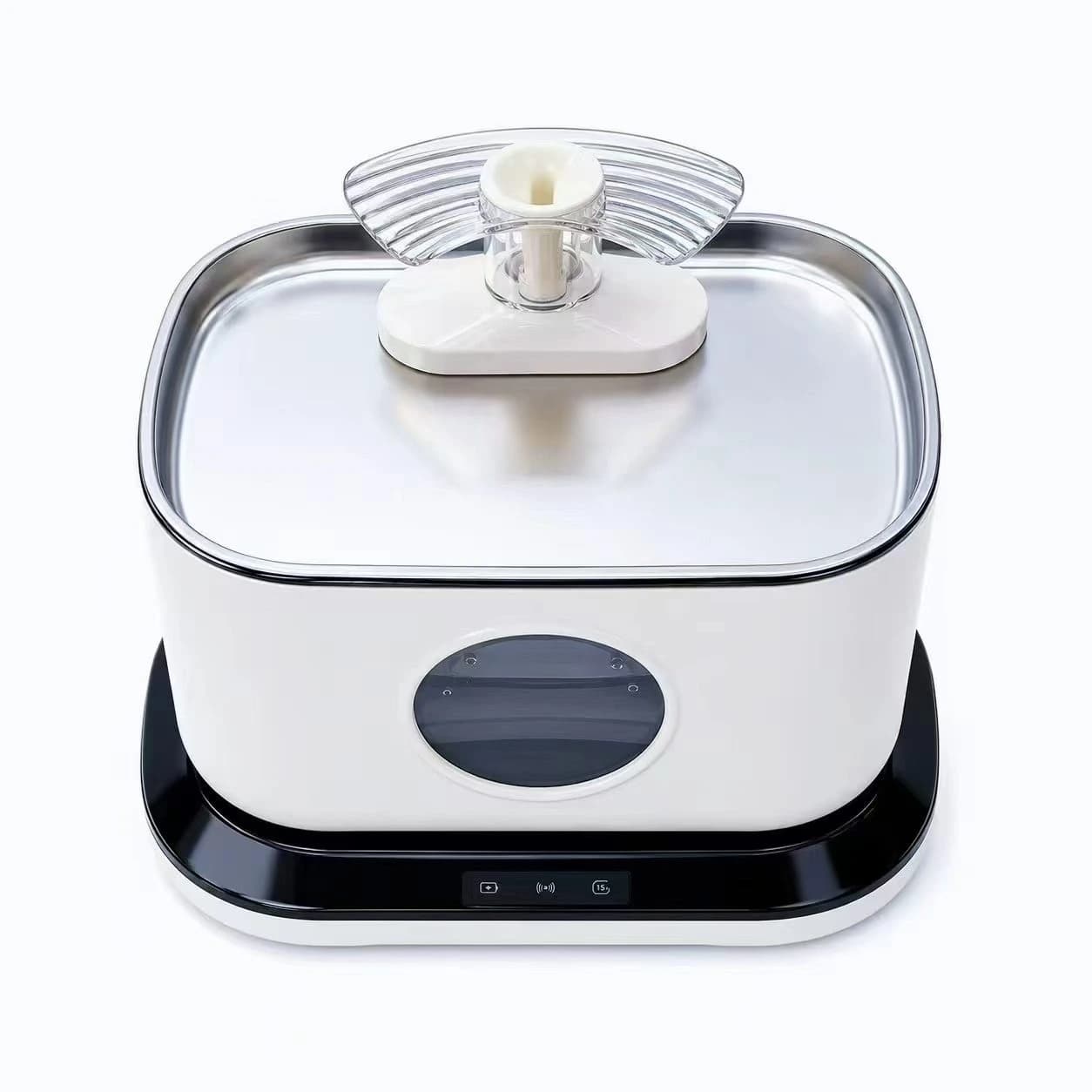
A “wireless” fountain arrives, you fill the tank, and then discover the base has to stay plugged in. The description may be referring to the pump inside the reservoir. Another fountain can run across the room on a battery yet still have a small cable connecting its internal pump. The same word can hide two different arrangements.
A wireless pump cat water fountain describes the wet-side connection; a cordless fountain describes whole-unit power. Removing the pump cable does not automatically remove the need for an outlet. A fountain can offer either feature, both, or neither.
I would separate three questions before reviewing a sample: where does the energy come from, how does it reach the water-moving mechanism, and what starts the flow? For the broader placement and charging decision, see our cordless vs plug-in cat water fountain guide. Here, we look inside that decision at the pump connection.
What Is the Difference Between a Wireless Pump and a Cordless Cat Water Fountain?
Cordless describes whole-unit power: the fountain can operate from an onboard battery away from an outlet. Wireless pump describes the connection to the water-moving mechanism, without a conventional pump cable running through the wet reservoir. These are independent features.
| Whole-unit power | Conventional wired pump | Wireless pump |
|---|---|---|
| Plug-in | External supply + pump cable | External supply + contactless pump connection |
| Cordless | Battery + conventional internal pump cable | Battery + contactless pump connection |
All four combinations can exist. The matrix describes architecture, not a ranking of quality or cleanliness.
Why Are “Wireless,” “Cordless,” and “Wireless Pump” So Often Confused?
“Wireless” is used for different parts of the product. It may mean no outlet cable during use, no conventional pump cable in the tank, or both. Terms such as wireless pump, magnetic drive, pumpless and pump-free are not standardized across the category, so each product’s architecture still needs checking.
PETLIBRO’s fountain comparison separates its Dockstream Wireless Pump model from its Cordless model and lists cord-free operation separately. Read those fields together: the name alone cannot tell you what happens when the external supply is disconnected.
What Is a Wireless Pump Cat Water Fountain?
A wireless pump cat water fountain moves water without a conventional electrical cable connecting the wet pump through the reservoir. Depending on the design, a base may transfer electrical energy contactlessly to a pump module, or drive a wet-side impeller magnetically.
Those implementations should not be treated as identical. PETKIT’s EverSweet 3 Pro UVC specifies magnetic induction power supply. Cheerble’s explanation of its pumpless design describes a magnetically driven impeller replacing a conventional submerged pump. Both avoid a conventional wet pump cable, but the location of the motor and the serviceable parts need checking.
For a sample review, I would ask for the energy path and removable-parts drawing together. A smooth tank exterior cannot establish what sits behind it.
How Does a Conventional Wired Pump Differ From a Wireless Pump?
A conventional pump normally has a powered module in the reservoir and a cable leading toward its supply. A wireless-pump design removes that conventional cable path, while retaining a mechanism that moves water.
The practical difference often appears during removal. A wired pump may require releasing a cable from a channel or disconnecting a permitted connector. A contactless arrangement can reduce that handling, but introduces its own seating and alignment requirements. Neither description tells you how easily the impeller chamber opens.
| Detail | Conventional pump | Wireless pump |
|---|---|---|
| Wet-side pump cable | Normally present | No conventional cable path |
| Battery / external plug | Depends on whole-unit power | Depends on whole-unit power |
| Cleaning | Pump, intake and water path | Pump or rotor and water path |
| Reassembly check | Cable route and connections | Module position and base fit |
| Flow controls | Separate design choice | Separate design choice |
Can a Wireless-Pump Cat Fountain Still Need to Stay Plugged In?
Yes. A base can transfer power contactlessly to the pump while relying entirely on an external power cable.
PETLIBRO identifies the Dockstream PLWF005 as a wireless-pump fountain that cannot operate without a cord. The Homerunpet WF20 FAQ likewise explains that its pump is not battery-driven: the base supplies power when the fountain is plugged in and the pump is positioned correctly.
For an outlet-free water station, look for an explicit battery-operation specification. A detachable tank is not proof of cordless operation.
Can a Cordless Cat Fountain Still Use a Conventional Wired Pump?
Yes. A rechargeable battery can supply a conventional internal pump. Cordless operation removes the need to stay connected to an outlet; it does not mean there are no wires anywhere inside.
Fountelio’s conventional cordless plastic and cordless stainless steel platforms should therefore be reviewed separately from the wireless-pump range. Confirm the selected configuration rather than inferring the connection from the housing material or charging port.
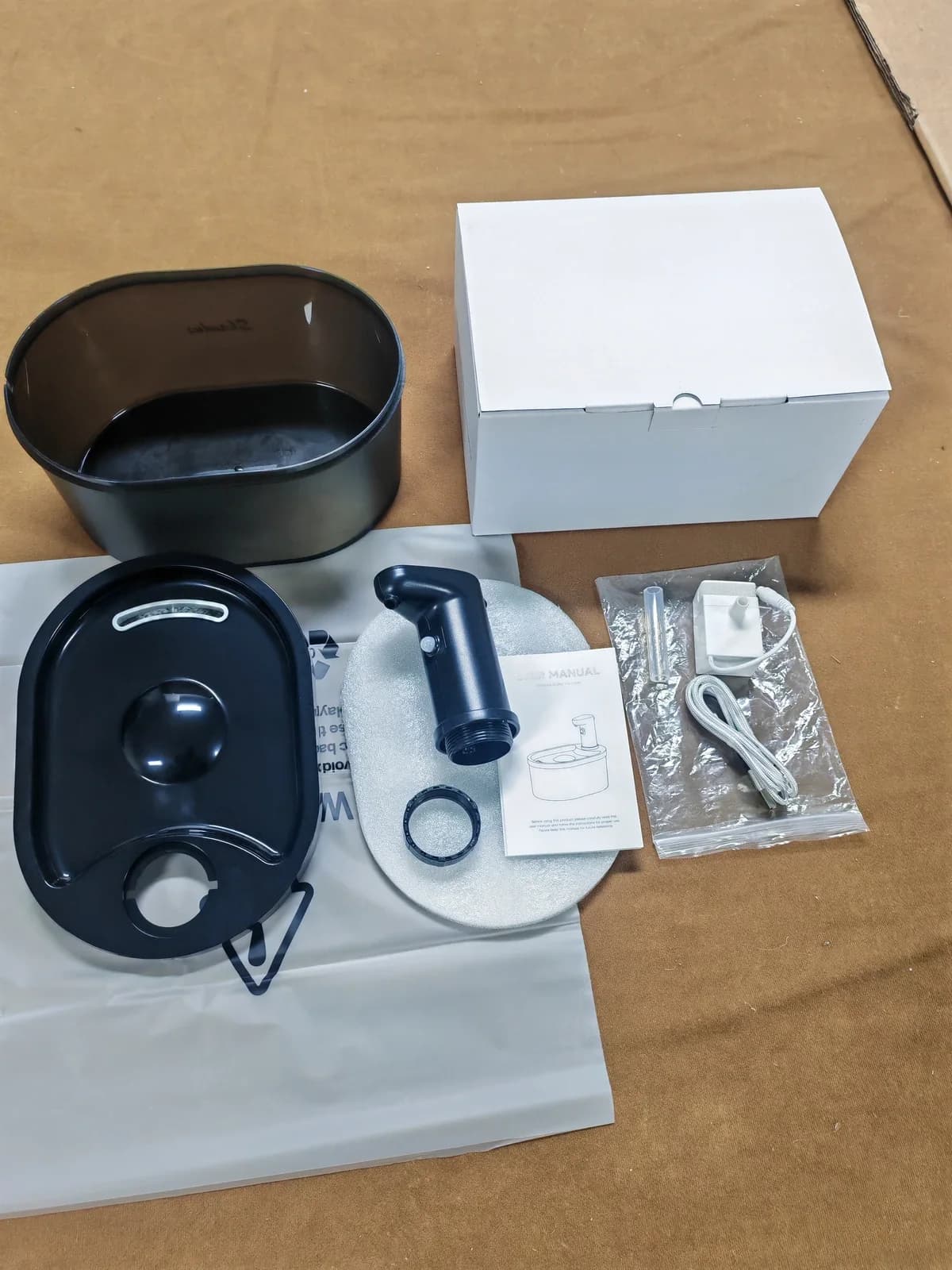
The supplied component photograph below shows why the distinction matters: the control/outlet assembly and wired pump are separate parts. I would trace that pump lead during sample inspection before describing the reservoir as cable-free.
Can a Fountain Be Both Cordless and Wireless-Pump?
Yes. A fountain can combine a rechargeable battery with a contactless pump connection, providing both outlet-free operation and a reservoir without the conventional pump cable.
The Homerunpet BF10 combines battery operation, a wireless pump and a charging base. Its FAQ also limits continuous Normal mode to plugged-in use. Having both features does not settle the flow-mode question.
- 01 · Whole-unit powerWhere does the energy come from?
Plug-in supply / rechargeable battery
- 02 · Pump connectionHow does it reach the water-moving mechanism?
Conventional pump cable / contactless transfer
- 03 · Control and flowWhen does water move?
Continuous / sensor-triggered / timed
Power ≠ pump architecture ≠ flow mode
Does a Wireless Pump Automatically Mean the Fountain Has a Radar Sensor?
No. Radar is an activation control; wireless pump is a connection architecture. Either can exist without the other.
A cable-free pump arrangement can run continuously, respond to a sensor, or follow a timer. Ask for the control specification separately, including which modes remain available on battery power.
What Does Radar Sensing Add to a Wireless-Pump Fountain?
Radar sensing determines when water starts flowing. Compared with continuous operation, suitable sensor-triggered use can reduce pump running time, but detection and battery performance remain configuration-dependent.
Fountelio’s rechargeable CWF-W1 platform specifies a 5000mAh battery, approximately 2–3m radar detection, a 150° detection angle and approximately 4–5 hours for charging under normal conditions. These are platform specifications, not universal wireless-pump properties or a measured runtime promise.
I would check activation at the intended approach path, including movement that passes nearby without stopping to drink. Extra triggers use energy too. Capacity alone cannot establish days between charges, and a sensor does not guarantee that every cat will approach within its detection area.
Does Every Wireless-Pump Fountain Need a Rechargeable Charging Base?
No. A base can transfer external power without storing any battery energy. A rechargeable base adds an energy-storage and charging function.
Compare the plug-in WF20 example with the battery-operated BF10 above. “Base” describes a physical part; “charging” describes a function. Check whether a listing means charging an onboard battery, transferring energy to the pump, or simply connecting the fountain to USB power.
Can a Related Wireless-Pump Architecture Be Used in a Plug-In USB Fountain?
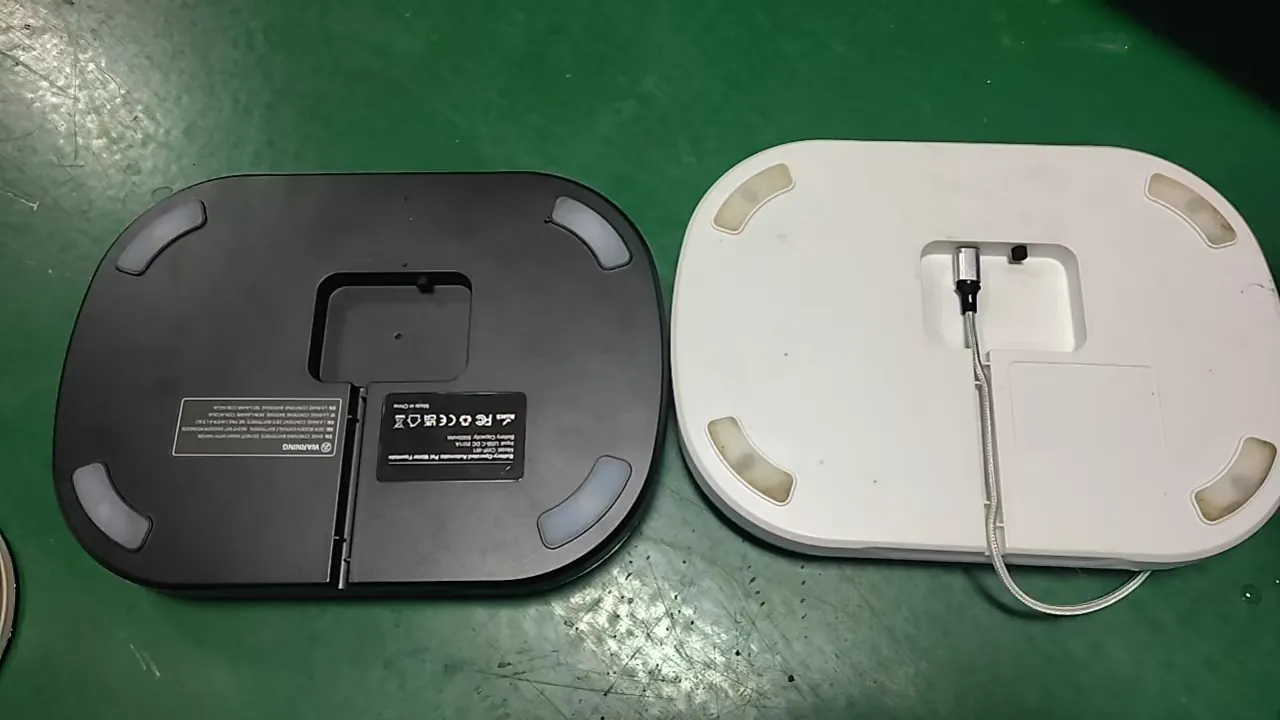
Yes. The same cable-free reservoir design principle can be applied to a rechargeable sensor platform or a USB-powered continuous-flow platform without establishing that the two versions use identical pump components.
Fountelio offers related architectures within its wireless-pump cat water fountain range. The rechargeable version combines a battery and radar-triggered operation. The lower-cost USB version has no rechargeable battery or radar and circulates continuously while connected to power.
Sensor-triggered use away from an outlet
No rechargeable battery or radar in this configuration
Fountelio platform comparison. A related architecture does not establish identical pump components or interchangeable bases.
This separates a product-program decision from a pump-connection decision. It does not mean a customer can swap the bases at home. Electrical ratings, component fit, controls and the approved parts list must match the chosen version.
Which Features Are Independent of Wireless-Pump Architecture?
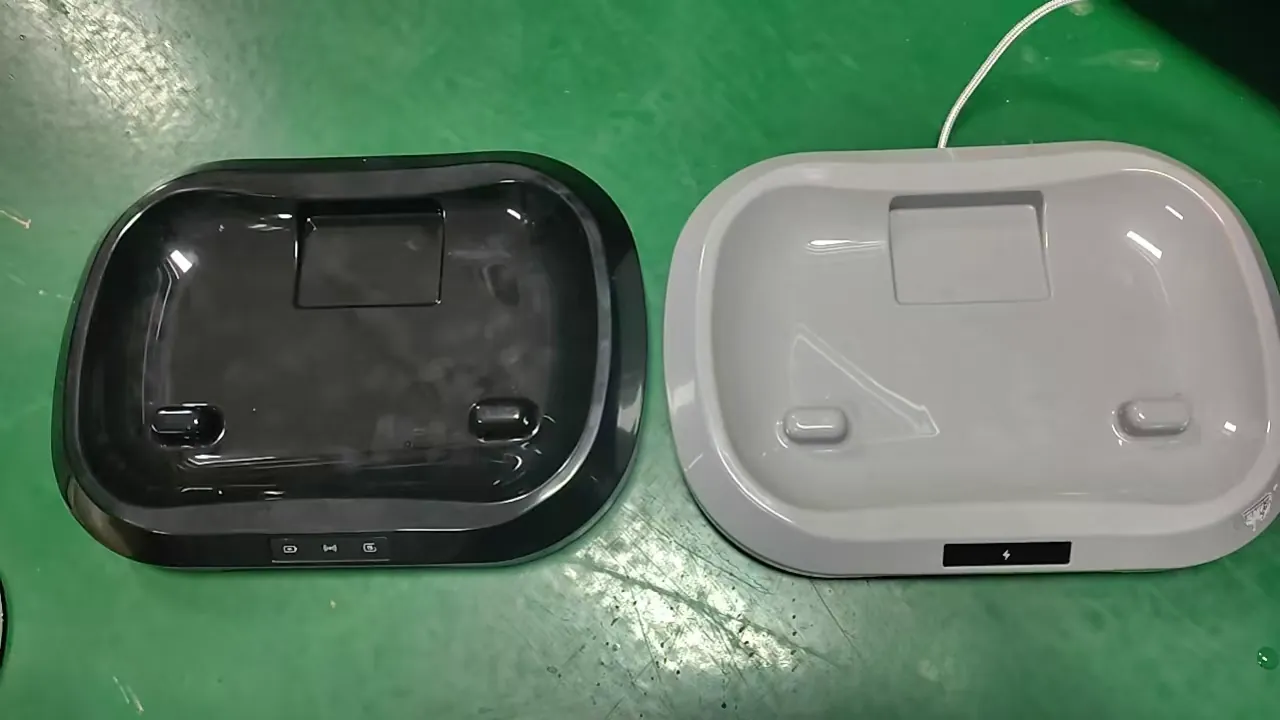
Battery capacity, sensor type, flow mode, filter media and water-level indication are separate specifications. A wireless-pump label does not establish any of them.
Separate does not mean unrelated in operation: a restrictive filter can affect flow, and longer flow cycles can use more battery energy. Specify each feature first, then check how the assembled system behaves.
Does a Wireless Pump Make a Cat Fountain Easier to Clean?
It can reduce cable handling when removing the tank or pump, but overall cleanability depends on access, surface geometry and the permitted disassembly.
A tank that lifts clear of its base may be easier to carry to the sink. That benefit is smaller if the intake is difficult to reach or a narrow outlet traps debris. Hair, mineral deposits and slippery buildup can still collect on wet parts regardless of their power connection.
My maintenance check would continue past tank removal: can a brush reach the intake, can the permitted rotor parts be removed, and can everything be reseated without guesswork? Follow the exact manual; do not open sealed electrical modules. Our cat fountain cleaning guide covers the full wet path.
| Stage | What to check |
|---|---|
| Separate | Switch off; identify tank, wet module and keep-dry base |
| Reach | Access intake, permitted rotor chamber and outlet |
| Wash | Use only the model’s allowed methods on washable parts |
| Reseat | Dry required surfaces; align parts and check flow after refill |
Does Wireless Pump Mean Water and Electricity Are Completely Separated?
Not as a blanket claim. Removing a pump cable does not prove that every electrical component is outside the water or that the entire unit can be washed.
A design may retain sealed electrical components in a wet-side module, while another places the drive electronics outside the reservoir. Waterproofing, insulation and permitted handling need model-specific documentation. For example, the BF10 FAQ says its base must not be washed. Keep charging and non-submersible parts dry as instructed; a cable-free appearance is not a safety test.
Is a Wireless-Pump Cat Fountain Quieter?
Not inherently. The mechanism, mounting, water level, outlet height and landing surface all contribute to operating sound.
Removing a cable does not remove water impact or vibration. Compare samples at equivalent fill levels and flow settings, and distinguish a short operating video from a controlled sound measurement. Sensor silence between cycles is also different from a quieter running mechanism.
Does Wireless Pump Change the Filter System?
It does not prescribe the filter media or replacement schedule. The selected filter still has to suit the holder and water path.
A cartridge that physically fits can still differ in thickness or flow resistance. Confirm compatibility for the exact model, then follow its service interval. Our filter replacement guide explains why visible loading and remaining media capacity are different questions.
Does Wireless Pump Change Water-Level Monitoring?
No particular monitoring method follows from the pump connection. A viewing window, low-water indicator and automatic shutoff are different features.
A window allows visual inspection; an indicator needs a defined detection and signaling system. Verify whether the model only alerts the owner or also stops the mechanism. Neither behavior should be inferred from a light on the base.
What Can Still Fail or Need Service?
The pump or rotor, water path, base, power supply and any battery or sensor can still need attention. Removing one cable does not remove maintenance or all failure points.
After cleaning, poor seating or an incorrectly assembled outlet may interrupt operation. Debris or scale can restrict moving parts; a charging problem belongs to a different subsystem. Before blaming the wireless connection, check fill level, assembly and the manual’s troubleshooting sequence. Do not run the mechanism dry to test it.
I would also ask which part can be ordered separately. A removable module is more useful when its replacement remains available and the correct revision can be identified.
Is Wireless Pump the Same as “Pumpless”?
Not necessarily. “Pumpless” can describe removal of a conventional submerged pump while a driven impeller still moves the water.
Cheerble uses the term this way in its pumpless fountain explanation. It should not be read as “no moving mechanism.” Ask what rotates, where the drive sits and which wet components require cleaning or replacement.
| Term | What it tells you |
|---|---|
| Cordless | Whole-unit operation away from an outlet |
| Wireless pump | No conventional wet-side pump cable |
| Pumpless | Brand-specific mechanism description; inspect the definition |
| Radar | An activation method |
| Continuous | A flow mode, subject to power-state limits |
| USB | A power input; not proof of a battery |
When Does Wireless Pump Make More Sense Than a Conventional Pump?
It is worth considering when pump-cable handling makes routine tank removal awkward and the alternative provides good access, reliable seating and obtainable service parts.
A straightforward conventional pump can still be a sensible choice when it is easy to remove, clean and replace. I would compare the complete maintenance sequence, not count the visible cables. For the wider buying checklist, use how to choose a cat water fountain.
Should You Choose Wireless Pump, Cordless, or Both?
Choose for the constraint you need to solve: outlet access, wet-side cable handling, or both. Then verify flow behavior and maintenance.
| Your priority | Look for | Confirm before buying |
|---|---|---|
| Placement away from outlets | Cordless operation | Battery modes and charging routine |
| Less cable handling at the sink | Wireless-pump architecture | Wet-part access and dry-base handling |
| Both benefits | Battery + wireless pump | Both features explicitly specified |
| Continuous flow at a fixed station | Plug-in operation | Flow mode; either pump layout may suit |
| Simple long-term servicing | Accessible, replaceable parts | Exact replacement module and availability |
What Should Brands Ask Suppliers About Wireless-Pump Fountains?
Ask for a configuration drawing and operating table that identify power, pump connection and controls separately.
- Where are the battery, motor or drive, and wet-side mechanism?
- Which parts can users remove, wash and replace?
- Which modes work on battery and external power?
- What distinguishes the USB and rechargeable versions?
- How are seating, low water and power faults handled?
- Which module revisions and replacement parts are compatible?
Frequently Asked Questions
Does a wireless pump need its own battery?
Not necessarily. It may receive energy from the fountain base. Check where any battery is actually located.
Can I replace a wired pump with a wireless one?
Do not assume a drop-in conversion. Power transfer, reservoir construction and controls must support the replacement.
Does wireless mean Wi-Fi or app control?
No. App connectivity is another specification and may be absent from either architecture.
Will water keep flowing when I lift the tank?
Do not assume it will. Separation may interrupt energy transfer; follow the model’s handling instructions.
What Should You Remember About Wireless Pump vs Cordless?
Cordless answers where the fountain gets power. Wireless pump answers how energy reaches the water-moving mechanism. Controls answer when it runs.
Keep those three questions separate and a confusing product name becomes a configuration you can check. Choose the arrangement you can place, clean and service reliably.
About This Guide
Written by Tony Kong, R&D Engineer at Fountelio. Fountelio manufactures cat water fountains and has a commercial interest in this category. Its platform examples draw on supplied specifications, component images and assembly materials; first-person comments describe product-review priorities, not comparative test results.
Diagrams explain relationships rather than exact internal layouts. Photographs show visible components; model documentation establishes their functions. Other manufacturers’ examples apply only to the named products. Follow the current manual for the exact model.