

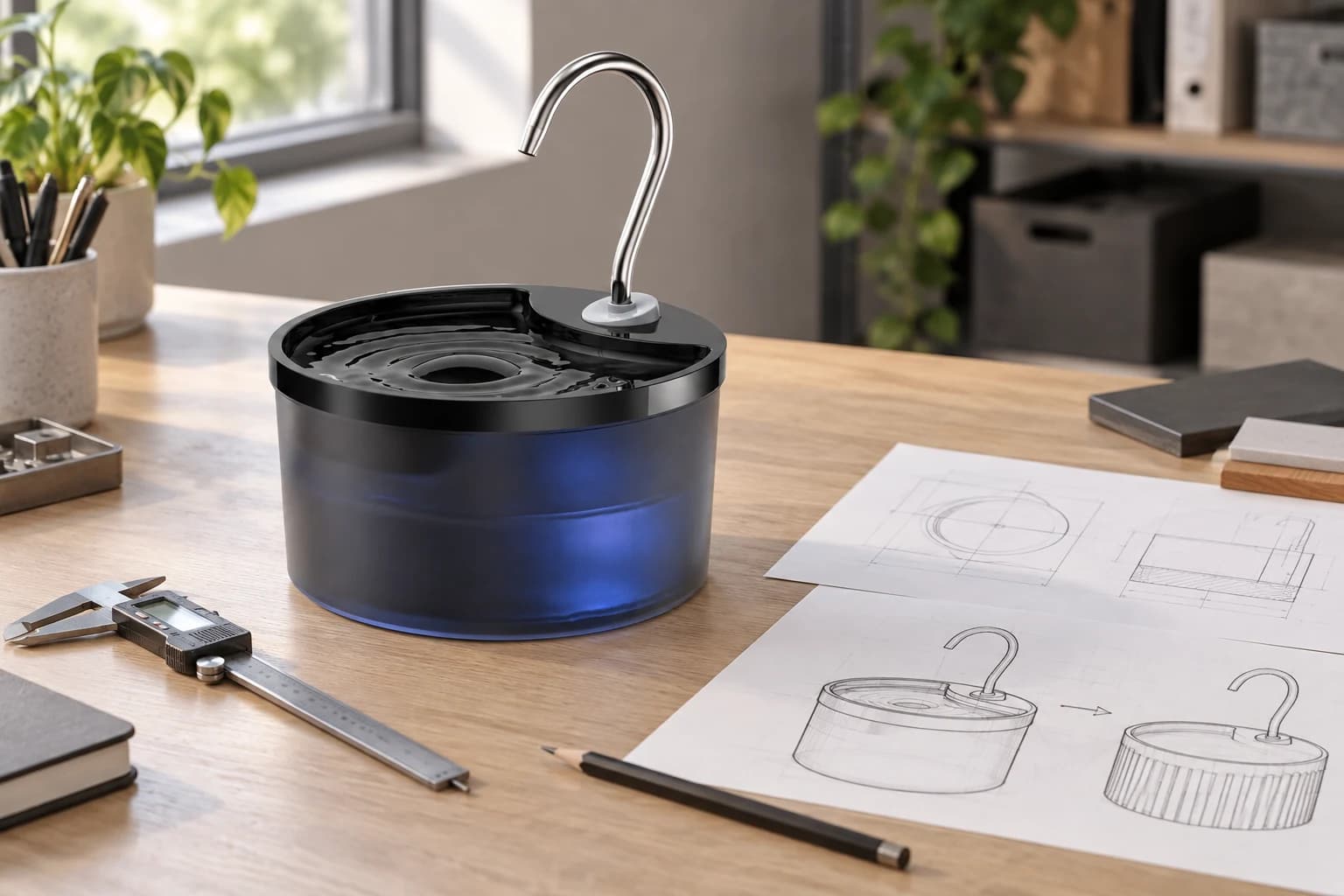
A custom-project inquiry often begins with “We only want to change the shape” or “Can you make this fountain look like our reference?” The word only can conceal very different work. Changing a logo or retail box is different from changing a reservoir, housing interface, pump position or electronic base.
Start with the lowest level of change that can achieve the product you need. If an existing fountain already meets the functional brief, branding, packaging and available configuration changes are usually the lower-risk starting point. New tooling becomes relevant when the requirement reaches molded geometry, structural interfaces or other features the existing platform cannot provide.
A buyer does not need to decide alone whether a request requires a new mold. The useful job is to define exactly what must change. Engineering can then determine whether the request fits an existing option, calls for a tooling modification, needs a new molded part or becomes a broader product-development project.
What Should You Know Before Discussing Tooling?
- Start with the closest platform. Do not create structural work unless a real requirement needs it.
- Separate branding from product change. Logo, manual and box work do not by themselves create a new fountain.
- Use engineering review for uncertain combinations. An existing component is not automatically compatible with another model.
- Treat geometry and architecture separately. A housing can remain similar while electronics change, or the reverse.
- Define the approval path before paying for tooling. Drawings, scope, responsibilities and change control should be clear first.
What Does “Custom Cat Water Fountain” Actually Mean?
“Custom” is not a useful production scope until it is divided into levels. A buyer may use the word for a logo on an existing unit, a different combination of available parts, a revised molded housing or a completely different operating system. Those requests should not share one quotation path.
The first distinction is whether the requested result already exists inside an approved platform. If it does, the work may remain private label or configuration selection. If the buyer wants parts combined in a way the platform does not already support, feasibility becomes an engineering question. When the requirement changes geometry, interfaces or architecture, the project moves toward product development and tooling review.
| Change level | Example | Typical starting path |
|---|---|---|
| Branding | Logo, manual, retail box | Private label |
| Existing configuration | Available color, outlet, base or version | Existing platform |
| Adaptation | A component combination or interface change | Engineering review |
| Structural change | Housing, reservoir or molded geometry | Tooling review |
| New architecture | Electronics, pump/base or sensing structure | Custom development |
“Custom” should describe the depth of the requested change, not serve as a blanket promise that every option can be combined.
Three Development Paths: Which One Fits Your Project?
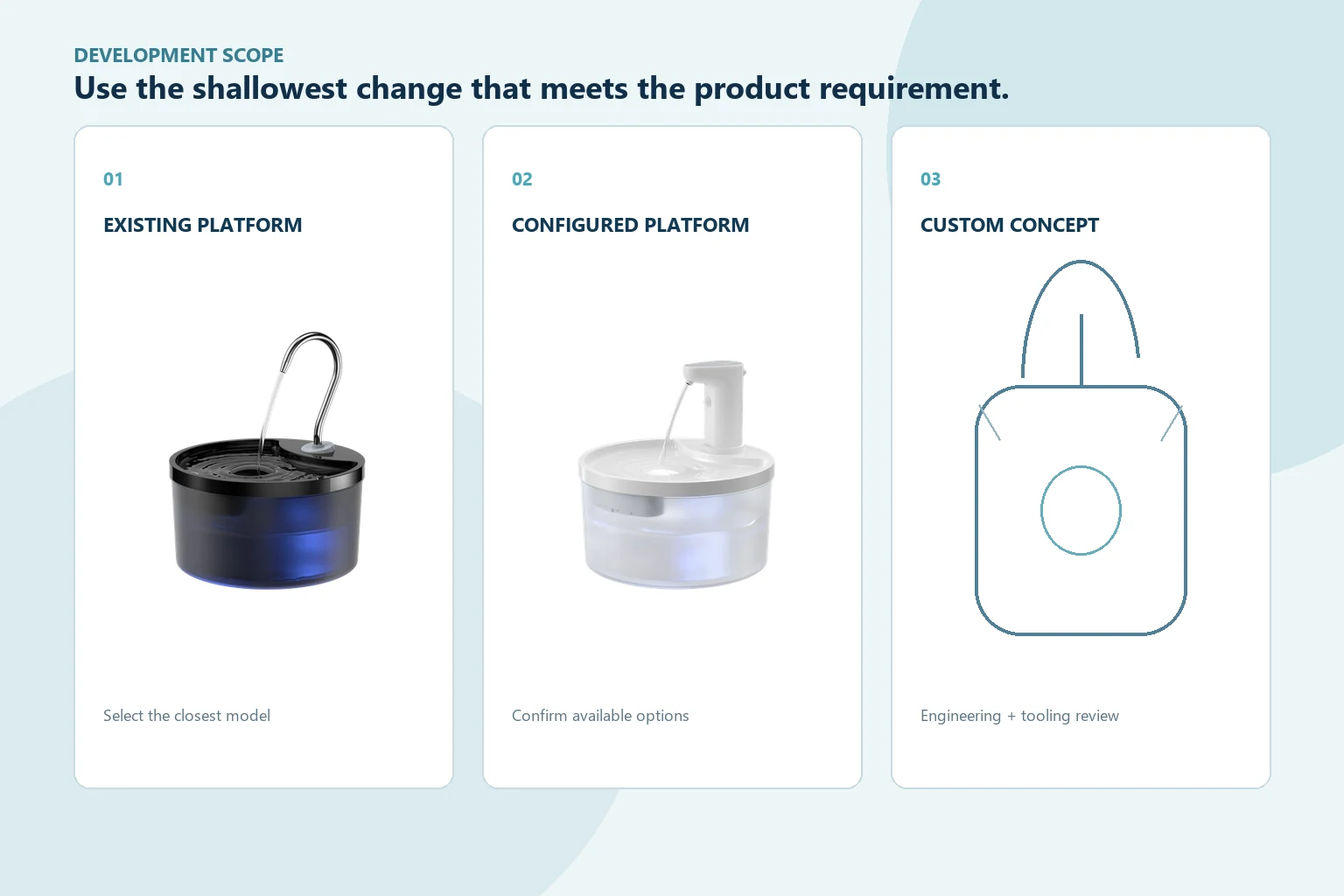
Most inquiries can begin on one of three paths. The correct path is determined by the product requirement, not by how ambitious the brand presentation looks.
Path 1 — Existing platform / private label
This path uses an existing fountain and its confirmed options. The work can include logo application, packaging, manual content and an available color, outlet or platform version. It is usually the simplest route because the housing, water path and component interfaces are already defined for that configuration.
In the projects we handle, product selection comes before branding. We first identify the platform and exact configuration, then discuss which private-label elements belong to that product. This prevents a new box or logo proof from being prepared around a model that is still changing.
Path 2 — Existing platform + engineering review
This middle path matters when the desired result sounds close to an existing model but is not a listed configuration. Combining an outlet from one model with another reservoir, changing a pump, moving a component or pairing a different base with a housing may look simple in a photograph. Fit, water path, power and assembly still need to be checked.
An engineering review is not a conclusion that new tooling is required. It is the step that identifies what actually changes and whether an existing part, tool modification, new insert or broader redesign is the responsible route.
Path 3 — Custom product / new-tooling review
A new housing, reservoir geometry, body dimension or molded interface usually moves the project into custom development. At that point the brief must cover more than appearance: the new parts have to fit, assemble, carry water as intended and accommodate the selected pump, filter, outlet and power system.
Fountelio’s current OEM and private-label scope places buyer-designed housings and custom molded products under separate engineering and commercial review. That is a scope boundary, not a promise that every new concept is feasible.
How Much Customization Does Your Project Actually Need?
Translate the buyer request into the first review path it creates. The table below is intentionally conditional: a familiar-looking part can still affect an interface, while a visibly different finish may leave the molded product unchanged.
| Buyer request | Likely starting path | New tooling? |
|---|---|---|
| Add your logo | Private label | Usually no |
| Create a custom retail box | Private label | No product tooling |
| Use an existing color | Existing platform | Usually no |
| Select another available outlet | Existing platform | Usually no |
| Combine options from different models | Engineering review | Depends |
| Move the pump position | Engineering review | Depends |
| Change filter shape or filter-holder geometry | Engineering review | Depends |
| Change the reservoir shape | Custom development | Likely |
| Change body dimensions | Custom development | Likely |
| Create new housing geometry | Custom development | Likely |
| Change the pump/base architecture | Engineering or custom review | Possibly |
| Add new electronics or sensing functions | Custom development | Possibly |
| Build a buyer-designed housing | New-tooling project | Likely |
These are decision examples, not automatic feasibility rules. The exact product, interfaces and existing tools must be reviewed before scope is confirmed.
Which Changes Usually Do Not Require New Product Tooling?
Branding and packaging normally sit outside the molded product. Applying a logo, preparing a user manual or creating a retail box can change the market presentation without changing the fountain’s housing or water path. These jobs can still have their own setup, proof, quantity and approval requirements.
Branding
Logo method, artwork, size, color and position should be matched to the selected surface. That is private-label work unless the brand mark itself requires a new molded feature, recess or raised geometry.
Packaging and printed materials
Retail boxes, manuals, labels and carton marks usually do not require product tooling. They do depend on the final product dimensions, included parts and destination market, which is why the private-label sample brief should keep product and packaging references connected.
Existing product options
An available color, outlet or version is usually selected from the existing platform. Choosing an existing option is not the same as creating a new feature. Confirm that the option belongs to the exact model rather than assuming every photographed combination is available.
Which Changes Should Trigger a Tooling Review?
A tooling review becomes appropriate when the requested change reaches the geometry that a production tool creates or the way molded parts meet. The review should identify the affected part and surrounding interfaces before deciding whether the existing tool can be modified.
Housing geometry
Changes to the outer contour, dimensions, wall features or visible openings can alter how the part is molded, removed and fitted to adjacent parts.
Reservoir geometry
A reservoir change can affect usable volume, minimum operating water level, pump location, filter position, drainage, cleaning access and the way the upper tray seats. Capacity is therefore not a simple scaling exercise.
Component interfaces
Tray-to-housing, outlet-to-lid, pump-to-reservoir and base-to-body connections must be reviewed as pairs. Changing one side can make the mating part the real development constraint.
Assembly features and molded details
Clips, screw points, bosses, slots, windows, cable openings and sealing areas can be small on a drawing but important in production. Their location affects assembly and may affect the tool construction.
Autodesk’s molding guidance explains why pull direction, draft, undercuts and the parting line constrain moldable geometry. It supports the need for manufacturability review; it does not determine whether a particular Fountelio tool can be changed.
Does Every Geometry Change Require a Completely New Mold?
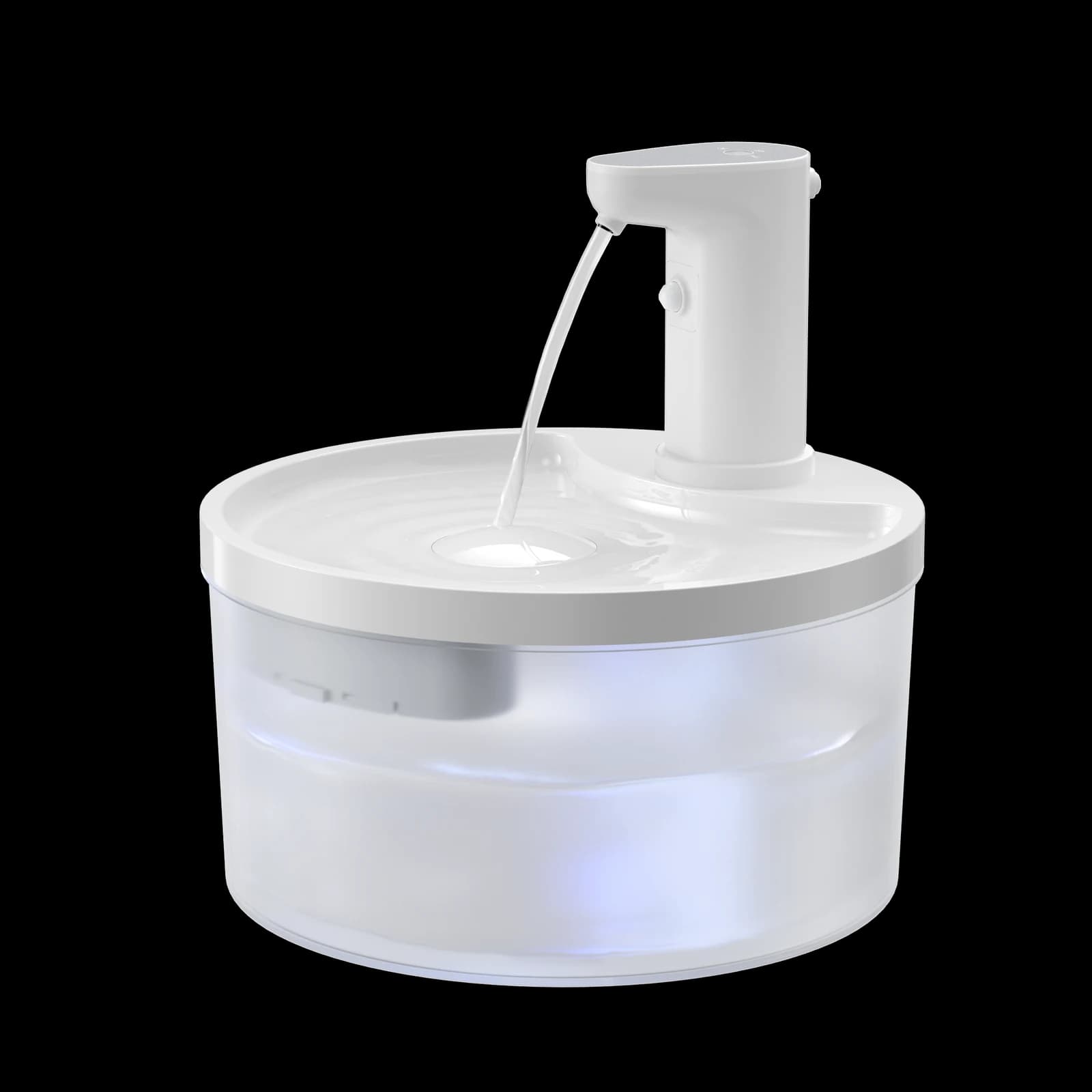
No. Some geometry changes may be possible by machining an existing tool, revising an insert or remaking only part of the tool. Other requests reach the cavity outline, parting line, gating, venting or surrounding features in a way that makes a new tool more practical or necessary. You cannot tell which case applies from a product rendering alone.
Protolabs’ mold-modification guide gives useful examples of why some changes can be cut into an existing mold while parting-line or more extensive changes may not be suitable. Its limits describe Protolabs’ own process; they should not be treated as universal rules or as Fountelio policy.
From our side, the responsible sequence is to compare the proposed geometry with the current part and tool information, identify the surfaces that change and then ask tooling engineers what can be retained. A quotation that says only “new mold” without naming the affected part leaves too much unresolved.
New tooling is a development conclusion, not something to guess from a rendering.
A New Housing Can Affect More Than Appearance
The housing is part of a working assembly. A wider body can change the tray span and packaging size. A taller reservoir can change pump head requirements, cleaning reach and stability. A relocated opening can alter the tube route, outlet fit or cable path. A new curve can change the surface available for a logo without improving product function.
A housing change may affect:
- pump position
- pump clearance
- filter geometry
- filter-holder fit
- replacement-filter compatibility
- water path
- reservoir volume
- outlet position
- tray fit
- base/interface fit
- sensor position
- cleaning access
- assembly sequence
- packaging dimensions
Review the water-contact side and the dry side separately, then trace the interfaces between them. The user must still be able to fill, carry, clean and reassemble the fountain. The factory must still be able to locate, join and inspect the parts consistently. A housing proposal is incomplete until those consequences are visible in the brief.
When we review a new external shape, we would not treat the current pump, filter or base as automatically compatible. Those components provide a useful starting reference, but their location and connection have to be checked against the proposed reservoir and body.
Real Example: Filter Geometry Follows the Product Platform
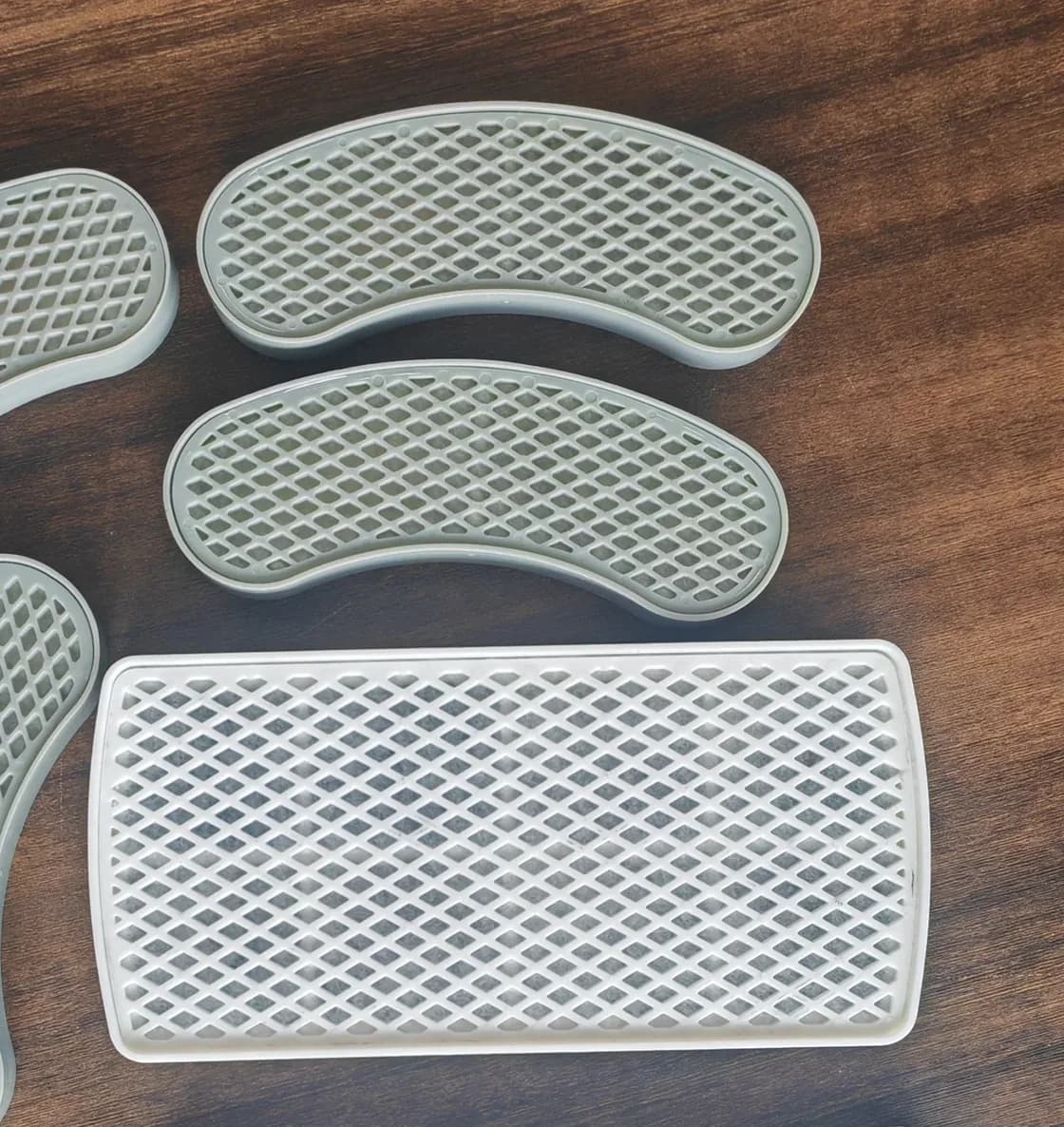
At Fountelio, filters are a practical example of why a housing change is not always cosmetic. Our current standard and cordless fountain platforms use a compact crescent cartridge measuring approximately 100 × 30 × 12 mm. The current Wireless Pump platform uses a larger rectangular cartridge measuring approximately 130 × 65 × 12 mm. Both formats use a rigid ABS cartridge structure around the media, but they are not visually or dimensionally interchangeable.
The reservoir and filter holder must locate the cartridge within the intended water path. A change to the surrounding geometry can therefore affect cartridge clearance, holder fit and how water is routed through the filter. It can also affect which replacement-filter reference belongs to the finished fountain. Those consequences should be checked before a housing drawing or tooling scope is approved.
This example does not mean every housing change requires a different filter or new tooling. An existing format may remain suitable when the holder, clearance and water path are retained. The result depends on the exact platform, model revision and proposed change.
| Product architecture | Filter format | Approx. size | Current compatibility |
|---|---|---|---|
| Standard / Cordless platforms | Crescent cartridge | 100 × 30 × 12 mm | Current platforms except Wireless Pump |
| Wireless Pump platform | Rectangular cartridge | 130 × 65 × 12 mm | Wireless Pump platform |
Approximate dimensions. Compatibility should always be confirmed against the exact fountain model and current product revision.
What If the Change Is Electronic Rather Than Molded?
A product can enter custom development without a dramatic change to its exterior. A new power input, battery arrangement, sensor, control mode, pump architecture or indicator can affect component space, connections, heat, firmware, charging, water separation, assembly and user instructions.
Some electronic changes may fit an existing enclosure; others may need new mounting points, windows, openings or a revised base. The correct order is system review first, then a tooling decision for any molded parts that must change. Do not assume that “same housing” means “no development.”
Destination-market responsibilities also need another look. The European Commission’s conformity-assessment guidance places assessment during both design and production and requires the technical documentation to support the applicable product requirements. The exact rules depend on the product and destination; a previous document set should not be copied automatically to a changed electronic configuration.
Shape · dimensions · openings · fit
Connections · sensing · mode · components
What Should You Send Before Asking for a Tooling Quote?
Send enough information for the supplier to identify the requirement and the closest existing route. A reference photo by itself communicates appearance but rarely resolves dimensions, interfaces, operating behavior or which features are mandatory.
| Input | Why it helps |
|---|---|
| Reference product or current model | Shows the closest starting platform and prevents category-level assumptions |
| Marked list of required changes | Separates must-have changes from preferences |
| Target dimensions and capacity direction | Exposes size, fit and reservoir constraints |
| Functional requirement | Clarifies water presentation, power, sensing and maintenance expectations |
| Required filter format or existing filter reference | Helps review holder geometry, water-path fit and replacement-filter compatibility |
| Target market and sales channel | Starts the documentation and packaging review at the correct scope |
| Quantity and launch direction | Allows the commercial route to be compared with the development burden |
| Available drawings or sketches | Communicates intent; it does not replace manufacturability review |
If drawings exist, identify their revision and units. If they do not, a marked-up reference with target dimensions and a written functional brief is still more useful than an unannotated rendering. Unknowns can remain open as long as they are visible.
Why Should a Tooling Price Come After the Scope Is Clear?
A tooling figure is meaningful only when both sides know which parts it covers and what has been retained from the existing platform. Two quotations can use the same phrase—“custom mold”—while covering different cavities, inserts, trial parts, revisions, gauges or approval stages.
In quotation discussions, we prefer to separate product development, tooling, samples and finished-unit pricing. That makes it easier to see whether the buyer is paying for a revised molded part, a completely new housing set or engineering work around a changed architecture.
Ask what drawing revision the price is based on, what changes are included, what triggers a re-quote and which prototype or trial output will be used for approval. Do not compare tooling totals until those fields are aligned.
What Should Be Clear Before Tooling Starts?
The goal is not to eliminate every future change. It is to make the starting scope, approval authority and consequences of change explicit before metal is modified or a new tool is commissioned.
- The product requirement and intended user outcome are written down.
- The closest existing platform has been identified and its gaps are listed.
- Affected molded parts, fitted components and interfaces are identified.
- The drawing or model revision to be reviewed is named.
- Prototype, sample and production-approval stages are distinguished.
- Tool modification and completely new tooling are quoted separately where relevant.
- Tool ownership, storage, maintenance, change approval and production access are stated in writing.
- Destination-market testing and documentation responsibilities are assigned.
- Replacement parts, filters and repeat-order version control are included in the product plan.
A pre-tooling record should name the current drawing or model, the parts included in the tooling scope and the person or team authorized to approve changes. If the project later changes, create a new revision rather than editing the original approval invisibly.
What Tooling Terms Should Buyers Clarify?
Clarify whether the quotation refers to a complete mold, a mold insert, a modification, repair or a separate fixture. Ask which product part each item produces, the number of cavities where relevant, the approved material or process assumption, and what sample stage follows.
Commercial terms also belong in writing: ownership, possession, storage location, maintenance responsibility, expected access for repeat orders, change approval and what happens if the project or supplier relationship ends. These terms are contractual and supplier-specific. Do not assume that paying a tooling charge automatically answers them.
Ask who retains the current drawings and change history. Repeatability depends on controlling the product revision as well as the physical tool.
When Is an Existing Platform the Better Commercial Decision?
An existing platform is often the stronger choice when it already meets the required material, capacity direction, cleaning access, power method and market position. The buyer can focus investment on branding, packaging, channel readiness and inventory instead of funding structural differentiation that customers may not value.
It is also useful when launch timing, first-order quantity or demand confidence does not justify a development program. This is not a claim that an existing platform is always cheaper or faster; availability, quantity and project scope still matter. It means the buyer should require a product reason before adding engineering depth.
Review the current cat water fountain platforms and compare their actual gaps with the brief. A different existing platform may solve the requirement more cleanly than modifying the first model considered.
When Can New Tooling Be Worth It?
New tooling can be justified when the unmet requirement is structural and commercially important: a footprint for a defined shelf or shipping constraint, a reservoir geometry that supports a needed capacity and maintenance concept, an interface required by a proprietary component system, or a distinctive housing central to the buyer’s product strategy.
The case is stronger when the buyer can define the target market, product life, expected volumes, ownership terms and approval resources. It is weaker when the request is driven only by a reference image or an undefined desire to “look different.”
Tooling is only one part of custom development. The pump, filter, water path, electronics, sensing, assembly, packaging and replacement-parts plan still need to resolve around the new structure.
Do You Need New Tooling? A Practical Decision Path
Begin with the requirement, then work inward. If the product already exists as a confirmed configuration, keep the project on the existing-platform path. If parts must move or be combined, pause for engineering review. If molded geometry or structural interfaces must change, ask whether the current tooling can be modified or whether a new tool is required.
Can an existing platform meet the requirement?
YesDefine the existing configuration↓Does the request combine or move fitted components?
Yes / unsureEngineering review↓Does it change molded geometry or structural interfaces?
YesTool modification or new-tool review↓Does it change electronics or operating architecture?
YesSystem development + compliance reviewThe last branch is deliberate: electronics and controls can create custom development even when they do not immediately require a new outer-housing mold. Identify any resulting enclosure or interface changes after the system is defined.
Does It Matter Whether the Supplier Calls the Project OEM or ODM?
The label matters less than the recorded scope. Suppliers use OEM, ODM, private label and custom development differently. Ask which product design already exists, which parts the buyer is changing, who supplies the drawings, who approves engineering decisions and which tools or components are being created.
A project described as ODM may involve only an existing platform and branding. A project described as OEM may still require a new housing or electronics. Use the terms for communication, then replace ambiguity with a part list, drawing revision and responsibility record.
Common Mistakes Before Starting a Custom Fountain Project
- Requesting a tooling price from one lifestyle rendering.
- Treating “change the shape” as a cosmetic instruction.
- Assuming existing components from different models fit together.
- Starting a mold before the water path and component layout are defined.
- Changing electronics without reviewing documentation and enclosure effects.
- Leaving tool ownership, maintenance and change authority unstated.
- Approving sample photos without identifying the drawing and configuration revision.
- Comparing finished-unit prices while the development scopes differ.
The simplest correction is to write the intended product outcome first, then identify the parts and systems that must change to achieve it.
How Does Fountelio Decide Whether a Project Needs New Tooling?
At Fountelio, we start with the closest current product platform and separate four questions: what can be handled through branding, what already exists as a configuration, what requires an interface or engineering check, and what introduces new geometry or architecture.
For a current platform, we identify the model and the available product options before discussing new work. If the request combines parts, changes a fit or alters the operating system, it moves into review. Buyer-designed housings and custom molded products require separate engineering and commercial consideration.
Our answer at the inquiry stage may therefore be “existing option,” “needs engineering review” or “custom-development scope,” rather than an immediate yes/no tooling promise. Share the closest product reference, required changes, target quantity and available drawings through the custom project process. The next useful output is a clearer scope.
Frequently Asked Questions
Does adding a logo require a new mold?
Usually not. Logo application is normally a private-label process, but the selected surface, marking method, size, color and quantity still need confirmation.
Does changing the color require tooling?
An available color normally does not require new product tooling. A new material or finish can still need color matching, process review, quantity confirmation or new validation, so do not treat every color request as identical.
Can two existing model options always be combined?
No. An outlet, base, pump or filter from one model may not fit another model. Treat a cross-model combination as an engineering question until the interfaces and operating configuration are checked.
Does a new housing always require a completely new mold?
Not automatically. Some changes may be possible through a tool or insert modification; others alter the cavity, parting line or surrounding features enough to require new tooling. The existing tool and proposed geometry have to be reviewed.
Can electronics change without changing the housing?
Yes, in some projects. That can still create work around power, component fit, heat, controls, firmware, sensing, documentation and testing even when the visible shell changes little.
Should tooling be quoted from a product rendering?
A rendering can communicate appearance, but it does not define wall sections, interfaces, assembly details, tolerances or the exact production route. Use it as an input to review rather than a complete tooling specification.
Is OEM or ODM the deciding label?
No. Suppliers use those labels differently. The useful questions are which existing design is being used, what is changing, who controls each decision and what must be developed or tooled.
Sources & References
- Protolabs: Simplifying Mold Modifications. Examples of changes that may be possible in an existing mold and changes that may require more extensive tooling. Its process limits are not presented as Fountelio policy.
- Autodesk: Evaluate Parting Line. Technical explanation of pull direction, draft, undercuts and parting-line constraints in molded geometry.
- European Commission: Conformity Assessment. Official guidance on product-specific requirements, design and production assessment, and technical documentation for the EU market.
- Fountelio OEM & Private Label. Current distinction between existing-platform customization and buyer-designed housing or new-product tooling review.
- Fountelio Product Platforms. Current plastic, stainless steel, cordless and wireless-pump platform groups.
About This Guide
Written by Lance, Director at Fountelio. The Fountelio examples reflect the current product-platform, private-label and custom-project workflow published on this website. Engineering feasibility, tooling modification, ownership terms and destination-market requirements remain project-specific and should be confirmed in writing for the exact product.