

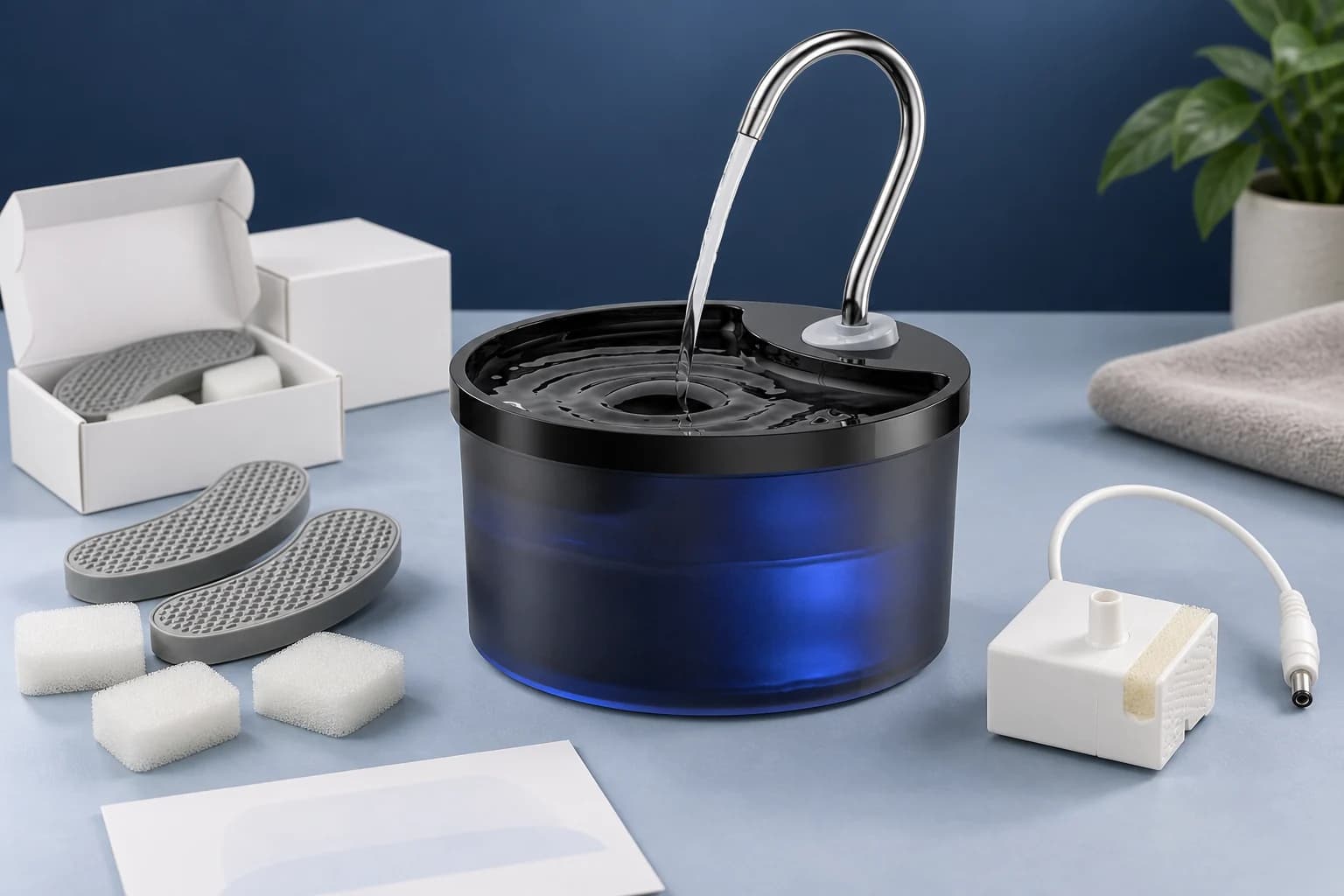
A private-label fountain can be approved—the product, logo, retail box and manual—while one commercial question remains unanswered: what does the customer buy six months later when a filter, pump or another service item needs replacement? That question is easier to solve before packaging is printed, retailer listings go live and customers own the product.
Before launch, map every supported consumable and service part back to the exact fountain model or configuration. Identify the replacement filter, pump and any relevant prefilter, outlet or power accessory; then decide what ships with the fountain, what may be offered separately, how each item will be identified, how it will be reordered and how a later component revision will be handled.
Not every fountain needs a large spare-parts catalogue. A simpler model may need one identified filter, clear instructions and a pump reference for support. A rechargeable sensor or wireless-pump platform can require more careful mapping of power components, the pump/base relationship and service boundaries. The goal is the minimum useful system without ambiguity.
Key Takeaways
- Plan consumables before launch, not after the first replacement request.
- Treat filter compatibility as model- or verified family-specific.
- Separate replacement frequency from the commercial pack quantity.
- Identify pumps and accessories by configuration rather than appearance.
- Record component revisions so old and new service parts are not mixed.
The Fountain Is One SKU; the After-Sales Program May Be More Than One
The retail fountain is the program anchor, but it may not be the only item the brand has to manage. Depending on the approved design, the wider program can include a replacement filter or multipack, a foam prefilter, a pump held for service, an outlet or spout, and a cable, adapter or base relationship. This is a list of possible planning items, not a claim that every platform offers every component separately.
In the projects we handle, replacement filters often enter the discussion after the fountain, logo and box. We prefer to identify them while the configuration is still being approved, because the filter reference and pack strategy can affect the manual, artwork and launch inventory.
Which Parts Should You Identify Before Launch?
Begin with the exact fountain model, then list every consumable, included accessory and service item relevant to that configuration. “Identify” does not necessarily mean “sell directly to consumers.” It means the buyer and manufacturer know what the component is, how it relates to the product and what support path applies.
| Part / program item | Why it matters | What to confirm |
|---|---|---|
| Fountain model | Anchors the complete program | Exact model, power platform and approved configuration |
| Replacement filter | Recurring consumable where used | Reference, shape, fit and confirmed model list |
| Foam prefilter | Separate service item on some architectures | Whether fitted, serviceable and separately supported |
| Pump | Operating component | Exact compatible pump or service reference |
| Outlet / spout | May differ by configuration | Matching style, fit and approved version |
| Cable / adapter | Relevant to powered products | Connection and power version |
| Charging / electronic base | Relevant to selected platforms only | Model and version relationship; service boundary |
| Manual | Carries service information | Correct product and component revision |
| Replacement pack | Aftermarket SKU if offered | Count, packaging, labeling and compatibility statement |
A product with conventional plug-in power will not have the same service map as a rechargeable sensor fountain. The list should be shortened or expanded around the actual product rather than copied across the range.
Filter Compatibility Is Model-Specific
A filter is not compatible because it looks close, has a familiar number of layers or can be pressed into the holder. Fit can depend on outer dimensions, thickness, holder geometry, orientation, the intended flow path, prefilter position and product revision. Capacity alone is not a filter specification.
Official market examples show both possible patterns. Catit identifies a dedicated filter for its Mini Flower Fountain, while its full-size Flower Fountain filter is stated to fit a broader, named Flower family. PetSafe's Pagoda support page maps named carbon and foam filters and a pump to defined fountain model numbers. These examples illustrate model or verified-family mapping; they are not Fountelio specifications.
Two Current Fountelio Filter Formats
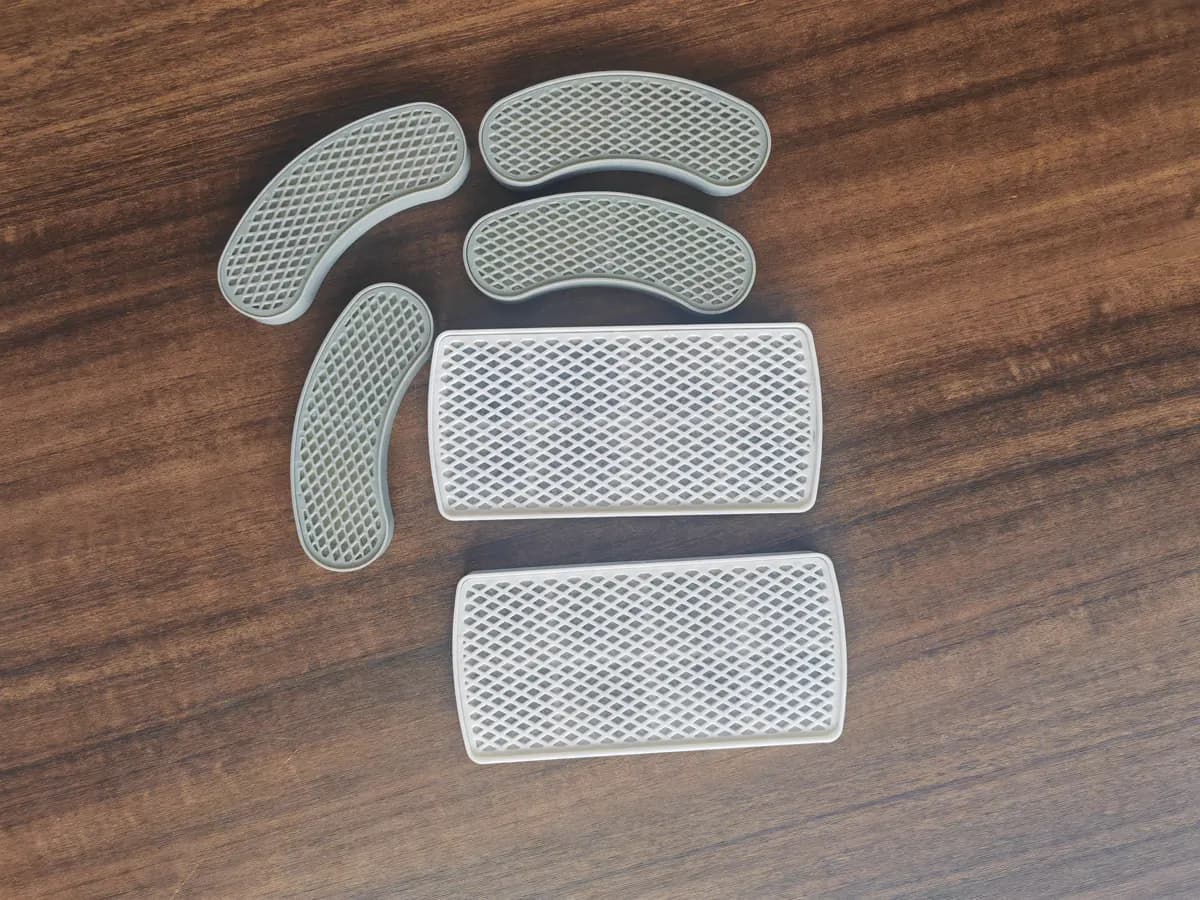
The current range uses a compact crescent cartridge for the platforms other than Wireless Pump, and a larger rectangular cartridge for the Wireless Pump platform. Both use a rigid ABS integrated structure. Their format and holder relationship are different; neither should be specified simply as a universal fountain filter.
| Product Platform | Filter Format | Approx. Size | Current Compatibility |
|---|---|---|---|
| Standard powered and cordless platforms | Crescent / moon-shaped cartridge | 100 × 30 × 12 mm | All current Fountelio fountain platforms except Wireless Pump |
| Wireless Pump platform | Rectangular cartridge | 130 × 65 × 12 mm | Wireless Pump platform |
Approximate dimensions. Compatibility should always be confirmed against the exact fountain model and current product revision.
For us, the useful question is not whether two filters look similar. It is whether the selected filter is documented for the approved fountain configuration. The product sample, specification and replacement reference should tell the same story. The consumer-facing replacement filter compatibility guide turns that principle into a model, geometry, holder and water-path check.
How Should Buyers Check Filter Compatibility?
Use a written compatibility record supported by the sample and product data. The exact checklist will vary by design, but the following fields prevent most photo-based assumptions.
| Compatibility check | Why it matters |
|---|---|
| Filter reference | Gives the replacement item an identity |
| Dimensions | Confirms physical fit |
| Shape | Relates the media to its holder |
| Thickness | Can affect seating and the intended flow path |
| Orientation | Some filters install in a defined direction |
| Filter holder | Similar media can use different interfaces |
| Prefilter / foam | May be a separate service item |
| Confirmed model list | Defines verified compatibility |
| Revision / version | Prevents mix-ups after component changes |
The current Fountelio cartridge specification distinguishes physical construction from filtration function. Record both, together with the compatible product version, rather than using a layer count as shorthand for performance.
6-Layer Integrated Filter Cartridge
The integrated cartridge combines a rigid perforated ABS outer structure, two high-density filter-cotton layers, coconut-shell activated carbon and cation-exchange resin. Its six physical layers are:
- Upper perforated ABS screen
- Upper high-density filter cotton
- Coconut-shell activated carbon
- Cation-exchange resin
- Lower high-density filter cotton
- Lower perforated ABS support screen
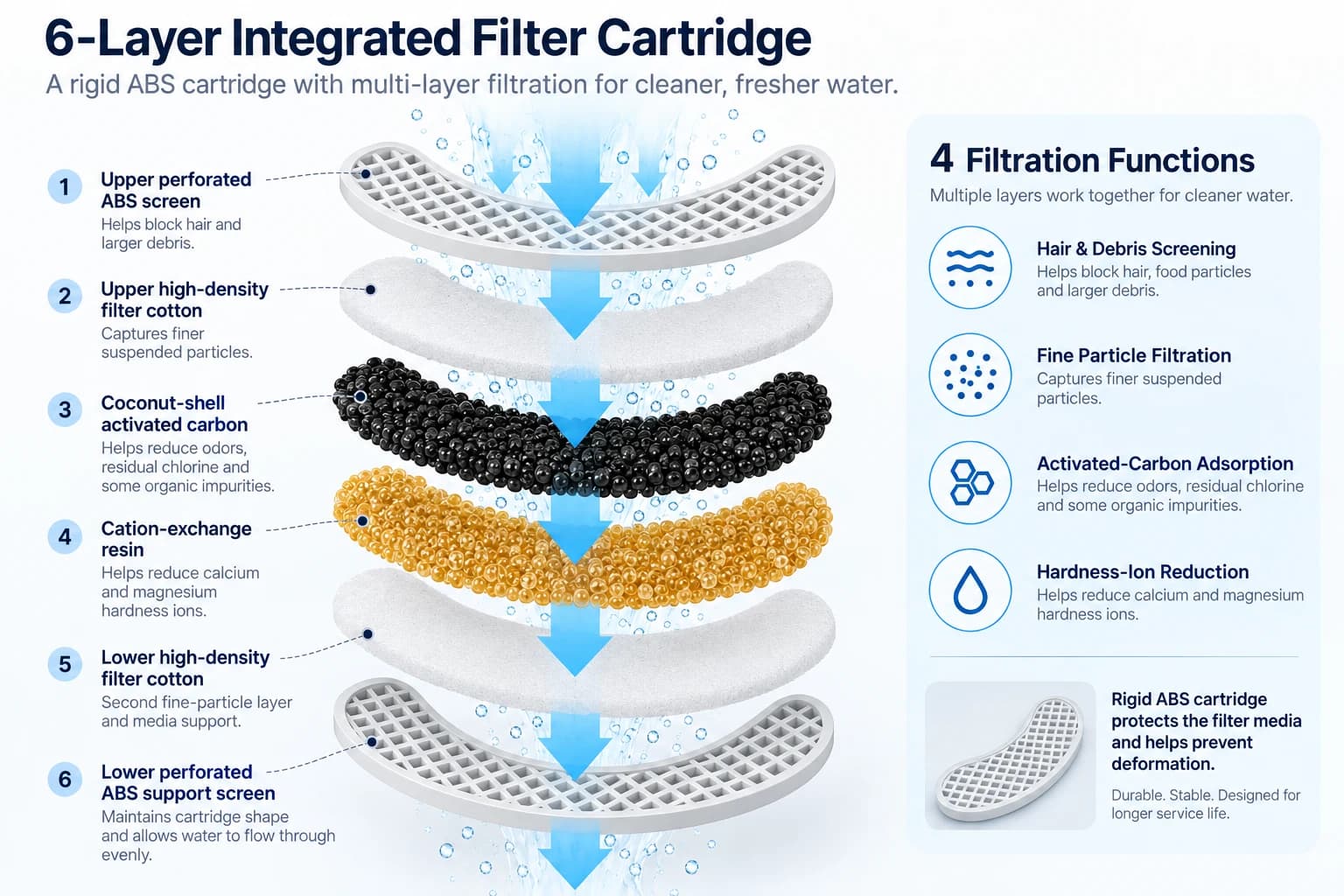
4 Filtration Functions
Six layers do not mean six independent filtration mechanisms. The two cotton layers share a fine-particle function, while the ABS screens also support and protect the media.
| Function | Role in the cartridge |
|---|---|
| Coarse debris screening | The perforated ABS screen helps intercept hair and larger debris. |
| Fine particle filtration | The high-density filter cotton captures finer suspended particles. |
| Activated-carbon adsorption | Coconut-shell activated carbon helps reduce odors, residual chlorine and certain organic impurities. |
| Hardness-ion reduction | Cation-exchange resin helps reduce calcium and magnesium hardness ions. |
These descriptions identify the roles of the materials, not a guaranteed removal rate or service life. Product conditions and the exact cartridge specification still matter when preparing customer-facing claims.
What the Rigid ABS Structure Changes
Fountelio uses an integrated ABS cartridge with ultrasonic sealing to support and protect the internal media and help resist deformation. Surface debris can be brushed or rinsed from the rigid exterior. That handling characteristic should be described separately from the condition of the media inside.
Brushing or rinsing visible debris does not regenerate activated carbon or ion-exchange resin. It does not make the cartridge indefinitely reusable. Keep the replacement guidance tied to the named product and its actual condition.
For the launch file, retain the cartridge specification and approved customer wording alongside the model reference. A layer label alone is not enough to identify the replacement item.
Filter Replacement Frequency and Filter Pack Size Are Different Decisions
Replacement frequency is a use and maintenance instruction tied to a named product and its conditions. Pack size is a commercial decision about how many units are sold together. A three- or six-filter crescent box—or a three-, four- or five-filter rectangular box—therefore does not establish how often the consumer should replace a filter.
When choosing a pack count, consider the exact model guidance, starter filters already included, target retail price, packaging cost, e-commerce shipping, expected reorder rhythm and inventory complexity. For consumer-facing replacement guidance, use the exact manual and see our separate filter replacement guide; do not derive the interval from the retail pack.
How Many Filters Should Ship With the Fountain?
There is no universal correct count. The choice changes both the opening ownership experience and the economics of the main fountain SKU.
| Strategy | Advantages | Trade-offs |
|---|---|---|
| Initial filter only | Keeps the main pack simpler | Replacement SKU must be easy to identify and obtain |
| Starter replacements included | Gives the buyer more opening supply | Adds pack space and cost; may delay the first aftermarket order |
| Separate replacement pack | Creates a clear recurring SKU | Needs separate packaging, inventory and reorder planning |
At Fountelio, we treat the included filter count as part of the approved pack-out. It should match the quotation, sample record, manual and packaging instead of being left as an informal assumption.
Plan the Replacement Filter Pack as a Product
If a replacement pack will be sold, it needs its own product identity: a reference, pack quantity, packaging direction, compatibility statement, instructions and artwork. A barcode may also be required by the buyer or sales channel, but that is a project requirement rather than a universal rule.
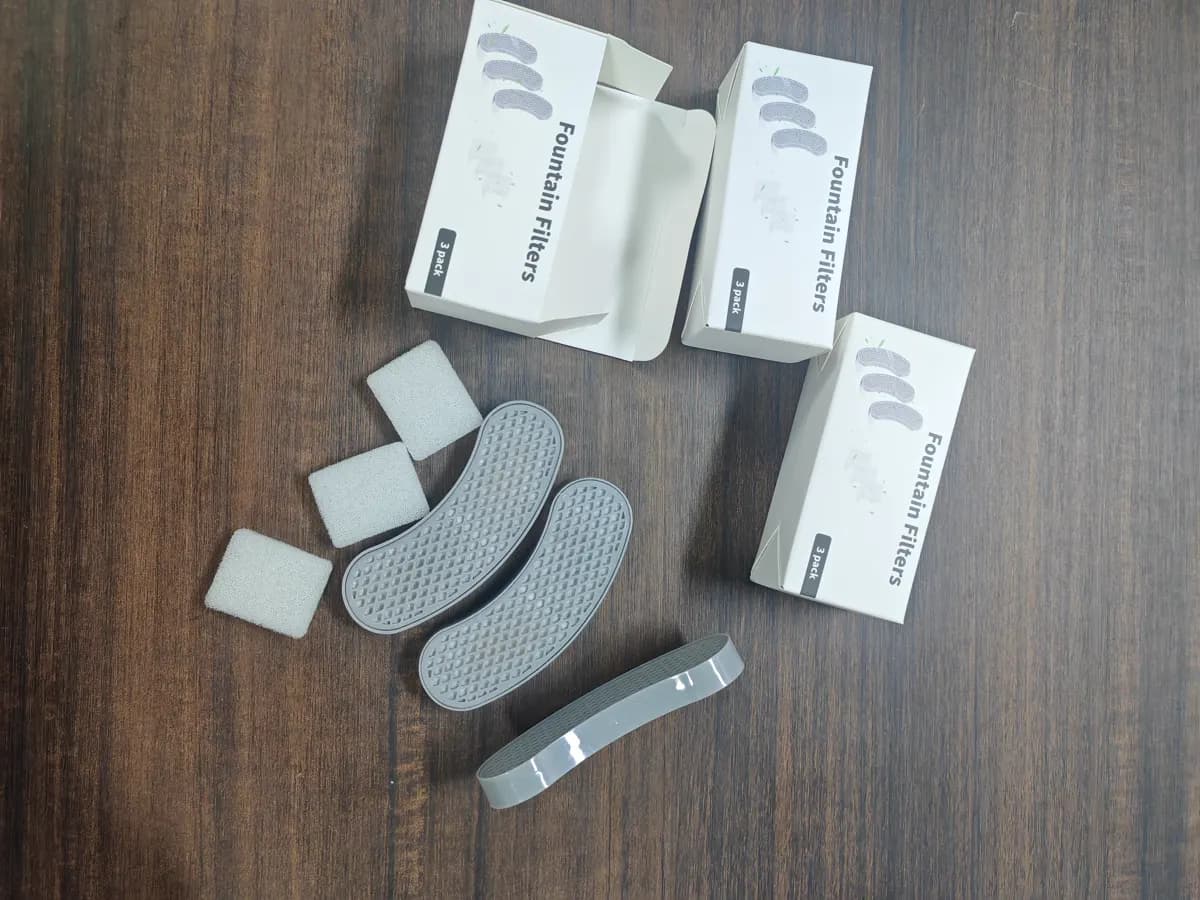
The description should make the filter easier to identify than “the crescent-shaped one from our fountain.” Confirm the fountain models or verified family, current revision and any orientation instruction before the customer-facing pack is finalized. The opening illustration uses conceptual packaging; the photograph below shows actual filter and packaging samples. Neither image replaces the approved packing list.
Choose the Replacement Box Quantity
Current Fountelio crescent-filter boxes contain 3 or 6 cartridges. Rectangular-filter boxes contain 3, 4 or 5 cartridges. Choose the available format around your sales channel, target price, stock plan and the cartridge that belongs to the fountain.
Confirm the MOQ, packaging requirements and availability for the selected format. Do not assume that all box quantities share the same ordering conditions, or that filter-pack MOQ is the same as fountain or printed-packaging MOQ.
The Spare Pump Needs Its Own Identity
“Send the same pump as last time” is not a durable service instruction. Where pump support applies, the record may need the fountain model, pump reference, physical fit, connector and cable arrangement, power requirement, inlet or interface, flow compatibility and current revision.
That record does not mean the pump is automatically a consumer-replaceable accessory. Some designs allow straightforward service; others involve components or sealed electronics that should remain within the supplier's documented service boundary. Confirm who replaces the part and what instructions support the process.
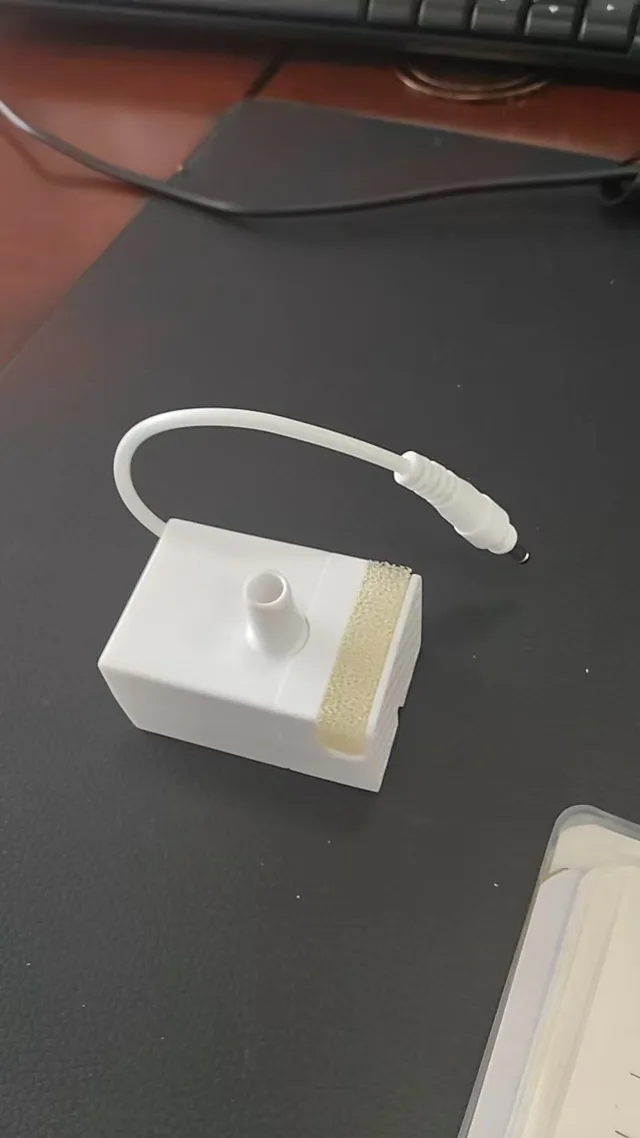
From our side of the table, the pump reference becomes useful when it can be traced back to the exact approved configuration. Product appearance is supporting evidence, not the identity system.
Replacement Pump Planning Is Not Pump Troubleshooting
Noise, weak flow or no flow does not automatically mean a pump should be replaced. Water level, operating mode, assembly, filter loading, the water path, debris or scale may be involved. Our pump troubleshooting guide covers that diagnostic sequence.
This article begins after replacement has been judged appropriate: which pump belongs to the product, is the part compatible with the customer's version, and how should the brand supply or service it? Keeping those questions separate avoids turning every support ticket into an unnecessary replacement.
Corded, Cordless and Wireless-Pump Platforms Need Different Service-Part Thinking
Power and pump architecture change the relationships that must be recorded. A conventional powered fountain may center on its pump, cable or connector, filter and outlet. A rechargeable sensor product adds charging and electronic-version relationships. A wireless-pump design links the pump module with the reservoir and the appropriate base or power platform.
| Platform | What may need mapping | Why |
|---|---|---|
| Standard powered | Pump, cable/connector, filter and outlet | Conventional powered architecture |
| Rechargeable sensor | Pump, filter, charging parts and electronic-platform relationship where relevant | Additional power, sensing and control configuration |
| Wireless pump | Pump module, filter, reservoir/base relationship and power-base version | Architecture differs from a conventional wired pump |
This mapping concerns support and identification. It does not imply that batteries, charging electronics or every other internal component are user-replaceable. For the architecture distinction, see wireless pump vs cordless.
Model Mapping Is More Important Than the Product Photo
A practical service record connects the fountain model to its filter, pump, accessory list and current packaging or manual revision. It can be maintained in a product information system, controlled spreadsheet or another format that both sides actually use; the tool matters less than one current source of truth.
We often see requests built around an old product image. Before confirming a reorder, we prefer to check the model and configuration because a familiar housing does not prove that every internal or accessory reference is unchanged.
What Happens When a Component Changes?
A supplier may revise a pump, filter geometry, connector, outlet, accessory pack or electronic base. The change itself does not tell the buyer whether earlier products remain supported. The buyer and manufacturer should determine which product version uses the new component, whether compatibility is retained and when transition stock changes.
The same review should cover customer-facing information. If a manual, replacement pack or support page names the earlier item, decide whether that reference still works or must be updated. Keep an effective date or production reference so support teams can distinguish the versions.
Backward Compatibility Should Be Confirmed, Not Assumed
A revised part may be fully backward-compatible, compatible with only some revisions, physically similar but functionally incompatible, or usable only with another related component. “Looks the same” is not a compatibility standard.
Ask for a clear decision against the affected fountain versions. When physical fit is only one part of the relationship—as with connectors, bases or pump architecture—verification should include the relevant functional checks as well. Do not present a revised item as universal until that scope is confirmed.
Plan Spare Parts Before Final Packaging Artwork
Packaging and manuals may name a replacement filter, show an installation direction, mention an accessory or point customers to a support route. If those references are printed before the service-part relationship is stable, later changes can leave the product, box and support information out of sync.
Identify the service relationship first, then finish the customer-facing reference. This is one reason the private-label sample brief should include filters and relevant accessories before final artwork approval.
After-Sales SKU Strategy: Simple or Granular?
A simpler SKU system is easier for inventory and retail teams. A more model-specific system can give support teams clearer compatibility. The right balance is the smallest number of replacement items that still describes the verified product relationships accurately.
| Strategy | Advantage | Trade-off |
|---|---|---|
| One filter SKU across verified compatible models | Simpler inventory | Requires documented cross-model compatibility |
| Model-specific filters | Precise fit and support | More SKUs to manage |
| Starter filters in the fountain box | More opening supply | Higher main-pack complexity |
| Separate replacement-filter pack | Clear recurring product | Separate inventory and packaging |
| Spare pumps held centrally for support | Controlled service route | Needs version and inventory management |
| Consumer-facing pump SKU where genuinely supported | Direct replacement route | Requires clear serviceability and instructions |
Never consolidate filters across models only because their shapes are similar. Official brands demonstrate both dedicated and verified-family filter strategies; compatibility, not visual resemblance, determines whether one SKU is defensible.
How Many After-Sales SKUs Does Your Range Actually Need?
Count the unique, verified relationships: filter families, pump families, supported accessories and power or base configurations. Then ask whether two models truly share a part, whether an accessory differs only cosmetically, whether a base belongs to a specific electronics version and whether the replacement pack needs a separate retail SKU.
Do not convert fountain count into a fixed spare-parts formula. Five fountains do not automatically require five filter SKUs or a published percentage of spare pumps. Use the product architecture and confirmed compatibility to remove unnecessary complexity without merging items that support teams need to distinguish.
Reorder Planning: Do Not Wait for Stock to Run Out
Filters, pumps and packaging can move on different demand and supply cycles. Confirm lead time for the specific part and project, and check whether the replacement-pack MOQ differs from the fountain or its printed packaging. Decide who holds inventory and how a reorder is approved.
A forecast can use the exact model's replacement guidance, projected fountain sales, launch horizon, pack count and confirmed reorder lead time. It should not rely on a universal “filters per fountain” or “spare pumps as a percentage” rule. For repeat orders, we prefer to reconfirm the current model and replacement references before treating an earlier photograph or order description as sufficient.
What Should Be in the Launch File?
The launch file is the bridge between sourcing, artwork, inventory and support. It does not need confidential engineering detail, but it should let the responsible teams identify the approved program.
| Record | What it should contain |
|---|---|
| Fountain specification | Exact model, platform and approved configuration |
| Filter reference | Confirmed compatible replacement item and model list |
| Pump reference | Exact compatible service or replacement pump where applicable |
| Accessory list | Items included and items supported separately |
| Pack-out | What ships with the main fountain |
| Replacement pack | Quantity, packaging and reference if offered |
| Manual | Current service and replacement guidance |
| Artwork | Current product and service-part references |
| Revision record | Current approved configuration and changes |
| Reorder process | How supply is requested and confirmed |
What Should Buyers Check on the Sample?
Use the sample to validate the after-sales relationships that can be checked physically. Confirm that the filter can be identified, its fit and orientation are understood, the pump or service component is traceable, the included accessory list is accurate and the manual matches the product.
Then compare the planned replacement references with the approved sample version. This is narrower than a full private-label sample review: the goal here is to ensure that future support items point back to the product actually being launched.
Common After-Sales Planning Mistakes
- Launching before identifying the replacement filter.
- Assuming similar filter shapes are interchangeable.
- Recording the fountain name without a filter or pump reference.
- Printing replacement information before compatibility is confirmed.
- Treating replacement frequency and pack quantity as the same decision.
- Assuming a pump is consumer-installable without checking the service design.
- Changing a component without reviewing support for earlier versions.
How Fountelio Approaches Filter and Service-Part Planning
At Fountelio, we prefer to identify the filter and other relevant components while the product configuration is being finalized. That helps keep the fountain, approved sample, manual, packaging and future replacement discussions tied to the same model.
Our current filter specification identifies the 6-Layer Integrated Filter Cartridge and its 4 Filtration Functions, with crescent and rectangular formats mapped to different platforms. We keep the chosen filter format, box quantity and replacement reference alongside the approved fountain configuration. That does not mean standard powered, rechargeable sensor and wireless-pump products share pumps, bases or other service parts.
This is a planning approach, not a promise that every component is sold separately or held permanently in stock. Buyers should confirm availability, MOQ, lead time, serviceability and compatibility for the selected project before launch.
Frequently Asked Questions
Are cat water fountain filters universal?
No. Some verified filter families may fit several named models, while others are model-specific. Check the reference, dimensions, holder, orientation and confirmed compatibility rather than appearance alone.
Should a private-label fountain include spare filters?
It depends on the launch strategy. The main pack may include the initial filter or additional starter filters; a separate replacement pack is another option.
How many filters should be in a replacement pack?
There is no universal count. Consider model-specific replacement guidance, price position, packaging, sales channel, starter supply and the intended reorder cycle.
Can the same replacement pump fit several fountain models?
Only when compatibility is verified for those configurations. Similar appearance or connector shape alone is not enough.
Should a spare pump be sold directly to consumers?
That depends on whether the product is designed and documented for consumer replacement. Some pumps may instead be managed through a controlled support route.
When should replacement filters and pumps be planned?
Preferably before final manual and packaging approval, so service references remain tied to the approved fountain configuration at launch.
Sources & References
- Catit — Mini Fountain Filters: official example of a replacement filter developed for the Mini Flower Fountain.
- Catit — Triple Action Fountain Filters: official example of a named filter family mapped to several full-size Flower Fountain models and offered in different pack counts.
- PetSafe — Pagoda Pet Fountain Support: official product support mapping named carbon filters, foam filters and a replacement pump to defined models.
- Fountelio — Quality Control: model-specific checks for pump, filter, accessory, platform and pack-out fit.
- Fountelio — Wireless Pump Fountain Platform: pump/base architecture information. The current cartridge construction and format specification is set out in this guide.
External brand references illustrate market approaches to compatibility and replacement products. Their specifications, pack counts and maintenance guidance do not describe Fountelio products.
About This Guide
Written by Lance, Director at Fountelio. Fountelio manufactures and private-labels cat water fountains and therefore has a commercial interest in fountain, filter and accessory programs. First-party filter construction, approximate dimensions, platform mapping and box options are based on current Fountelio factory product documentation. The in-body comparison and packaging photographs and handling/batch clips are real Fountelio materials. Other service-part availability remains subject to the selected model and project.
The opening image and explanatory visuals are illustrations, including the six-layer exploded view; they are distinct from the real product photographs and factory footage. Diagrams simplify service-part relationships; conceptual packaging is not a live retail SKU, and no visual establishes compatibility without product documentation.