

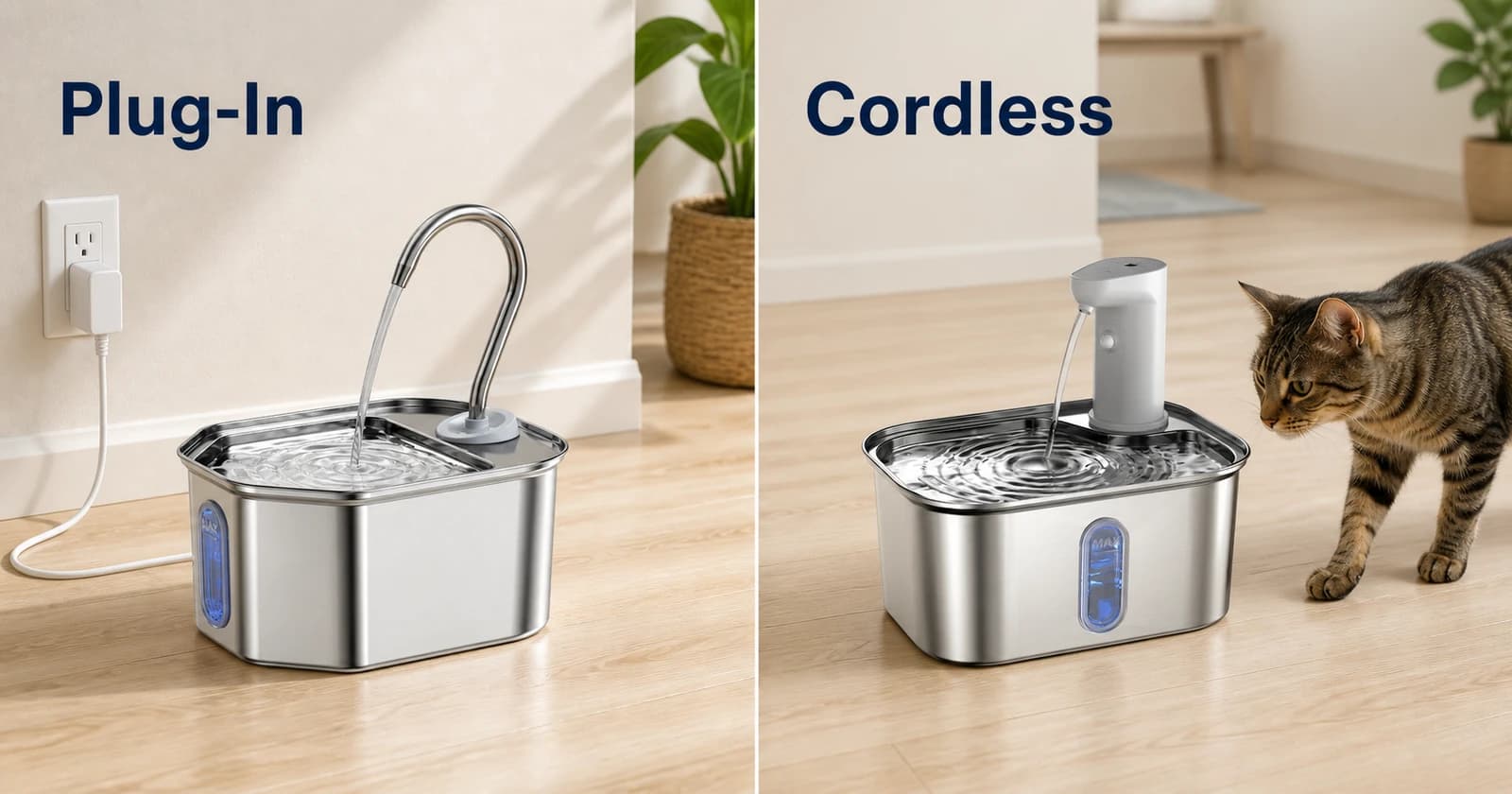
Two fountains can show the same steady stream in a product video, yet behave differently once you remove the cable. One may keep flowing. Another may wait for movement before starting its pump. The missing cable is easy to see; the change in operating mode is much easier to miss.
For the cordless vs plug-in cat water fountain decision, start with the flow you want and the location you can maintain. Plug-in power usually suits continuous operation without charging. Cordless operation offers more placement freedom, but available battery modes and recharge requirements need checking. Cordless does not automatically mean nonstop flow.
I would ask to see a rechargeable sample operating both connected and disconnected before comparing battery numbers. The useful specification says which mode is active, how often the pump runs and what changes when power is removed. Our guide to how to choose a cat water fountain puts those checks alongside the broader buying decision.
Is a Cordless Cat Water Fountain Better Than a Plug-In Fountain?
Neither is universally better. Plug-in fountains remove battery charging from daily ownership and commonly support steady flow. Cordless fountains can work away from an outlet, often using sensor or timed operation to conserve energy. Choose the behavior that fits the water station, then verify it on the exact model.
- Choose plug-in for a permanent station near a suitable outlet and continuous flow without recharge management.
- Choose cordless when cable routing prevents a useful placement and the supported battery modes suit your routine.
- If the mode table or charging behavior is unclear, resolve that before buying.
How Do Cordless and Plug-In Cat Water Fountains Compare at a Glance?
The main trade-off is outlet dependence versus battery management. Flow, cleaning and noise still depend on the design. This comparison covers an ordinary plug-in fountain and a rechargeable model during cordless use.
| Factor | Plug-in | Cordless / rechargeable |
|---|---|---|
| Power during use | External supply | Stored battery energy |
| Outlet dependence | Yes | Not during battery use |
| Continuous flow | Common | Exact model and mode dependent |
| Sensor / timed flow | Available on some designs | Common battery-saving approaches |
| Charging | No battery to charge | Required |
| Placement / cable | Suitable outlet and cable route needed | More flexible until recharge is needed |
| Noise / cleaning | Flow and construction dependent | Flow and construction dependent |
| Operating checks | Supply, pump, filter, water | Also battery and any sensor controls |
| Cost | Often simpler power hardware | Battery and charging hardware added |
Cordless changes where the fountain can operate; it does not automatically determine how the water flows.
What Do Plug-In, Cordless, Battery-Operated, and Wireless Actually Mean?
Plug-in describes dependence on external power during normal use. Cordless describes operation without staying connected to an outlet, usually from an onboard rechargeable battery. Battery-operated identifies the energy source; rechargeable means that battery can be charged again. Wireless is ambiguous and may refer to the fountain, its pump connection or another feature.
These labels can overlap. A rechargeable cat water fountain may also run plugged in, while a USB-powered fountain may contain no battery at all. A USB-C socket tells you the connector shape, not whether the product stores energy.
Ask how the complete unit and the pump are powered. Battery location matters too: a battery in a base affects which part goes to the charging point and which part must stay dry.
Is a Cordless Fountain the Same as a Wireless-Pump Fountain?
No. Cordless refers to the fountain's ability to operate without an external supply. Wireless pump refers to the pump's power-transfer arrangement. A fountain can have a wireless pump while the complete unit still needs an outlet.
For example, PETLIBRO's Dockstream Smart Fountain PLWF105 documentation explicitly identifies a wireless pump, no internal battery and required plug-in operation. That combination is useful evidence of the distinction, not a shortcoming: removing the pump cable and removing outlet dependence solve different problems.
Where does its energy come from?
External supply or an onboard battery
This determines cordless operation.How does the pump receive power?
A wired connection or a wireless transfer arrangement
This describes the pump interface.These attributes can coexist. A wireless pump does not establish that the fountain contains a battery. Conceptual relationships, not an electrical wiring diagram.
For cleaning, inspect the pump interface. For placement, inspect the power source. Neither answer can be inferred from the other.
Why Should Power Type and Water-Flow Mode Be Compared Separately?
Power type tells you where energy comes from. Flow mode tells you when the pump runs. Keeping these separate avoids buying a battery fountain for a behavior it supports only while plugged in, or overlooking a plug-in model with timed operation.
| Power state | Continuous | Sensor-triggered | Intermittent / timed |
|---|---|---|---|
| Plugged in | Common | Possible; model dependent | Possible; model dependent |
| On battery | Verify explicit support | Common on rechargeable designs | Available on some designs |
Continuous means sustained pump operation. Sensor mode starts flow after detection. Timed mode starts it on a schedule. Some products combine pet-triggered flow with occasional background cycles, so even those descriptions need the manual's detail.
A mode button alone is not enough. Ask whether it remains selectable after unplugging, and whether the setting changes again after reconnecting. Cordless is not a flow mode.
Does a Cordless Cat Water Fountain Run Continuously?
It depends on the model and power state. Do not assume either that all cordless fountains support continuous battery flow or that none can. Many rechargeable designs restrict continuous operation to external power to reduce battery consumption.
The original Dockstream Cordless PLWF115 support page describes continuous plug-in flow and proximity-triggered battery operation, with periodic background flow. PETLIBRO's Dockstream 2 mode comparison likewise specifies pet-sensing only on battery for the cordless version, with continuous and pet-sensing modes available when connected. Its separate plug-in version offers continuous and timed modes.
Those are named examples, not rules for the category. A stream in an advertisement cannot show which power state produced it.
Should You Choose Continuous Flow or Sensor-Triggered Flow?
Choose continuous flow when steady movement matters and you want no detection delay. Sensor-triggered flow can reduce pump running time, making battery use more practical, but the approach direction, sensing zone and flow duration must suit the location. Neither mode establishes what every cat will prefer.
Watch the approach, not just the stream. Can the fountain detect activity from the side the cat uses? Does flow continue long enough? Passing movement can also trigger it without drinking. Timed flow avoids reliance on each approach, but the pump may be off when the cat arrives.
For Fountelio's cordless plastic and cordless stainless steel ranges, review the selected controls and power-state behavior with the final sample. A shared housing does not establish identical settings.
How Long Does a Cordless Cat Water Fountain Battery Actually Last?
There is no category-wide runtime. Time between charges depends on usable battery energy, pump load, operating mode, flow duration, activation frequency, background cycles, controller consumption and battery condition. A claim in days needs its test conditions before it becomes a useful comparison.
The pump's duty cycle is the share of time it runs. Longer cycles or more triggers increase that share, even with the same battery. Sensors and control electronics can still consume energy while water is stationary. Counting only drinking visits may miss passing movements or scheduled circulation.
What can the battery deliver?
- Capacity and voltage
- Usable charge and battery condition
- Conversion efficiency and cutoff
How much does the fountain use?
- Pump load while running
- Cycle length and activation count
- Scheduled background cycles
- Sensor and controller consumption
A qualitative relationship, not a calculator. Activation count changes pump runtime; it is not a separate quantity to subtract from mAh. More capacity helps only in the context of the complete load.
| Official example | Published conditions | What to preserve |
|---|---|---|
| Dockstream 2 Smart Cordless | Up to 30 days for one pet: 30 daily drinking sessions, 45 seconds each | Named model, usage count and cycle duration |
| Original Dockstream Cordless PLWF115 | Up to 30 days in laboratory testing with one cat and 48 daily flow activations | Different test condition; do not import another model's cycle duration |
These manufacturer claims illustrate reporting conditions; they are not Fountelio test results. I would ask for the actual activation count and enabled background cycles before comparing two advertised runtimes. A longer flow setting changes the load even if the headline capacity stays the same.
Is 5000mAh Automatically Better Than 4000mAh?
No. mAh measures stored charge, not days of operation. Voltage is also needed to compare nominal energy, and usable energy depends on the battery and electronics. With otherwise equivalent conditions, more capacity can help; across different products, a larger number does not establish longer runtime.
Rechargeable batteries also lose usable capacity as they age. The US Department of Energy's battery explanation describes the processes that make repeated charging progressively less effective. A new-battery claim is not a promise for every year of ownership.
How Much Does Charging Time Matter?
Charging time matters because it changes when and where the fountain can be used cordlessly. A unit that operates while charging may still need moving back to an outlet. Plan for the whole charging period, not just the advertised days between charges.
The Dockstream 2 Smart Cordless FAQ gives about 7 to 8 hours when not in use and up to 10 hours during use. The original Dockstream Cordless guidance gives 7 to 8 and 8 to 9 hours respectively. Keep the numbers with their model.
I would include the charging location in a sample review: what must be moved, what remains available for drinking and how completion is indicated? A convenient cordless location can become awkward if every recharge disrupts the only water station.
- ChargeUse the specified supply and dry connections.
- Use on batteryConfirm the active flow mode.
- Check statusDistinguish battery level from water level.
- RechargeKeep another usable water source available.
Charging and fountain operation can overlap only where the model permits. Do not wait for an empty battery as the routine reminder.
Can a Cordless Fountain Be Used While It Is Charging?
Some models permit it, but this is not universal. Verify that operation during charging is allowed, which modes remain available and which base, port or electronic parts require keep-dry handling. Connecting a cable may change the active mode.
The model examples above publish charging times during use, but that does not establish the same permission for another fountain. Use its specified power supply and handling instructions. A charging symbol is not proof that the pump is operating, and visible flow is not proof that the battery has finished charging.
Does Battery Life Change in a Multi-Cat Household?
Often, yes. More triggers or longer combined use increase total pump running time. Both cited PETLIBRO cordless examples warn that multiple pets can shorten runtime. The size of the change depends on activation logic and use, not a fixed fraction per cat.
I would shorten the initial checking interval rather than assume two cats halve battery life. Overlapping visits might share one cycle; movement past the station might start extra cycles. Record how often charging becomes necessary in the intended position, while keeping water and cleaning checks separate.
When Does Cordless Placement Freedom Actually Matter?
It matters when a suitable water location has no convenient outlet, cable routing would obstruct access or the station needs occasional relocation. If the fountain will remain beside an outlet, charging and mode restrictions may outweigh the benefit of removing its cable.
Try the intended floor position and approach route before settling on a sensor setting. An uncluttered corner can still give poor detection if the sensor faces away from the approach. Cordless also does not mean outdoor-rated: the original Dockstream Cordless support page, for example, recommends indoor use.
Is Removing the Power Cord Always an Advantage?
Removing a permanent external cable can simplify placement, but the fountain still contains powered components and needs charging. It exchanges continuous cable management for battery management; it does not become electricity-free or automatically safer in every respect.
Keep charging connections dry as directed and use the model's approved supply. For a permanent station with a manageable cable route, an ordinary plug-in steel fountain can remain a practical choice.
Is a Cordless Cat Water Fountain Easier to Clean?
Not automatically. Cordless identifies the power supply, not access to wet surfaces. A rechargeable fountain may still have a wired pump, narrow channels and a filter holder. Disassembly and separation of washable parts from electronics determine the workload.
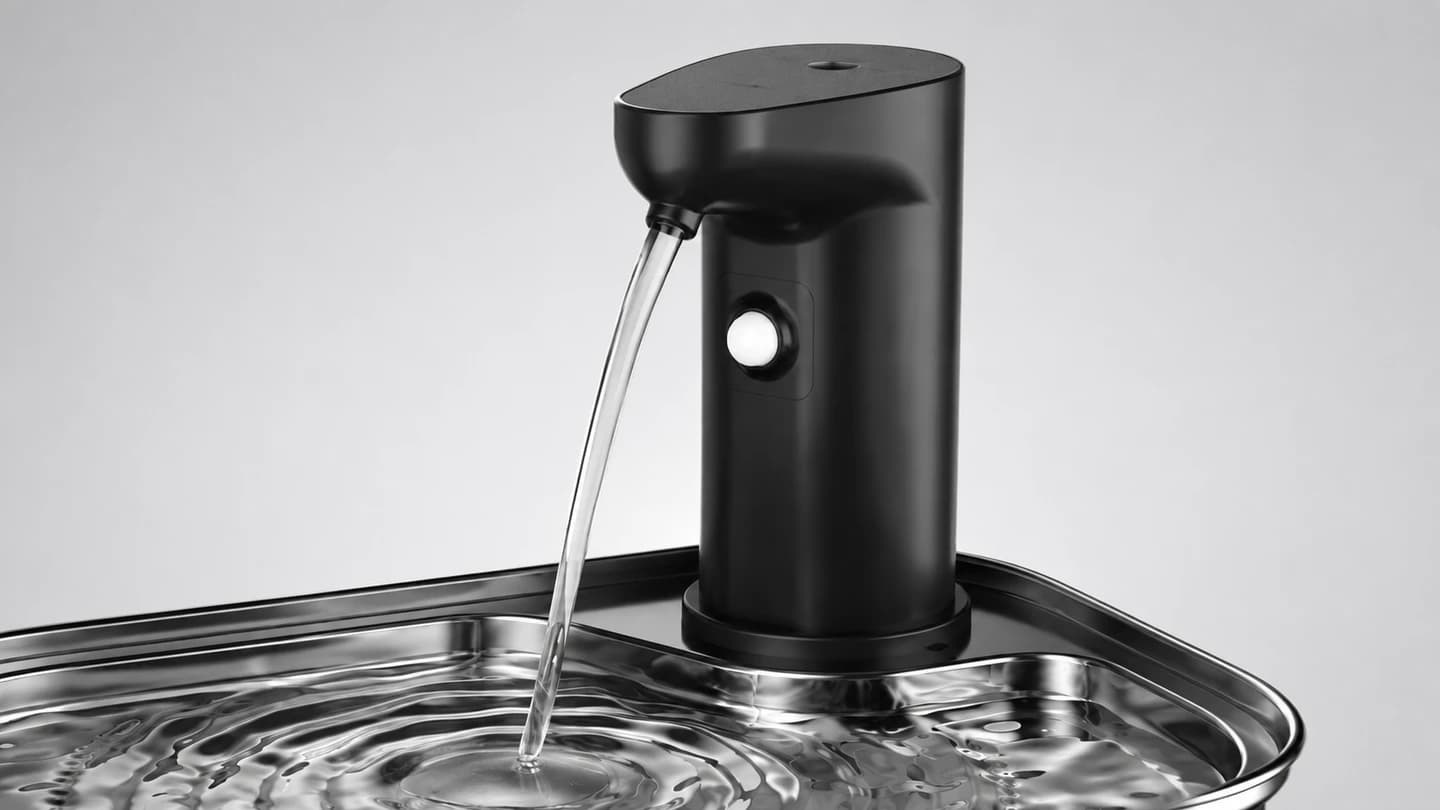
The control assembly adds a handling question: can the wet components come away without bringing the battery or charging port to the sink? The component illustration below shows the exterior, not permission to open or wash it. Follow how to clean a cat water fountain for the broader process, always subject to the exact manual.
Is a Cordless Cat Water Fountain Quieter Than a Plug-In Model?
Not inherently. Sensor or timed operation may remove pump and falling-water sound during inactive periods. During flow, noise still depends on the pump, mounting, housing, outlet and fill level. A battery label does not rank operating sound.
I would separate silent-while-idle from quiet-while-running. Listen to the start, sustained flow and stop at an ordinary water level. A comparison made with one pump off and the other running answers a scheduling question, not which design has quieter operation.
Which Is More Reliable: Cordless or Plug-In?
Plug-in removes charging and battery depletion from normal operation. Cordless reduces outlet dependence but adds battery state and, where used, sensing behavior. The more reliable choice is the one whose interruptions the household can notice and manage.
| Situation | Plug-in without backup battery | Cordless-capable model |
|---|---|---|
| Outlet power fails | Pump stops | May continue if battery and switching behavior allow |
| Battery is depleted | Not applicable | Flow stops or behavior changes as specified |
| Approach not detected | Relevant only to sensor modes | May miss a requested flow cycle |
| Pump blocked / filter restrictive | Can reduce or stop flow | Can reduce or stop flow |
| Incorrect reassembly / low water | Can interrupt operation | Can interrupt operation |
Failure visibility matters. Does a light mean low water, low battery or charging? No flow can be normal between cycles, so it is a less obvious warning on an intermittent fountain. Learn the model's indicators and verify that a request for water actually starts flow.
Before relying on battery backup, confirm how the model switches after an outage. A charged battery is necessary but does not prove automatic switching or preservation of continuous mode. Water below a covered tank lid may also be unreachable when the pump stops.
Should You Keep a Backup Water Bowl With a Cordless Fountain?
A separate, maintained bowl can be useful while charging, cleaning or dealing with a stopped fountain. Its value is continued access to water, not the particular combination of two products.
Keep it clean and reachable even when rarely used. The fountain versus bowl guide explains choice and redundancy in more detail. Battery runtime never replaces checking the household's water supply.
Which Costs More: Cordless or Plug-In Cat Water Fountains?
Cordless adds a battery and charging circuitry, often with sensors, so equivalent designs can cost more. Retail prices do not follow power type alone: materials, capacity, controls and pump design also matter. Compare the complete package and its service requirements.
Include adapter availability, replacement filters and battery serviceability. The original PLWF115 guidance, for instance, describes a battery built into the base rather than a user-removable cell. Ask whether repair means a battery, a base or a replacement fountain; do not assume all rechargeable models have the same service route.
When Should You Choose Cordless, and When Should You Choose Plug-In?
Choose around the station and the required flow, then verify the exact model's operation. These are starting points, not a winner score.
| Your priority | Better starting point |
|---|---|
| Steady flow, no recharge routine | Plug-in with continuous mode |
| Permanent station by a suitable outlet | Plug-in |
| Useful location away from an outlet | Cordless with acceptable battery modes |
| Reduced sound during inactive periods | Sensor or timed mode, on either supported power type |
| Occasional relocation | Cordless, with a workable charging plan |
| Outage resilience | Verified battery switchover plus accessible backup water |
| Multiple pets | Evaluate triggers, water access and checking frequency |
What Mistakes Should You Avoid When Comparing Cordless and Plug-In Fountains?
Avoid comparing labels while leaving the operating conditions undefined. The most consequential mistakes are:
- Assuming cordless means continuous battery flow.
- Treating wireless pump as proof of a battery.
- Comparing mAh or days without the load and test conditions.
- Ignoring charging duration and permitted operation during charging.
- Assuming a sensor suits every approach or every cat.
- Confusing idle silence with quiet pump operation.
- Equating cordless with easier cleaning.
- Buying placement freedom without a useful place to use it.
What Should Brands and Sourcing Teams Ask About Cordless Fountain Power Systems?
Ask for a specification that joins the battery, modes, test conditions and service behavior. A useful runtime claim describes how the result was obtained as well as the maximum days.
- What are the battery capacity, voltage and chemistry?
- Which mode produced the runtime result?
- How many daily activations and background cycles were included?
- How long does each flow cycle last?
- Does continuous flow work unplugged?
- Which modes work on external power?
- How long does a full charge take?
- Is operation during charging allowed?
- What happens at low battery and after power returns?
- What sensor type, range, angle and retrigger logic apply?
- Which parts are serviceable and available as replacements?
- Which battery, transport and market-compliance documents cover this exact configuration?
I would turn those answers into sample acceptance checks before agreeing the private-label specification. A brochure offering several modes is incomplete if it never says which ones work on battery.
What Are the Most Common Questions About Cordless vs Plug-In Cat Water Fountains?
Does cordless mean wireless?
Sometimes in shopping language. Technically, a wireless pump and battery operation describe different attributes.
Can a cordless fountain run continuously?
Only if that model supports continuous flow in battery mode. A plug-in demonstration does not prove it.
Does a larger mAh number mean more days?
Not across different loads, voltages and operating modes.
Can it run while charging?
Check the exact model. Permitted modes and charging time may change during use.
Is cordless safer?
It reduces permanent cable routing but retains batteries, electronics and charging requirements.
Is sensor flow better for cats?
Not universally. Observe acceptance and response in the intended location.
Does cordless mean easier cleaning?
No. Wet-part access and electronics separation determine cleaning difficulty.
What Should Decide Between a Cordless and Plug-In Cat Water Fountain?
Choose the operating behavior, not the power label. Know what flows on battery, what changes at the outlet and who will handle recharging. If those answers fit the household, cordless offers useful freedom. If steady flow beside an outlet already fits, plug-in keeps ownership simpler.
About This Guide
Tony Kong is Fountelio's R&D Engineer, working on product structure, configuration review and sample evaluation. Fountelio manufactures cat water fountains and has a commercial interest in both standard and rechargeable models. His recommendations here concern product operation, not veterinary treatment.
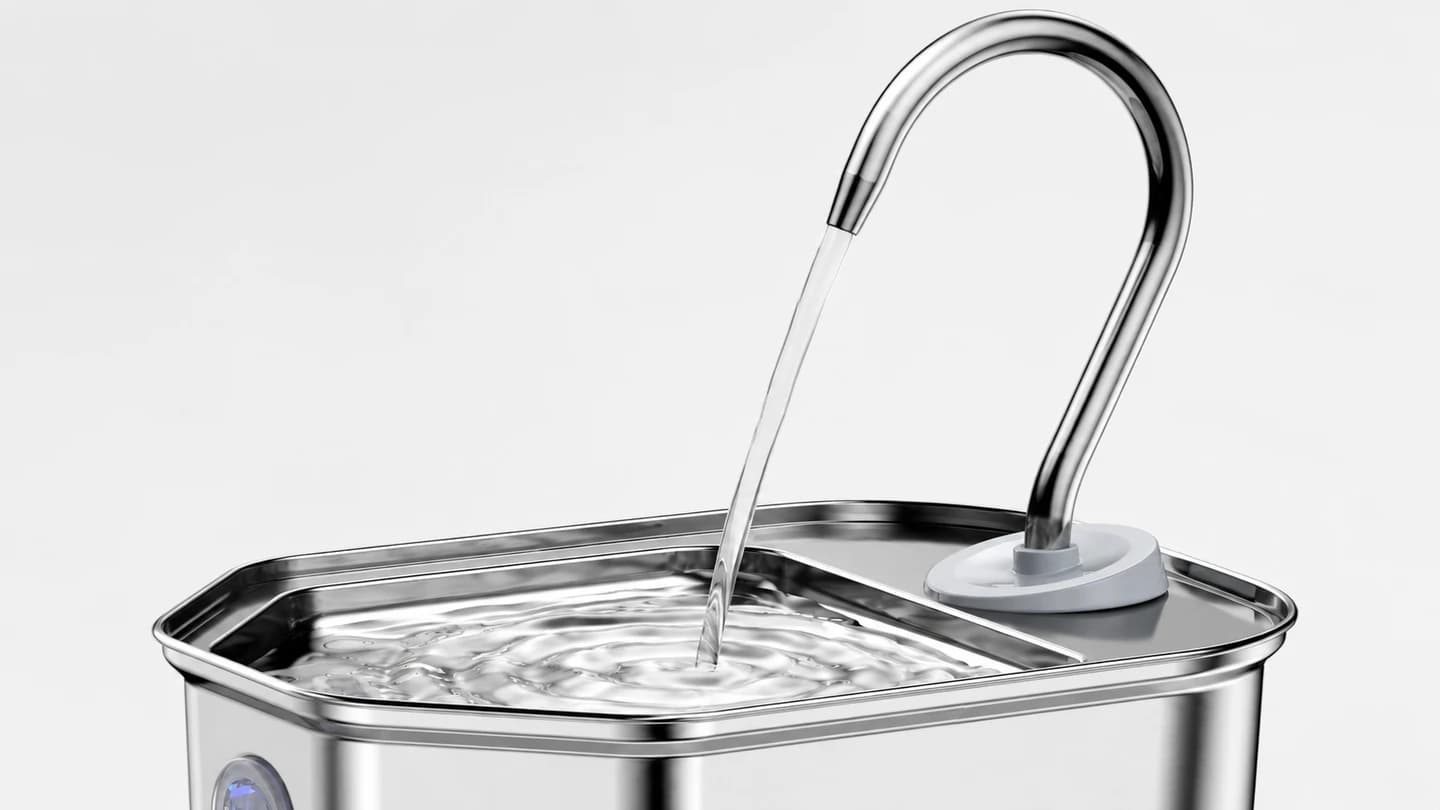
Named product examples come from official manufacturer documentation and explain differences rather than rank brands. The sensor video shows supplied Fountelio footage. The cover and two product close-ups are AI-assisted illustrations based on supplied product assets, not photographs or independent battery, flow or acoustic tests. Diagrams explain relationships rather than exact electrical construction.
Sources & References
- PETLIBRO: Dockstream 2 plug-in and cordless power/mode differences
- PETLIBRO: Dockstream 2 product FAQ, runtime conditions and charging
- PETLIBRO: Original Dockstream Cordless PLWF115 continuous and battery modes
- PETLIBRO: Original PLWF115 runtime, charging and battery service guidance
- PETLIBRO: PLWF105 wireless pump, external power and no battery
- US Department of Energy: How batteries store energy and change with cycling