

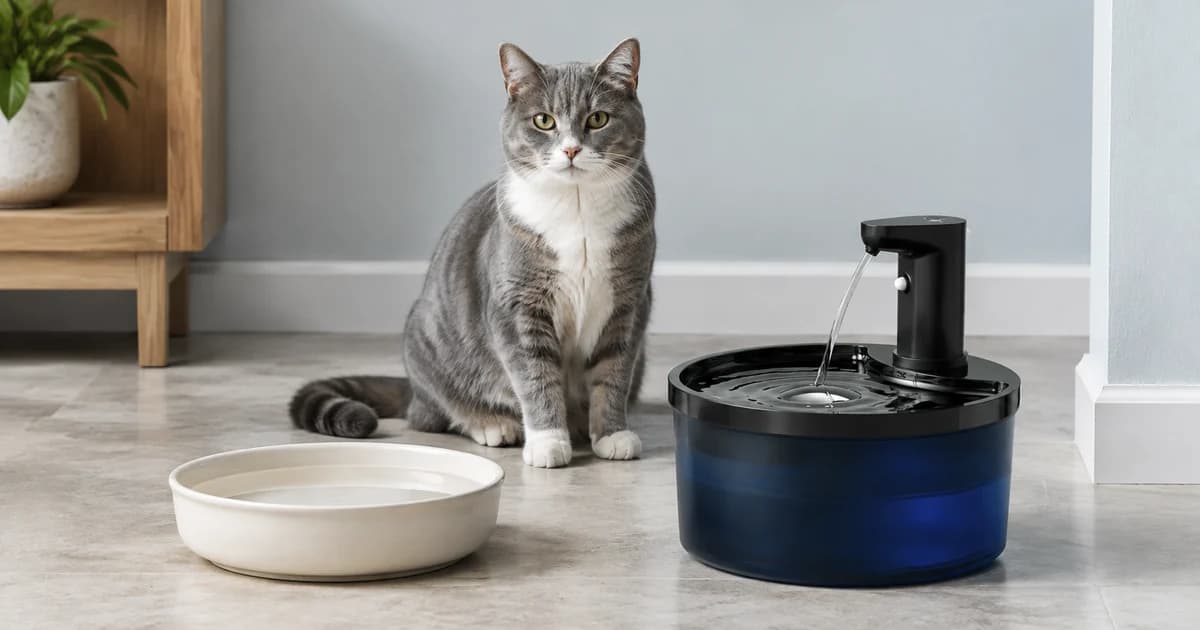
The useful comparison starts after the unboxing. The fountain needs its first proper wash, the familiar bowl is still on the floor, and you are watching which one your cat returns to. A stream and a filter are visible upgrades in hardware. Whether they improve your household's water setup is a different question.
Neither a fountain nor a bowl is universally better. A bowl has fewer parts, no motor noise and no power requirement. A fountain offers moving water and often filtration, which may suit an individual cat, but adds maintenance. The cat water fountain vs bowl decision should start with regular use and reliable access to clean water.
I would compare the cleaning access, outlet, power supply and what happens when flow stops before making a recommendation. Those are product questions I can assess; they cannot predict every cat's drinking behavior. If a fountain fits your routine, our guide to how to choose a cat water fountain covers the next selection step.
Is a Cat Water Fountain Better Than a Water Bowl?
Not for every cat. A fountain offers moving water and additional functions; a bowl offers simpler care and fewer things that can stop working. Research does not establish a consistent drinking benefit from fountains. Choose around the individual cat's acceptance and the household's ability to keep water clean and available.
- A fountain may fit a cat that repeatedly uses moving water, with an owner willing to service it.
- A bowl suits simple cleaning, silence and freedom from power management.
- Both can provide choice and a separate backup water source.
How Do Cat Water Fountains and Water Bowls Compare at a Glance?
The fountain adds functions. The bowl removes complexity. These are typical differences between a powered fountain and an ordinary open bowl; construction and care instructions still vary by model.
| Factor | Fountain | Bowl |
|---|---|---|
| Water presentation | Circulating, flowing or falling; model dependent | Still water |
| Filtration | Often fitted; replacement care required | Usually none |
| Power | Plug-in or rechargeable | None |
| Operating noise | Pump, vibration and water sound possible | No powered operating sound |
| Cleaning workload | Reservoir, tray, water path and serviceable pump | One main vessel |
| Failure points | Power, pump, filter and assembly, plus empty water | Empty, dirty or tipped vessel |
| Level visibility | Window, translucent tank or indicator; varies | Usually directly visible |
| Placement | Cable or charging considerations | No electrical constraint |
| Ownership cost | Usually higher; consumables and service parts | Usually lower |
| Cat preference | Individual | Individual |
Do Cats Actually Drink More Water From a Fountain?
Some individual cats may use one water presentation more than another, but the small controlled studies below do not establish a consistent group-wide increase from fountains. A fountain is an option, not a hydration guarantee. Drinking behavior and measured water intake also need to be distinguished from urinary outcomes.
| Study / population | Comparison | Result and important limit |
|---|---|---|
| Grant, 2010: 13 household cats enrolled | Bowl versus fountain | 12 remained after one withdrawal. Initial intake was higher with the fountain, but urine osmolality did not differ significantly. Excluding a cat whose diet changed removed the significant intake difference. |
| Pachel & Neilson, 2010: nine cats | Still versus flowing water | Mean consumption was numerically higher with flowing water, but not statistically significant. Individual variation was substantial; four 22-hour test periods do not establish a universal preference. |
| Robbins et al., 2019: 16 enrolled, 14 completed | Still, circulating and free-falling systems | No significant overall difference in intake, urine volume or urine specific gravity. Three cats had significant pairwise water-source preferences, including one favoring still over circulating water. |
| Kosmal et al.: review of 32 publications, 1975–2025 | Feline water-intake literature | The review found little support for a general moving-water effect. Only three included studies assessed water source; this is not 32 independent fountain trials. Published online in 2025, in the 2026 volume. |
These results support offering options without promising an intake increase. They are not a reason to remove a water source a cat already uses.
What Does the Research Tell Us—and What Doesn’t It Tell Us?
The evidence shows individual variation and gives little support to a universal fountain effect. It does not prove fountains are useless or that both sources work identically for every cat. A non-significant group result is a limit on the claim we can make, not a prediction for your pet.
Study setting matters. Grant studied cats at home; Robbins used individually housed laboratory cats. The scoping review calls for more work in settings that reflect household use. It also separates water drunk from a vessel from total water intake, which includes food moisture. Watching visits to a fountain cannot settle that broader question.
Use the research to reject guaranteed hydration claims, then use practical observation to choose an acceptable source. These studies do not establish fountains as treatments for dehydration or prevention for kidney or urinary disease.
Why Might One Cat Prefer a Fountain While Another Prefers a Bowl?
A fountain changes more than movement: it changes the drinking surface, outlet height, sound and often location. Individual responses can differ, as the water-source studies show. Observing avoidance or repeated use does not by itself identify which feature caused it.
I would compare the whole outlet and tray, rather than assume the pump defines the experience. A falling stream and water spreading across a shallow surface present different access points and water-impact sounds. Stronger flow is not automatically a better choice.
Keep those variables in mind before rejecting all fountains after one unfamiliar design. Equally, a cat using a bowl comfortably has not demonstrated a need for a powered alternative.
Bowl
Vessel + water
One main wet surface to inspect.Fountain
Reservoir + water path + pump + outlet + power
Often a filter too. Each added component has a care or service role.Conceptual comparison of an ordinary bowl and a typical powered fountain. Symbols are not a specific product's teardown.
Which Is Easier to Clean: a Fountain or a Bowl?
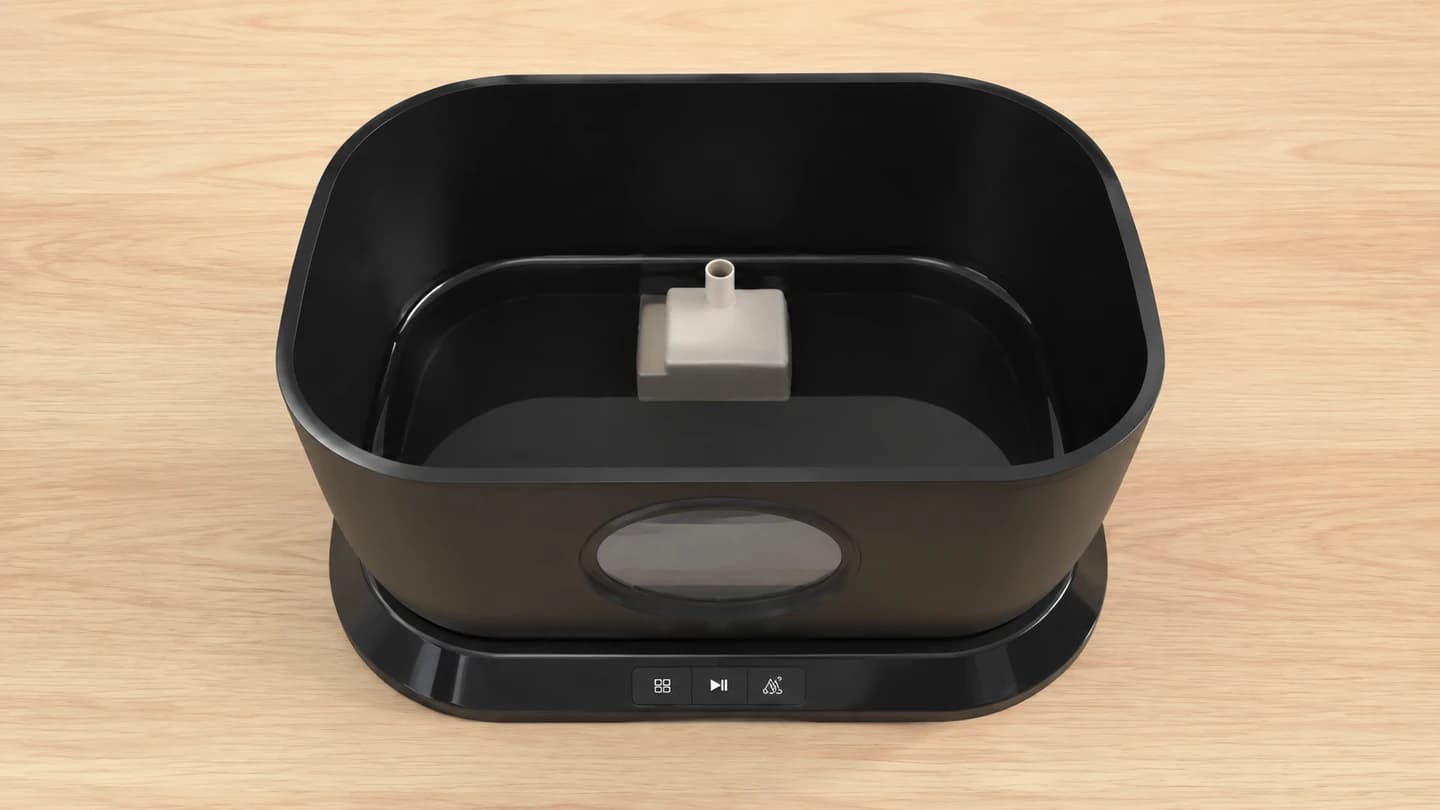
A bowl is usually easier because it has fewer wet parts. A fountain adds a reservoir, tray, connectors, filter holder and pump passages where applicable. Accessible parts can make this manageable, but an attractive top surface tells you little about the work underneath.
Before buying, look at the disassembly instructions. Can you reach the water channel with the permitted cleaning tools? Does the pump open for impeller care? I would rather see the removable parts laid out than rely on an “easy-clean” label.
Use how to clean a cat water fountain for the full process. Follow the exact model's washing rules and keep electronic, charging and non-submersible components dry as directed.
Bowl
- Empty the vessel
- Wash and rinse
- Refill with fresh water
Fountain
- Switch off; separate dry electronics
- Remove permitted wet parts
- Clean reservoir, tray and water path
- Service pump; care for filter separately
- Rinse, reassemble and refill
A workload comparison, not a substitute for either product's instructions.
Does Circulating Water Mean a Fountain Stays Cleaner Than a Bowl?
No. Circulation is not self-cleaning. Moving water passes over wet components; it does not wash them for you. A regularly cleaned bowl and a neglected fountain cannot be ranked hygienically just by whether their water moves.
Look beneath the tray and around the pump intake, not only at the stream. Debris or slippery buildup calls for cleaning under the manual's instructions. Appearance alone does not identify particular microbes or establish a health risk. Refreshing the water also leaves attached deposits behind unless you clean the surfaces.
Material is another separate variable. Our stainless steel versus plastic comparison explains why surface condition and access matter alongside the material name.
Does a Fountain Filter Make the Water Better Than Bowl Water?
A specified filter can serve a useful purpose, but filtration is not a general medical advantage over clean bowl water. Mesh intercepts debris; carbon and ion-exchange media have different treatment roles where fitted. The media specification and its condition matter more than the presence of a cartridge.
Factor replacement into the purchase. A filter does not clean the reservoir or restore a dirty pump, and a clean-looking cartridge is not proof of remaining capacity. Our filter replacement guide compares named-model care requirements and explains why one interval cannot fit every design.
Which Is Quieter: a Cat Water Fountain or a Water Bowl?
An ordinary bowl has no motor or falling-water noise. A fountain can introduce pump hum, housing vibration and water-impact sound. Mounting, fill level, outlet geometry and deposits can change what you hear; material alone is not a reliable noise ranking.
I would listen at a normal fill and again at a lower level within the permitted operating range. Check the surface it sits on too. A new hum or gurgle warrants a level and maintenance check rather than an assumption that the sound is normal. Never run the pump dry to compare noise.
Which Is More Reliable: a Fountain or a Bowl?
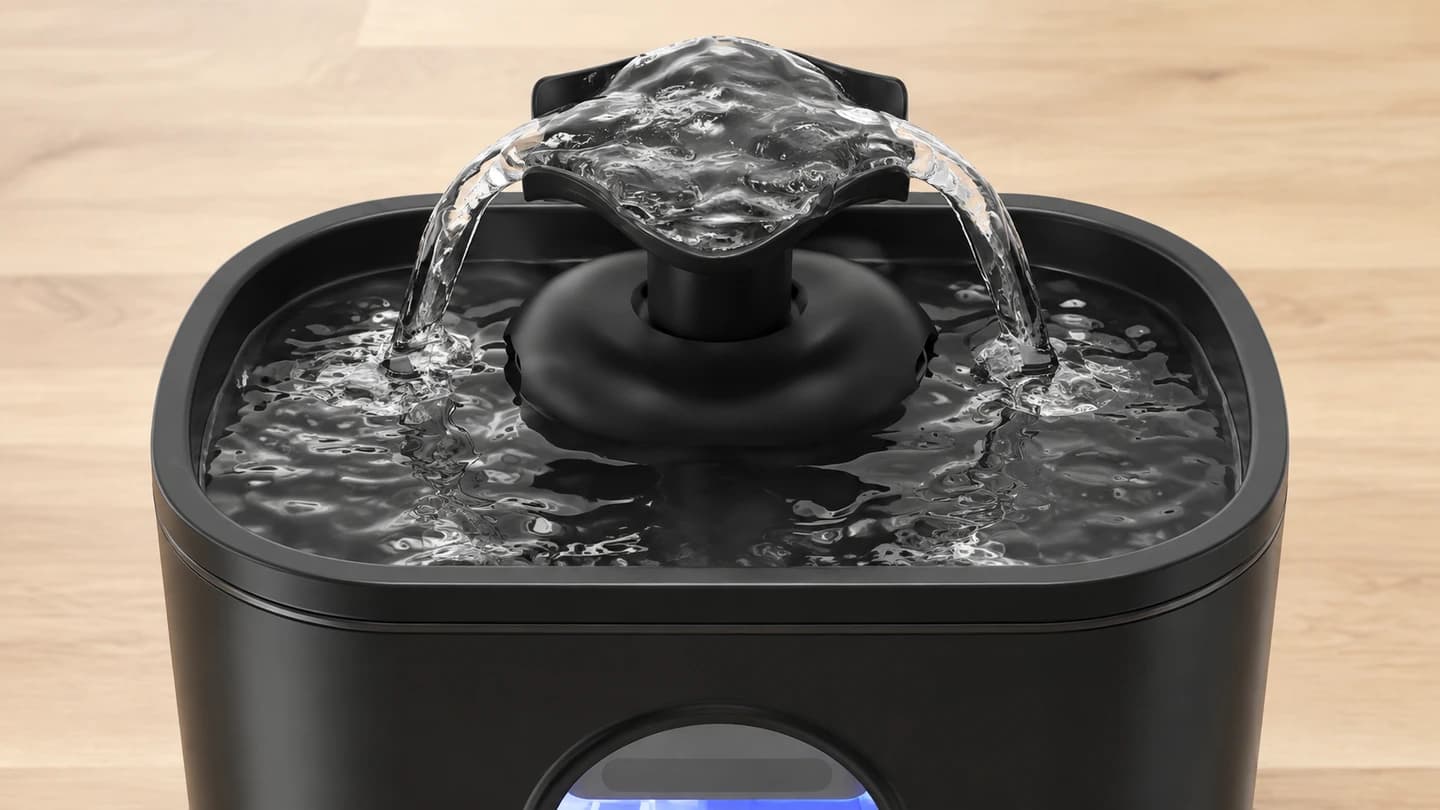
A bowl has fewer components that can fail. A fountain adds useful functions, but power, a pump or a restrictive filter can interrupt delivery. Reliability includes how easily you notice the interruption and whether water remains reachable, not merely how much is stored in the reservoir.
| Issue | Fountain | Bowl |
|---|---|---|
| Power outage / empty battery | Flow may stop; depends on power architecture | No powered function to lose |
| Blocked pump / restricted filter | May interrupt water delivery | Neither component present |
| Empty water | Possible; level may be partly concealed | Possible; usually easy to inspect |
| Spill or tipping | Depends on stability and assembly | Depends on vessel stability |
| Problem visibility | Flow, window or indicator may help | Open surface shows remaining water |
A stopped pump does not always remove all access to water. Some trays retain an accessible pool; others depend more heavily on pumped delivery. Check the exact design with power safely switched off and a separate water source available. Do not count water sealed below a lid as backup drinking water.
My reliability check would ask what an owner sees when delivery stops. A low-water light can be useful, but does it indicate water level, battery charge or something else? Visible flow and an accessible reserve answer different questions. No indicator replaces checking the station.
Does a Fountain Limit Where You Can Put the Water Source?
Sometimes. Plug-in models need a suitable outlet and cable route. Rechargeable fountains loosen that constraint but add charging and battery checks. A bowl needs neither, so it is easier to put an additional water station where access is convenient.
Cordless fountain designs can help where an outlet would otherwise dictate placement. Check operating mode and charging instructions for the model. “Wireless pump” describes pump architecture and does not, by itself, promise operation without mains power.
Where Should You Place a Fountain or Water Bowl?
Choose an accessible, stable location where drinking does not require negotiating a busy route or another cat. The AAFP/ISFM environmental guidelines recommend separate resource locations and separation of food and water. They do not specify one universal distance for every home.
Keep water away from the toileting area and consider the route to it, not just available floor space. An otherwise suitable corner may be awkward if access passes through a contested doorway. Adapt the arrangement to the cats and the home rather than placing every resource together for human convenience.
Should You Use Both a Cat Water Fountain and a Bowl?
Often, both are a practical option. A separate clean bowl offers still water and remains available while the fountain is being cleaned or has no power. This applies the principle of multiple separated resources; veterinary guidance does not specifically require a fountain-and-bowl combination.
Moving-water option
Available while operating and properly maintained.
Still-water option
Remains accessible during fountain cleaning or a power interruption.
One practical arrangement, not a prescribed veterinary combination. Both stations need care.
The two functions are distinct. Choice means the cat can use either presentation. Backup means one source remains usable when the other is unavailable. Two containers that both become empty, or sit behind the same closed door, do not provide that backup.
A second station also adds work. Check and refresh it even when the fountain appears to be the favorite. The arrangement is only useful if the cat can reach it and someone maintains it. Two bowls can provide redundancy too; the mixed pair simply adds another presentation option.
Is a Fountain or Bowl Better for a Multi-Cat Household?
Access to multiple separated stations may matter more than choosing one large vessel. The 2024 AAFP intercat tension guidelines recommend multiple visually separated water stations. A large reservoir adds stored water, but it does not create another route or location from which to drink.
Observe whether one cat waits, turns away or has to pass another to reach water. These observations are reasons to review access, not proof of a diagnosis. Separate rooms or visual barriers may help apply the guidance within the home's layout.
Schematic only, not to scale. Three stations illustrate separation, not a universal number for a given cat count. Keep routes open and adapt to the household.
There is no defensible universal promise that a particular tank volume serves a fixed number of cats. Refill needs, use of other sources and maintenance all vary. Keep enough manageable stations that one shared point does not become the only option.
How Much More Maintenance Does a Fountain Require?
Usually more, because washing the vessel is only part of the job. A fountain can require pump and impeller care, filter replacement and model-approved descaling. The workload depends on access and buildup, so a fixed “minutes per week” estimate would be misleading.
Consider the task you are most likely to postpone. If opening a pump housing is unrealistic for your routine, a simpler bowl may be the more dependable choice. A larger reservoir should not be used to justify leaving old water and wet surfaces unattended.
Which Costs More Over Time: a Fountain or a Bowl?
A fountain usually costs more to own because it adds powered hardware, consumables and possible service parts. An ordinary bowl has fewer ongoing expenses. Whether the difference is worthwhile depends on actual use of the fountain's functions, not simply the number of features.
| Cost | Fountain | Bowl |
|---|---|---|
| Initial purchase | Usually higher | Usually lower |
| Consumables | Filters where specified | No filter cartridge |
| Service parts | Pump; serviceable battery where applicable | Usually replacement vessel only |
| Power | Electricity or charging | None |
| Care | More components; model-specific descaling | Washing; deposits still possible |
Check replacement availability before comparing pack prices. A battery may not be user-replaceable, and a filter pack may exclude a separate foam component. No single two-year total fits all models and markets.
What Are the Main Downsides of a Water Bowl?
Simplicity does not make a bowl maintenance-free. It can collect debris, empty or tip, and offers no moving-water option. It still needs inspection, washing and fresh water.
- No built-in filtration in an ordinary bowl.
- Water level and cleanliness depend on regular attention.
- The vessel's shape and position may not suit an individual cat.
What Are the Main Downsides of a Cat Water Fountain?
A fountain adds cleaning, power management and components that can clog or wear. Its sound or presentation may not be accepted. Fountelio sells fountains, but those trade-offs remain part of an honest comparison.
- Hidden wet areas can be neglected while the tray looks clean.
- Filters and service parts need a supply plan.
- A full tank does not always mean accessible water after a stoppage.
How Can You Tell Whether Your Cat Prefers a Fountain or a Bowl?
Offer both while keeping the familiar water source available, then watch repeated voluntary drinking. This is practical home observation, not a validated clinical test. A first-day sniff, paw tap or playful splash is not enough to establish drinking preference.
- Keep the usual clean bowl accessible.
- Introduce the fountain without forcing contact or withholding other water.
- Allow familiarity and watch use on repeated occasions.
- Note actual drinking at each source, alongside location and time.
- If needed, change one appropriate setting or placement factor at a time.
What Counts as a Real Preference?
Repeated drinking when both options remain available is more useful than novelty interest. It still does not measure hydration. A falling water level can include spills and evaporation; Grant's study specifically addressed these measurement difficulties. Do not interpret every missing milliliter as water swallowed.
A fountain is not a medical treatment. A sudden change in drinking or concern about dehydration calls for veterinary advice, not just a different vessel. Cornell's hydration guidance recommends prompt veterinary contact for suspected dehydration. Urinary signs also need veterinary assessment.
When Is a Fountain the Better Fit, and When Is a Bowl Better?
Start with the priority you need to meet, then confirm the cat uses the arrangement. There is no useful universal winner score.
| Priority | Starting point |
|---|---|
| Simplest cleaning, no motor noise, low cost | Ordinary bowl |
| No dependence on electricity | Bowl |
| Observed preference for moving water | Fountain may be worthwhile |
| Filtration or flow options wanted | Fountain with the relevant specification |
| Larger reserve | Compare actual usable capacity; often a fountain |
| Flexible placement | Bowl or suitable cordless fountain |
| Backup during cleaning or loss of power | Separate maintained sources; both can work |
| Multiple cats | Several accessible, separated stations |
| Cat already uses a bowl reliably | No automatic reason to replace it |
What Should Brands Compare When Choosing Between a Fountain and a Bowl Program?
Compare the support program as well as the retail product. A fountain requires decisions about power, replacement filters and pumps, cleaning instructions and troubleshooting. A bowl program has fewer service components, although material, stability and packaging still need review.
I would settle the accessory supply and manual before approving a fountain launch. Target retail position, packed weight, maintenance expectations and customer-support needs belong in private-label planning. Confirm the proposed configuration through sample review and production planning, without making hydration promises the hardware cannot establish.
What Are the Most Common Questions About Cat Water Fountains vs Bowls?
Do cats prefer fountains or bowls?
Preference varies. Group results do not predict every cat's choice.
Do fountains make cats drink more?
Not consistently across the cats studied. Moving water is not a hydration guarantee.
Is fountain water cleaner?
Not automatically. Filtration and circulation do not replace cleaning wet parts.
Is a bowl more hygienic?
It is simpler to inspect and wash. Cleanliness still depends on water, surface condition and care.
Should I keep a bowl too?
A separate maintained bowl is a practical backup and still-water option.
What happens during a power outage?
It depends on power supply and tray design. Check whether reachable water remains when flow stops.
Which works for multiple cats?
Provide separated access instead of relying only on a larger shared tank.
Is a steel bowl automatically better than a plastic fountain?
No. That changes both material and delivery architecture; assess each separately.
What Should Decide Between a Cat Water Fountain and a Bowl?
Choose what the cat accepts, what you can keep clean and what the household can provide reliably. A bowl reduces complexity; a fountain adds presentation options and service requirements. Separate sources can offer choice and backup without forcing an either-or decision.
About This Guide
Tony Kong is Fountelio's R&D Engineer. His product perspective covers structure, maintenance and service access; feline behavior and water-intake claims are tied to independent published research and veterinary guidance.
Fountelio manufactures cat water fountains and has a commercial interest in this category. Manufacturing experience is not evidence of a universal hydration benefit. The cover is an AI-assisted editorial scene based on a Fountelio product reference, not a preference test. The two reservoir and flow illustrations are AI-assisted reconstructions based on supplied assets. Body diagrams are conceptual; the original assembly video shows a specific product configuration.
Sources & References
- Grant (2010), Effect of water source on intake and urine concentration in healthy cats
- Pachel & Neilson (2010), Comparison of feline water consumption between still and flowing water sources: A pilot study
- Robbins et al. (2019), Quantified water intake in laboratory cats from still, free-falling and circulating water bowls
- Kosmal et al., scoping review of 32 feline water-intake publications (online 2025; Journal of Animal Science, 2026)
- AAFP and ISFM Feline Environmental Needs Guidelines (2013)
- 2024 AAFP intercat tension guidelines: recognition, prevention and management
- Cornell Feline Health Center: Hydration