

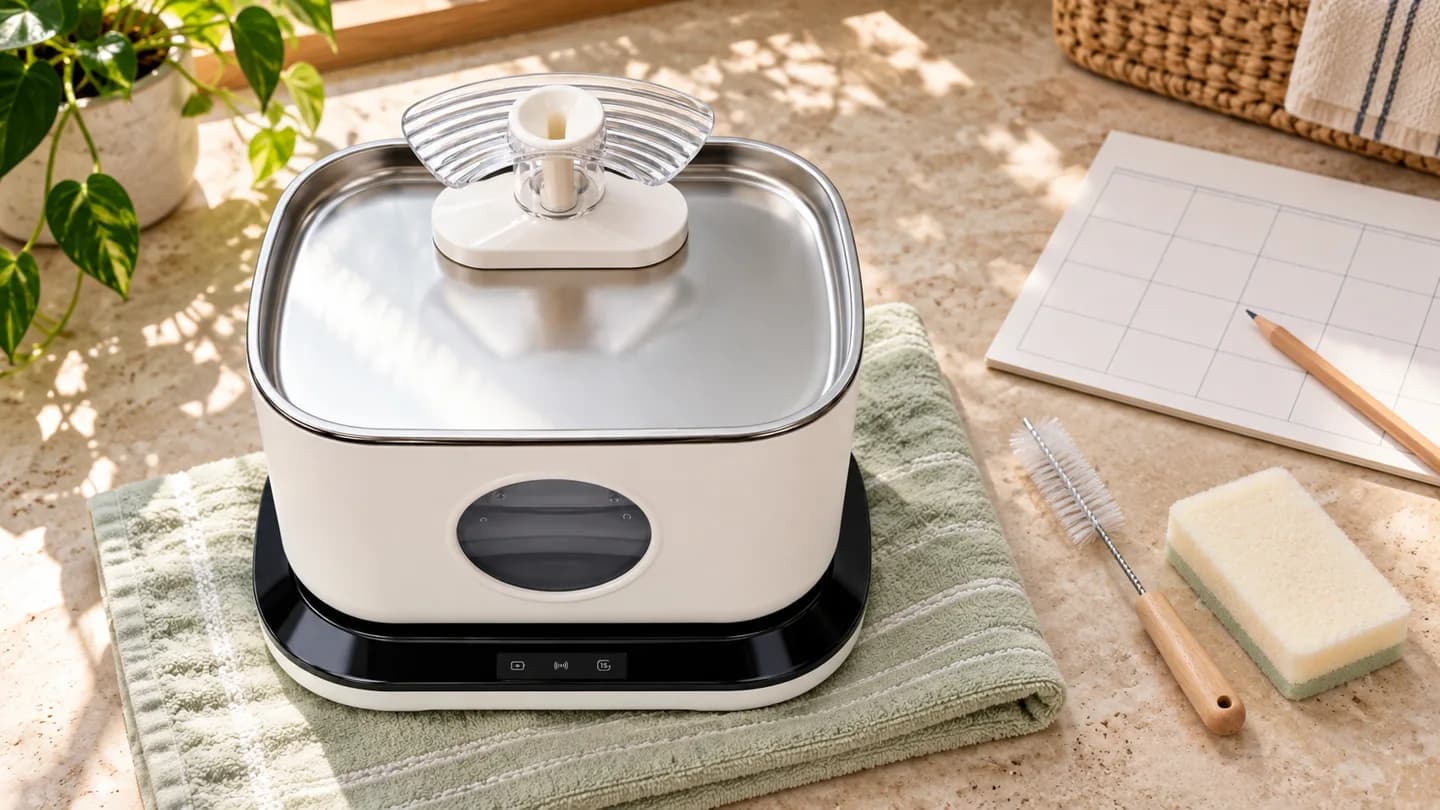
Check your cat water fountain every day, refresh the water and wash accessible drinking surfaces as part of daily care. Follow the exact model’s schedule for the reservoir, hidden passages and pump, and clean sooner when you find debris, slippery residue, odor or changed flow. Filter replacement is a separate job; a new cartridge does not clean the surfaces around it.
To clean the fountain, disconnect power, empty it and remove only the parts intended for owner maintenance. Wash the permitted water-contact surfaces, service accessible pump components as instructed, rinse thoroughly, then reassemble and refill before restoring power. Keep the adapter, battery and dry electrical sections away from the wash.
There is no single interval that suits every part or household. Shared use, shedding, food debris and hard water can bring work forward. I would start with the areas hidden beneath the tray, where a spotless top can conceal a dirty holder or pump intake. Use the maintenance schedule to plan the jobs and the numbered cleaning steps when you are ready to start.
How Often Should You Clean a Cat Water Fountain?
Use a daily care routine alongside the manufacturer’s separate instructions for full cleaning, pump maintenance and filter replacement. Bring a task forward when the fountain needs it. A date on the calendar is a reminder, not permission to leave dirty water or a slimy surface until the weekend.
The CDC’s pet-supply cleaning guidance recommends washing water bowls every day and following an item’s own cleaning instructions. For a fountain, daily washing of the accessible drinking surface is a useful starting point. That general bowl advice does not mean every electrical fountain needs a complete pump teardown each day.
| Task | When to plan it | What to do or look for |
|---|---|---|
| Water refresh | Check daily; a daily fresh-water refill is a practical routine | Discard used water rather than only topping up. Refill to the model’s specified level; change it immediately if debris, cloudiness or odor appears. |
| Drinking tray / accessible bowl | Daily washing as a hygiene baseline | Unplug before handling; wash permitted water-contact parts and rinse. Include the rim and underside where accessible. |
| Reservoir and hidden water path | At the model’s scheduled full clean; inspect when emptying | Clean sooner for slippery film, trapped food, odor or visible deposits. Include the holder, outlet and corners, not only the flat tank walls. |
| Pump and permitted internal parts | Use the exact pump / fountain instructions | Published examples differ: Catit specifies every two weeks for the model cited below; PetSafe’s pump guide says at least monthly, potentially every two weeks with multiple pets. |
| Filter and filter holder | Inspect during routine cleaning; replace to the filter’s own instructions | Remove trapped debris as permitted. Clean the holder separately. A rinse does not renew spent filter media. |
| Mineral deposits | Check during cleaning; descale when deposits appear | Use the approved method for that component. Hard water may shorten the interval; there is no universal descaling date. |
The pump examples come from the Catit Stainless Steel Drinking Fountain cleaning guide and PetSafe’s pump-cleaning instructions. They show why “clean the fountain” needs a part name and a model attached to it. Neither schedule establishes a rule for all Fountelio models.
Refresh, wash accessible drinking parts and inspect.
Open the permitted pump parts, holder and outlet.
Investigate now, even when the next clean is not due.
How often should you change the water?
Make a fresh-water refill part of your daily check rather than waiting for the tank to run low. This is a practical care recommendation, not a claim that all water becomes unsafe at a fixed number of hours. Emptying also gives you a chance to see the reservoir floor. If the water is cloudy, smells unusual or contains food, replace it and clean the affected parts immediately.
Adding water to maintain the minimum operating level can still be necessary between changes. It does not remove old water or deposits. A larger tank gives more reserve, but it does not extend the cleaning interval automatically.
What should make you clean sooner?
Shared use, shed hair, food carried to the tray and rapid scale accumulation can all increase the work. Watch the actual result: a filter seat covered in hair, a film you can feel, or flow that has changed under the same mode and water level. Do not diagnose mold by color alone. If slime returns soon after cleaning, inspect the places covered by the tray and pump cover; our guide to recurring slime and mold-like residue explains that search in more detail.
For a new fountain, note when and where buildup first appears over several cleaning cycles. If it returns before the scheduled clean, shorten that task’s interval and review your method. Do not lengthen a manufacturer’s stated interval simply because the water still looks clear.
What Parts of a Cat Water Fountain Need Cleaning?
Clean every accessible surface that holds or carries water, including concealed areas beneath the tray. Depending on the design, this includes the reservoir, filter holder, connector, water channel, pump intake, impeller chamber and outlet. A filter does not clean the surfaces around it.
- Drinking surfaceRim, tray and underside
- ReservoirWalls, floor and viewing area
- Water channel / connectorInside passages and removable joints
- Filter areaHolder and cover; handle filter separately
- Pump intakeScreen and reachable mounting points
- Impeller chamberOnly owner-serviceable parts
- Outlet / return pathSpout and return openings
If water passes through it, ask how it is cleaned.
This is an inspection order, not a universal water-flow diagram. Models may combine, omit or rearrange these areas. For a sealed passage, ask the manufacturer for the approved cleaning method rather than prying it open.
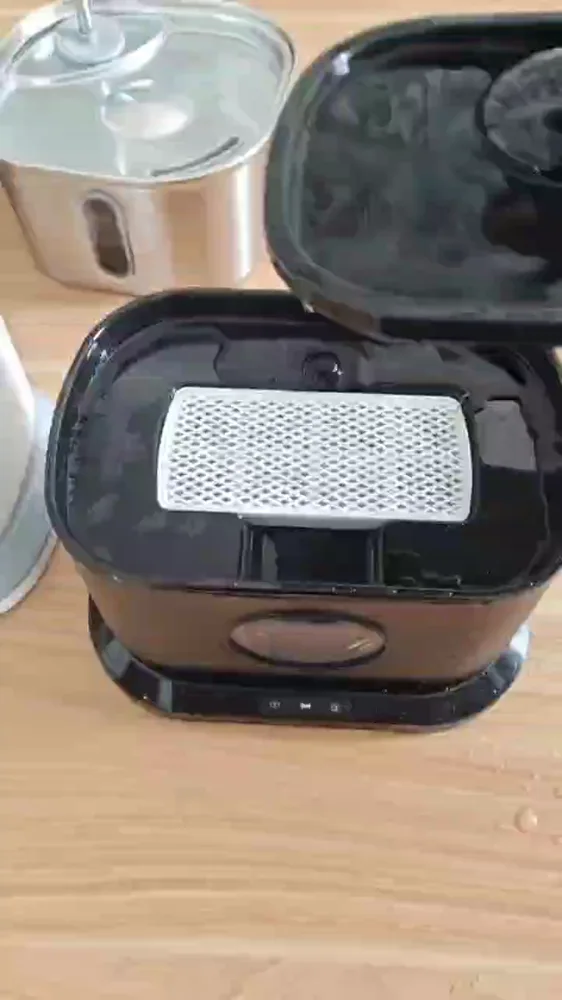 Under the tray: cartridge and holder
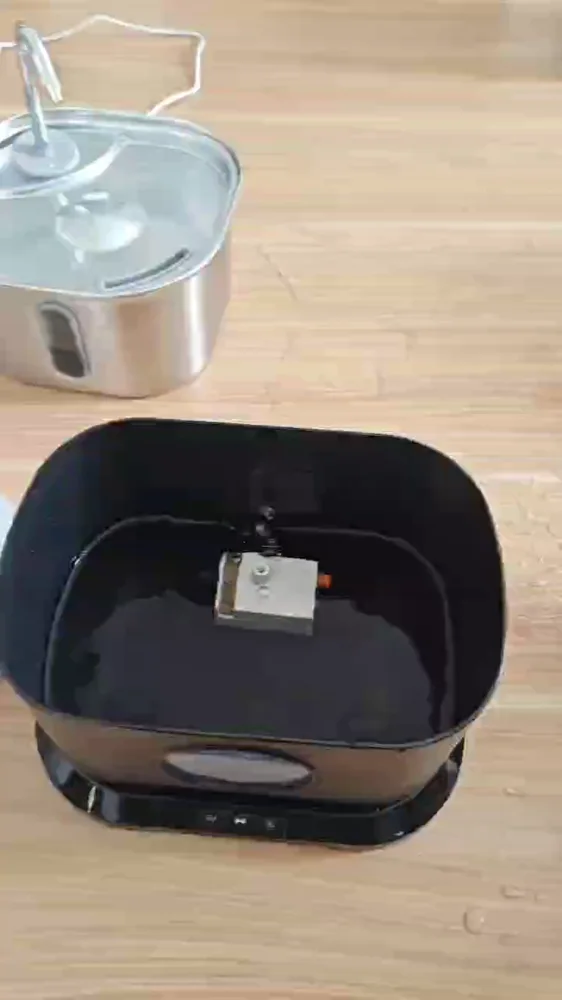 Inside the tank: pump and reservoir
Wipe exterior surfaces by the method allowed for their finish. Follow separate dry-part instructions for controls, charging ports and the powered base; do not carry the assembled electrical section into the sink.
How to Clean a Cat Water Fountain Step by Step
Disconnect power, separate the washable parts, clean the complete accessible water path and rinse before rebuilding. Keep a clean bowl of drinking water available while the fountain is apart. Have the model’s manual, a soft cloth, an appropriate small brush and a shallow container for loose pieces beside you.
- Disconnect power with dry hands. Unplug external power and switch off battery operation as instructed. Removing a charging cable alone may leave a rechargeable fountain running.
- Empty the old water. Separate the reservoir from any powered base before taking washable parts to the sink. Keep adapters, charging ports, batteries and non-submersible assemblies dry.
- Remove only user-removable components. Follow the manual’s order for the tray, outlet, holder and pump. Photograph connections if their orientation is unclear. Lift parts by their bodies rather than cables; do not force clips or open sealed housings.
- Remove loose hair and food. Check the intake slots, tray rim, return openings and cartridge seat. Keep small seals and pump pieces away from the drain.
- Wash permitted water-contact surfaces. Use the specified cleaner and tool. Where mild dish soap is allowed, work around corners, the lid underside and accessible channels, then rinse thoroughly. Avoid abrasive pads, and include any viewing window rather than treating a steel tank as one uniform material.
- Clean serviceable pump parts. If scheduled or visibly affected, open only the permitted covers and clean the accessible chamber and impeller as described below. Never run the pump dry or improvise a circulating-cleaner test.
- Inspect the filter separately. Follow its rinse or replacement directions. Wash the holder, but do not apply soap or descaler to the cartridge or open a sealed cartridge to replace its contents.
- Rinse and inspect. Remove loosened residue and all cleaner from washable parts. Treat remaining scale only with an approved method for that component. Never mix cleaners or assume that a reservoir soaking instruction applies to the pump.
- Reassemble in the specified order. Reseat impeller retainers where applicable, close the pump cover, align connectors and return seals and the filter to their correct positions. Keep fixed seals fixed.
- Refill, then restore power. Stay within the minimum and maximum operating levels. Check that electrical interfaces are dry and intact, then observe flow, vibration and leaks. Switch off before correcting a loose part; do not keep running an empty or stalled pump.
If water enters a section intended to stay dry, leave the unit off and ask the manufacturer for guidance. A dry-looking charging port does not establish that its interior is safe. For ordinary maintenance, the goal is to remove residue using the approved method; a clean-looking surface is not proof of sterilization.
How Often Should You Clean the Pump?
Clean the pump at the interval specified for that model, and inspect it sooner if flow weakens, noise changes or debris accumulates at the intake. The two-week and monthly examples above are product-specific guidance, not an industry-wide range that you can choose from freely.
A pump can still move water while hair collects on its cover. A clean reservoir therefore does not tell you whether the pump is clean. On serviceable designs, the important inspection may be behind the intake cover or around the impeller, the small rotating part that moves the water.
Before blaming dirt for a new sound, check water level, selected mode and reassembly. A loose outlet, a low tank or contact with a hard surface can change what you hear. Unplug before adjusting or opening the pump. Never test it dry to see whether the noise goes away.
I would keep a short pump note separate from filter replacement: date opened, what was found and whether normal flow returned. If cleaning and correct assembly do not restore operation, use the pump troubleshooting guide or contact the supplier. Repeated cleaning is not a fix for a damaged cord, leaking electrical part or failed pump.
How to clean the permitted pump components
The impeller is the rotating part that moves water. It may sit behind an intake cover and a second retaining cover. PetSafe's Drinkwell pump instructions call one removable part a stator. Use the names and diagram for your pump; that wording is not an instruction to dismantle a sealed electrical motor.
- Find the intake and remove loose hair from accessible openings.
- Release the permitted cover at its intended tab. If its release point is unclear, stop and check the diagram.
- Remove the impeller only where specified. Keep its shaft supports or small end pieces with it.
- Clean inside the accessible chamber, including the recess behind the rotor, with the approved tool and method.
- Rinse washable pieces, inspect their fit and restore each retaining part before installation.
Conceptual separated-component map, not a Fountelio exploded drawing. The sealed motor housing is outside this service sequence.
Handle a removable impeller gently. Do not lever against blades, bend a shaft or force a stuck rotor. Clean the recess behind it as well as the rotor itself. Leave fixed shafts in place; cracked blades or worn supports need the correct replacement.
For a brand preparing instructions, “clean regularly” leaves too much guesswork. Name the pump, show the pieces a user may remove and state its maintenance interval. A wireless-pump design still needs appropriate care; absence of an exposed pump cable does not mean absence of a water path to clean.
Cleaning cannot restore a damaged component. Our fountain lifespan and repair guide explains when to consider a replacement part.
When Should You Replace the Filter?
Replace the filter according to its own instructions and condition, separately from cleaning the fountain. Rinsing permitted surface debris does not renew exhausted media or reset the replacement interval. Clean the holder even when the cartridge is not yet due for replacement.
Keep soap and descaler away from filter media. For timing and early-replacement signs, see how often to change a cat water fountain filter. Before ordering, use the filter compatibility guide to confirm the exact model and cartridge.
What Makes a Cat Water Fountain Easy to Clean?
An easy-to-clean fountain lets you reach, inspect and rinse its water-contact parts, then put them back correctly without a struggle. A smooth bowl helps, but it is only one part of the design.
Think about the job with the fountain in your hands. Can you lift the tray without pulling a wire? Can a suitable brush reach the outlet? Does the filter holder come out, or can it be cleaned thoroughly in place? A narrow recess that cannot be seen or reached may take more effort than a larger removable part.
| Feature to examine | Try this on the actual product | Why it matters |
|---|---|---|
| Pump access | Follow the instructions to reach the intake and permitted internal parts | Shows whether routine pump care is practical, including any tools required |
| Tray and tank surfaces | Look and feel under rims and around joints after rinsing | Reveals areas a quick wipe can miss |
| Filter access | Remove and reseat the correct cartridge without bending or forcing it | Makes routine inspection and replacement less awkward |
| Channels and outlets | Check whether a suitable brush reaches the washable passages | A visible opening may lead to a difficult-to-reach bend |
| Reassembly | Put the parts back using only the supplied instructions | Shows whether orientation, seals and electrical connections are clear |
| Parts and instructions | Match the filter and pump references to reorder information | Keeps future maintenance possible after the original accessories wear out |
Material names do not answer these questions. A stainless steel tray may lift off easily while a separate outlet takes longer to clean. A plastic reservoir may have accessible corners or complicated recesses. Examine the actual shape and access instead of treating one material as a promise of effortless care.
Nor does easy access prove the fountain will stay clean longer. Its value is that necessary cleaning is easier to do thoroughly and repeat. That is useful both to an owner deciding what to buy and to a retailer deciding what maintenance instructions customers will need.
Does Hard Water Change How Often You Need to Clean a Fountain?
Hard water can mean more frequent checks for mineral deposits and more frequent descaling of permitted parts. It does not create one fixed “every seven days” rule for every home.
USGS explains water hardness in terms of dissolved calcium and magnesium. Chalky deposits can become noticeable around the outlet, tray edge and other areas where water evaporates. They require a different response from slippery organic residue.
During routine cleaning, check accessible pump parts as well as the visible waterline. Remove deposits using the component’s approved method; do not scrape them with a metal tool or apply an acid to the whole assembly. Some manuals permit diluted white vinegar for particular parts. That is a descaling instruction, not a universal disinfecting method or permission to soak electronics.
Our hard-water stains and limescale guide covers the cleaning boundaries. Keep descaling as a separate note in your routine, and rinse the permitted parts thoroughly before they return to service.
Can You Put a Cat Water Fountain in the Dishwasher?
Only put an individual part in the dishwasher when the manufacturer identifies that part as dishwasher-safe. “Stainless steel,” “removable” and “waterproof” are not substitutes for that instruction.
The tray, reservoir, lid, pump, cartridge and control module can have different requirements even on the same fountain. Follow any stated rack position, temperature and drying limitations. Keep the pump, adapter, battery base and electronic modules out unless there are explicit, component-specific instructions permitting a particular cleaning method. Do not treat ordinary water exposure during use as dishwasher approval.
Tray, reservoir and lid
Look for dishwasher instructions for the exact removable part, including rack, temperature and drying limits.
Pump and filter cartridge
Follow their own cleaning or replacement directions. Do not assume that a washable bowl makes these parts dishwasher-safe.
Adapter, battery and controls
Keep electrical assemblies dry. Detaching a module does not make it suitable for immersion or machine washing.
If the instructions do not say, use the approved hand-cleaning method or ask the supplier for the exact part’s guidance. A useful product listing names dishwasher-safe components individually. A statement that “the fountain is dishwasher-safe” should prompt a follow-up question before you load it.
How Can Buyers Evaluate Cleaning and Maintenance Before Ordering?
Use a sample to complete one documented cleaning and reassembly cycle, then check whether the instructions and replacement-parts plan support that routine. This evaluates usability; it does not establish a microbiological result or the product’s long-term service life.
Start with the exact model and version you intend to sell. Have someone follow the supplied instructions without an informal demonstration. Note any point where they cannot tell which piece detaches, what must stay dry or how a seal returns to position.
I would record a specific difficulty rather than score the whole fountain “easy” or “hard.” For example: “The outlet passage is washable, but the supplied brush cannot reach the bend; confirm the recommended tool.” That gives the supplier an issue it can address and you a change you can check again.
| Check | Why it matters | Record during sample review |
|---|---|---|
| Access and tools | The owner must reach the parts named in the instructions | Model/version, removal sequence, required tools and any unreachable channel |
| Part-specific care | Material names do not establish washing permissions | Component materials, what stays dry, approved cleaners and any explicit dishwasher instructions |
| Filter and pump support | Maintenance continues after the original parts wear out | Exact replacement references, availability and reorder route |
| Reassembly and operation | Removal alone does not prove the routine is usable | Seal and connector fit; flow and leaks at the recorded water level and operating mode |
| Instruction gaps | A supplier needs a specific issue to correct | Photo or step reference, requested change and result of the repeated maintenance check |
If a sample includes revised parts, repeat the affected cleaning and assembly steps. An easier-to-remove lid does not automatically resolve a difficult pump chamber. The sample order checklist helps turn these observations into evidence, requested changes and a defined approval scope.
For retail instructions, give customers a routine they can follow, not just a warning to keep the product clean. Include a labeled parts view and explain what to do when buildup returns sooner than expected. That connects the product’s design to the care it actually needs.
Cat Water Fountain Cleaning FAQ
How often should I clean my cat’s water fountain?
Check it every day, refresh the water and wash accessible drinking surfaces as part of daily care. Use the exact model’s interval for reservoir, hidden-channel and pump cleaning, and clean sooner if you find residue or odor. One weekly reminder cannot cover all of those jobs.
How often should I clean the fountain pump?
Follow the pump’s instructions. Official examples include every two weeks for the Catit model cited above and at least monthly in PetSafe’s pump guide, with more frequent cleaning potentially needed for multiple pets. Neither is a universal recommendation for every fountain.
Is topping up the tank the same as changing the water?
No. Topping up maintains the operating level but leaves existing water and debris in the tank. Emptying and refilling lets you inspect the reservoir; wash affected surfaces rather than pouring new water over buildup.
Does a filter mean I can clean the fountain less often?
A filter can catch some debris, but it does not wash the tray, holder or pump chamber. Follow the cleaning schedule regardless of whether the cartridge is new. For operating requirements, check the exact manual and our guide to using a fountain without a filter.
Can I put the whole fountain in the dishwasher?
No general permission applies to the whole fountain. Only wash components explicitly identified as dishwasher-safe under the stated conditions. Keep electronic parts, batteries and adapters out, and check the separate requirements for the pump and filter.
How do I adjust the routine for hard water?
Check the outlet, tray edges and accessible pump parts for chalky deposits during cleaning. Descale approved components when needed using the model’s instructions. Do not confuse this mineral-removal task with washing away slime or with disinfecting.
Can I use vinegar to clean a cat water fountain?
Only on components whose instructions permit it, using the stated dilution and contact time. Rinse thoroughly afterward. Do not soak electronics, wash filter media with vinegar or mix it with other cleaners.
Build a Cleaning Routine You Can Keep
Start with daily water and drinking-surface care, then give the pump, filter and hidden passages their own reminders. Use the exact model’s instructions to set those intervals, and bring cleaning forward when you find residue, odor or changed flow. A routine works best when it tells you both when to act and which part needs attention.
Before choosing a fountain, try to picture that routine at your sink: lifting the tray, reaching the pump, rinsing the holder and putting everything back. For an owner, those details shape everyday upkeep. For a buyer, they are worth checking on the sample before the design and care instructions are approved.
About This Guide
Written by Tony Kong, R&D Engineer at Fountelio. Product access examples use Fountelio assembly footage; the hero is an editorial scene made from a product reference. First-person comments describe maintenance and sample-review priorities, not laboratory results. The component map is an inspection guide, not a universal water-flow diagram. Manufacturer intervals apply to the cited products or support guidance; follow the current instructions for your exact model.
Sources & Product References
General hygiene guidance, individual product instructions and Fountelio specifications serve different purposes in this guide. Cleaning intervals from another manufacturer apply to the named product or support guidance, not automatically to every fountain.
- CDC: Cleaning and Disinfecting Pet Supplies. Daily water-bowl washing, following item-specific instructions and the distinction between cleaning and disinfecting.
- Catit Stainless Steel Drinking Fountain: Cleaning Guide. The cited model’s two-week pump-cleaning instruction.
- PetSafe: How to Clean Your Pet Fountain Pump. At-least-monthly pump care, with more frequent cleaning potentially needed in multi-pet households.
- USGS: Hardness of Water. The calcium and magnesium basis of water hardness.
- PetSafe: Drinkwell Pump Disassembly. The cited pump’s service covers and removable parts; not a universal motor layout.
- Fountelio Replacement Filters. Current cartridge formats, compatibility and conditional replacement guidance. These intervals do not replace fountain cleaning.
- Fountelio Sample Order Checklist. Recording maintenance-access observations and defining the scope of sample approval.