

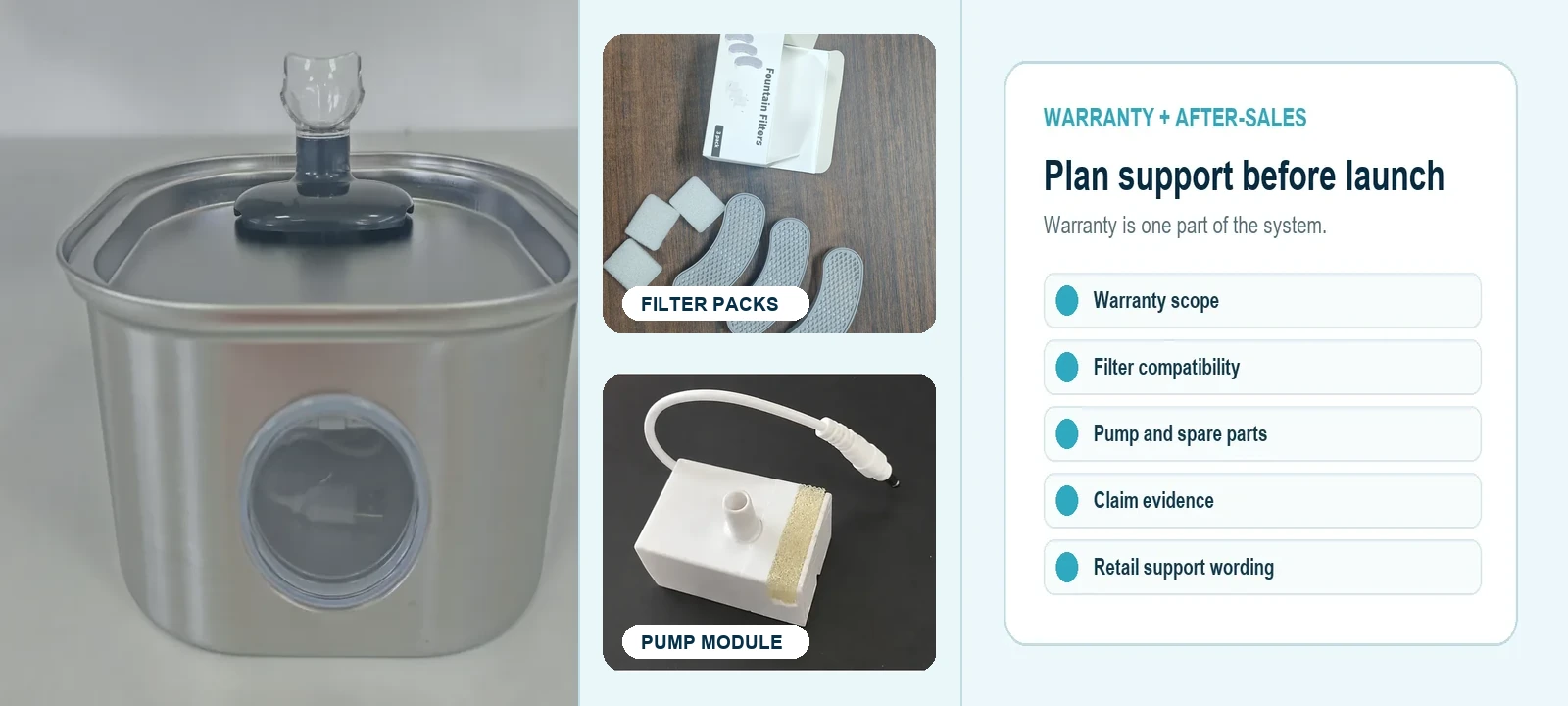
A buyer can like the product, accept the quotation and still hesitate before placing a bulk order. The unresolved risk is what happens after sale. Which faults are covered? Which parts are consumables? Where will customers buy filters? If someone reports weak flow, a noisy pump, a missing accessory or a damaged unit, who collects the evidence and who decides the remedy?
The fountain body and pump are designed for normal long-term use when the product is cleaned regularly, kept at the correct water level and used as instructed. They are not treated as short-cycle consumables. The filter is the main planned consumable, and buyers should arrange replacement filters with the first order because filter shape, holder fit and water path are often model-specific.
A cat water fountain warranty is therefore only one part of the support plan. This guide separates coverage from routine replacement, then shows what to confirm about filters, pumps, small parts, claim evidence, manuals and retail support wording. The aim is to make the pet water fountain easier to sell, maintain and support before the first customer asks for help.
What Should Buyers Check First?
Check the warranty period, covered parts, excluded consumables, filter compatibility, pump policy, service-part availability, claim evidence requirements, replacement process and customer-support wording. Filters are the main recurring consumable. Pumps normally have a longer service role, but coverage, dry-run exclusions, diagnosis and separate supply still need written confirmation for the selected model and market.
Warranty Is Only One Part of After-Sales Planning
A warranty defines a claim boundary. An after-sales plan explains how the product remains usable and how a reported problem reaches a supported resolution.
A warranty period does not tell a distributor which filter to stock, whether a replacement pump can be supplied or what proof a customer must provide. Those gaps become expensive after the product reaches the market.
In our buyer discussions, I separate support into five areas: coverage, consumables, service parts, claim handling and customer instructions. This keeps a refill question from being treated as a warranty fault.
| After-sales area | Why it matters | What the buyer should confirm |
|---|---|---|
| Warranty period | Sets the time boundary for eligible defects | Start date, duration, market and sales channel |
| Covered defects | Separates manufacturing issues from maintenance or misuse | Covered parts, conditions and available remedies |
| Filters | Customers need a repeat supply after launch | Exact reference, pack count, MOQ and reorder route |
| Pump | Weak flow may need cleaning, diagnosis or replacement | Coverage, exclusions, serviceability and separate supply |
| Adapter / cable | Electrical parts need a clear stop-use and replacement path | Specification, coverage and model match |
| Small parts | A lid, tube, holder or spout can decide whether a unit remains usable | Which parts are identified and separately supported |
| Claim evidence | Incomplete reports slow diagnosis | Order, model, quantity, photos, video and checks already made |
| Replacement process | The remedy must work across borders and channels | Who approves, who ships and who informs the customer |
| Retail FAQ | Good instructions prevent avoidable claims | Cleaning, filter, flow, water level and contact guidance |
| Private-label wording | The end customer sees the buyer's brand | Support owner, warranty wording and applicable local rules |
What Should a Cat Water Fountain Warranty Cover?
The buyer should clarify which verified defects and components are covered under normal use, the coverage period, exclusions and available remedy.
A headline period is not a complete policy. Ask when it starts, which pump, power and structural parts it covers, and whether transit damage follows a warranty, freight or separate claim process. The answer may change by market and channel.
Coverage also needs evidence rules. A damaged housing may need carton photos; a pump case may need an operating video after basic checks; an artwork error needs the approved proof. These examples are buyer questions, not a Fountelio legal warranty.
| Item | Common buyer question | What to confirm |
|---|---|---|
| Main body | Is a manufacturing crack, deformation or assembly defect covered? | Conditions, evidence and remedy |
| Pump | Is a verified pump defect covered under normal use? | Period, dry-run or misuse exclusions, diagnosis and supply |
| Adapter / cable | What happens if the correct power part is defective? | Exact specification, market plug, evidence and replacement method |
| Reservoir / lid | Does damage on arrival differ from later wear? | Inspection timing, packaging evidence and covered defects |
| Filter holder | Is it a structural part or a separately supplied service part? | Part reference and availability |
| Shipping damage | Who handles a crushed carton or impact damage? | Freight term, inspection window and carton photos |
| Missing parts | How is a missing pump, filter, cable or manual resolved? | Pack-out reference and quantity evidence |
| Wrong model | What proves that the packed configuration differs from the order? | PO, carton label, product label and photos |
| Logo / packaging | How are approved-artwork errors handled? | Signed proof, version control and affected quantity |
What Is Usually Not Covered: Filters and Normal-Wear Items
A replaceable fountain filter is a consumable. Routine loading, discoloration or end-of-life replacement belongs in maintenance planning, not an assumed product claim.
PETLIBRO's current warranty policy lists fountain filters among normal-wear items. The cited PetSafe filter instructions and Catit manual give different intervals for specific models and filter types. These examples show why one schedule cannot cover every fountain.
A loaded filter can affect flow and odor, while replacing it does not replace cleaning. Retail guidance should separate a refill from a warranty remedy and identify the correct cat water fountain filter formats.
Why Should Replacement Filters Ship With the First Order?
Buyers should normally plan replacement filters with the first fountain order so customers have a verified refill source from launch day.
If the refill SKU arrives later, customers may buy a similar-looking cartridge that has not been verified. A matched refill supply supports customer satisfaction and gives retail or private-label programs consistent model codes, packaging and replenishment.
At Fountelio, the filter is the first after-sales consumable I ask buyers to map. There is no fixed filter-to-fountain ratio: stock depth depends on the channel, pack count, packaging MOQ and refill lead time. The filter and spare-parts planning guide covers that inventory decision.
| Buyer type | Filter planning recommendation | Why |
|---|---|---|
| Pet store | Keep matched refill packs beside or close to the fountain | Makes the correct replacement visible at purchase |
| Ecommerce seller | Create a separate refill listing and link it from the fountain page | Reduces guesswork after the original listing changes |
| Distributor | Map each fountain model to its filter code and carton data | Prevents mixed references across accounts |
| Private-label brand | Approve branded or neutral filter packaging before launch | Keeps the model code and customer instruction consistent |
| Refill program | Set pack count and reorder trigger from actual channel demand | Avoids promising a cadence before the installed base is known |
Why Are Cat Water Fountain Filters Often Model-Specific?
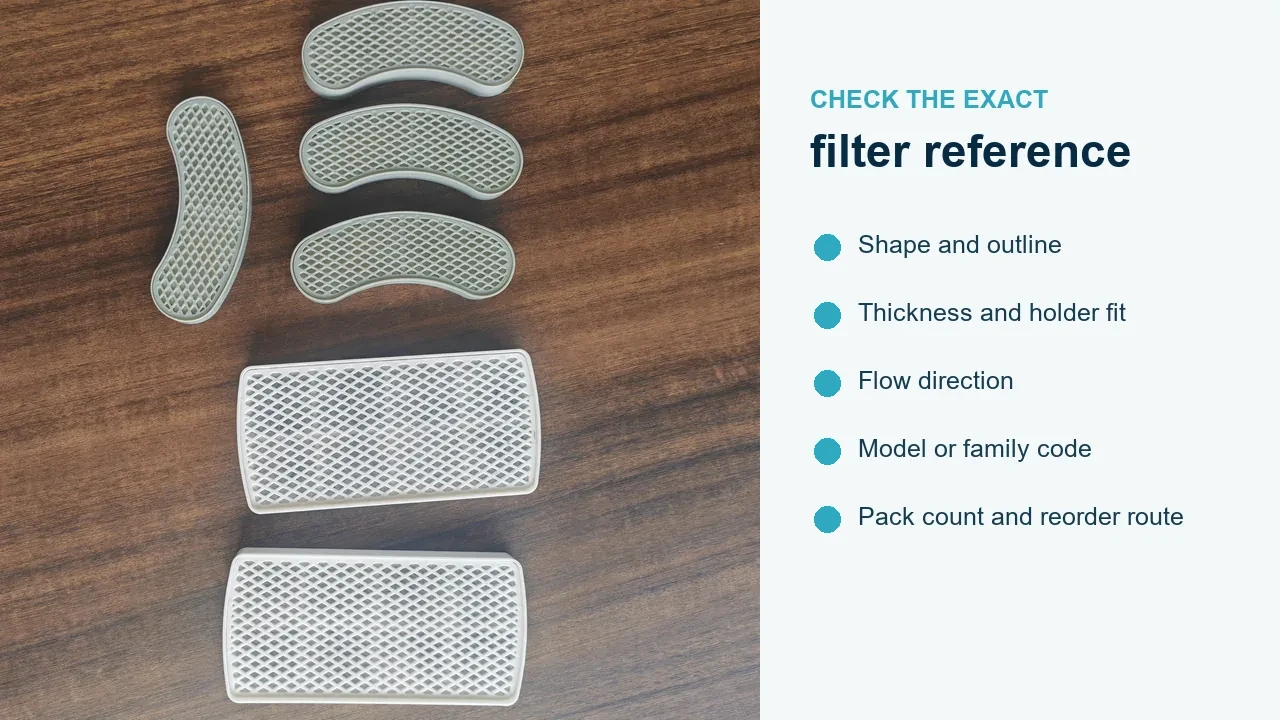
Do not assume a filter from another supplier, marketplace listing or similar-looking model will fit. Shape, thickness, media, flow path, holder size, outlet position, private-label version and model generation may differ.
A loose cartridge may bypass the intended path; a thicker one may restrict flow or stop the lid seating. A photo proves neither fit nor filtration.
A GEX Pure Crystal manual specifies a dedicated filter for its system. For Fountelio programs, I recommend mapping the fountain model, filter code, pack configuration and approved revision. Consolidate SKUs only after compatibility is confirmed.
| Filter question | Why it matters | What to confirm |
|---|---|---|
| What is the filter code? | A visual description is too easy to confuse | A stable model or family reference |
| Which fountains use it? | One range may contain several holders or water paths | Verified compatibility list and revision |
| What are the dimensions? | Similar outline does not prove physical fit | Shape, length, width, thickness and locating features |
| How is water routed? | Fit alone does not confirm intended filtration | Holder orientation, inlet side and outlet side |
| How many filters per pack? | Pack count affects price, shelf space and reorder planning | Retail and master-pack configuration |
| What is the filter MOQ? | Consumable packaging may have its own minimum | Neutral and custom printed options |
| What is the reorder lead time? | A fountain can remain in market longer than the first filter stock | Production, packaging and shipment planning |
| Can several SKUs share it? | Consolidation is useful only when compatibility is genuine | Written confirmation for the exact model family |
What Should Buyers Confirm About Pump Coverage?
Pumps are usually longer-life functional parts under normal use, but buyers should still confirm coverage, dry-run or maintenance exclusions, diagnosis and spare-pump policy for the exact platform.
Weak flow or noise does not prove a pump defect. Check water level, filter loading, hair, scale, assembly and vibration before replacement. A short video with the operating water level visible can help diagnosis. The cat water fountain pump troubleshooting guide gives a consumer-facing sequence.
Pump lifespan and warranty are different. GEX model-specific guidance says cleaning resolves many flow and noise cases and that long use may weaken the impeller magnet. PetSafe gives individually purchased replacement pumps a 90-day warranty in its U.S. policy. Neither example creates a universal lifespan or Fountelio term.
Confirm whether the pump is user-replaceable, separately supplied and matched by connector and power specification. Rechargeable and wireless platforms may separate the pump, base and electronics. The cat water fountain lifespan guide explains why a warranty period is not a durability estimate.
Which Spare Parts Matter Beyond Filters and Pumps?
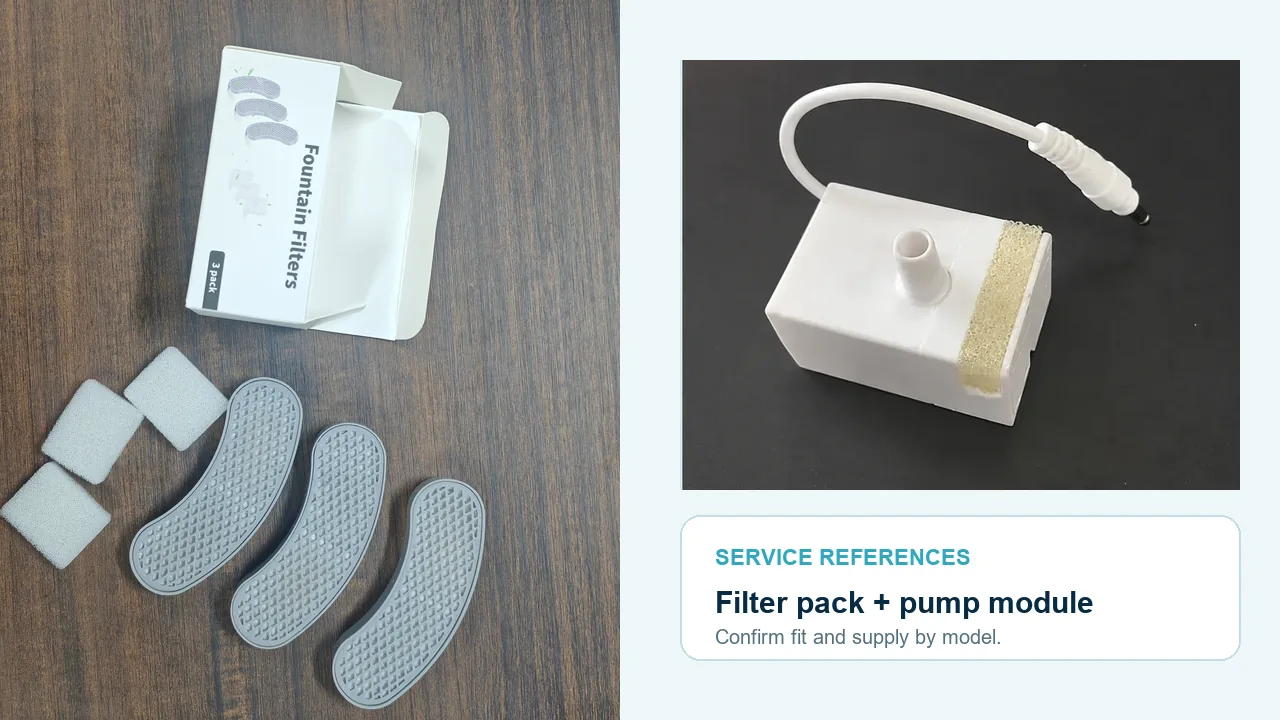
A complete plan identifies the small part that could keep a serviceable fountain out of use, but it does not require every buyer to stock every component.
Tubes, holders, lids, spouts and power parts may be removable on one model and integrated on another. Ask which parts have stable references, can be replaced safely and may change with a revision.
Stock should follow the channel and installed base. A distributor may keep verified parts centrally; a small store may need only filters and an escalation route. Never substitute a similar-looking pump or adapter without matching its full specification.
| Part | Consumable? | Should the buyer stock it? | Planning note |
|---|---|---|---|
| Filter | Yes | Yes, in a quantity based on the launch and channel | Main recurring consumable; confirm exact compatibility |
| Pump | No, not normally a short-cycle consumable | Consider a service quantity where separate supply is supported | Confirm user replacement, connector and version |
| Silicone tube | Not usually | Model- and program-specific | Length, diameter and routing must match |
| Filter holder | No | Useful where the part is removable and separately available | Do not assume holders transfer across platforms |
| Adapter / cable | No | Policy depends on power architecture and market | Electrical specification and plug type must match |
| Cleaning brush | Accessory | Optional retail or support item | Useful only if it reaches the intended service points |
| Manual / QR card | Documentation | Include with every approved pack-out | Control language, model and revision |
| Packing insert | Packaging part | Normally reserved for production and repeat packaging | Not an end-customer service part |
What Evidence Should a Buyer Collect for a Claim?
A warranty claim is easier to process when the buyer provides the model, order information, clear photos or video, issue description and basic troubleshooting status.
Record the order or PO, batch, carton or serial reference when available, affected quantity, dates received and noticed, water level, filter replacement status and whether the pump was cleaned. A short video can distinguish silence, weak flow, vibration and a leak.
For shipping damage, keep photos of the outer carton, inner protection, product and carrier label. Complete evidence helps avoid sending the wrong part and separates a single service case from a transport or batch issue. Requirements remain policy-specific.
| Claim type | Useful evidence | Common mistake |
|---|---|---|
| Dead on arrival | Model, order, power setup and short video | Discarding the unit before review |
| Weak flow | Water level, filter status, pump-cleaning check and video | Reporting only that the pump 'does not work' |
| Noisy pump | Video with water level visible and operating context | Recording after the reservoir has run low |
| Leak | Dry-unit test, water source, assembly and close photos | Assuming splash or overflow is a body leak |
| Missing part | Open-box photo, carton label and pack-out list | Using a photo taken after accessories were moved |
| Shipping damage | Outer carton, inner protection, product and carrier label | Throwing away the carton before the claim is recorded |
| Logo / packaging issue | Approved proof, received version and affected quantity | Sending the current file without identifying the approved revision |
How Should Distributors and Retailers Handle After-Sales Cases?
Use one documented path from customer report to evidence, basic checks, supplier review, agreed resolution and issue logging.
The retailer is closest to the customer, while the supplier knows the platform and part references. Decide before launch which checks the retailer may request, when it should stop and how it escalates the case.
Support improves when filters, pump references, manuals and evidence lists are ready. If an issue appears across several units, record the quantity and batch or carton references for wider review.
What Should the Retail FAQ and User Manual Explain?
Customer instructions should identify the filter, cleaning route, water-level requirement, first checks, claim contact and warranty limits.
Many returns begin as information gaps. Explain safe setup in the manual, then use a shorter FAQ for refill links, weak-flow checks and claim evidence.
A QR code can lead to a maintained page or form, but cannot replace required printed safety information. Approve its destination, language and owner before printing. The cat water fountain safety guide is useful background; the sold model still needs its own instructions.
How Should Private-Label Warranty and Support Wording Be Planned?
Decide whose brand receives the complaint, who approves the remedy and what support promise appears on the box, manual, listing and website.
The public contact path should match the seller customers know. Conflicting email addresses across a box and marketplace listing create duplicate or lost cases.
Write down who stores parts, handles first-line questions, contacts Fountelio, ships a remedy and keeps the record. I also ask buyers to lock the filter code and support URL before packaging approval.
This is not legal warranty wording. Consumer rights and return rules differ by market and channel, so final terms need local review. Plan replenishment through the bulk cat water fountain order lead time guide.
What Should Buyers Confirm Before Placing a Bulk Order?
Approve the product and support system together. Every warranty term, filter reference, service part, claim step and instruction needs an owner.
Use this table during quotation and sample approval. Answers may belong in the order agreement, product specification or retail policy; they do not need to become one warranty document.
- CoveragePeriod, parts, exclusions
- FiltersCode, pack, MOQ, reorder
- PumpCoverage, diagnosis, supply
- ClaimsEvidence and decision path
- RetailManual, FAQ, contact
| Checklist item | Why it matters | Ask the supplier |
|---|---|---|
| Warranty period | Defines the claim window | When does it start, how long is it and which market applies? |
| Covered parts | Prevents assumptions about a whole-unit promise | Which body, pump, power and structural parts are included? |
| Excluded items | Separates wear, consumables and misuse | Which maintenance, dry-run, damage or consumable cases are excluded? |
| Filter model | Customers need the correct replacement | What code and fountain family does this filter serve? |
| Replacement interval | Instructions must be model-specific | What does the exact manual say and what conditions shorten it? |
| Filter MOQ | Consumables may have a separate minimum | What are the neutral and printed-pack minimums? |
| Filter reorder lead time | Stock must outlast the first launch | How early should a repeat order be placed? |
| Pump policy | A cleaning issue and a verified defect need different responses | What is covered, excluded and checked first? |
| Spare pump availability | A part solution may avoid a whole-unit return | Is the exact pump separately supplied and user-replaceable? |
| Adapter / cable policy | Power parts are market- and model-specific | What reference is supported for the destination? |
| Small parts | Minor parts can stop use | Which holders, lids, tubes or spouts have service references? |
| Claim evidence | Good evidence speeds review | What order, batch, photo, video and maintenance details are required? |
| Replacement process | The buyer needs an operational path | Who approves, who stocks and who ships the remedy? |
| User manual | Instructions shape safe use and prevent avoidable cases | Are model, language and revision approved? |
| Retail FAQ | Support teams need consistent answers | Where are cleaning, filter, flow and contact answers maintained? |
| Private-label wording | The buyer's brand owns the customer promise | Who is named, which law applies and who approves the copy? |
Frequently Asked Questions
What should a cat water fountain warranty cover?
Clarify the period, covered components, normal-use conditions, exclusions, evidence and remedies. Shipping damage, missing parts, wrong configurations and artwork errors also need handling paths, even when they sit outside the product warranty.
Are cat water fountain filters covered by warranty?
Filters are commonly treated as consumables, but buyers must confirm the policy. PETLIBRO, for example, lists fountain filters among normal-wear items. Plan compatible refill stock and a clear reorder route.
Should buyers order replacement filters with the first order?
Yes, for most filtered fountain programs. Refills support customers from launch and reduce the chance of an unverified cartridge being used. Quantity depends on pack count, channel, first-order volume and reorder lead time.
Are cat water fountain filters interchangeable?
Not automatically. Shape, thickness, holder geometry, water path, media and revision may differ. Ask for a filter code, compatible models, dimensions and approved packaging reference rather than judging by appearance.
How often should customers replace the filter?
Follow the exact model instructions and loading conditions. PetSafe and Catit publish different intervals for the cited fountains, so retailers should avoid one universal schedule. See the cat water fountain filter replacement guide.
Are pumps a common after-sales problem?
A pump is a longer-life service component, not a routine consumable. Weak flow or noise may also come from low water, a loaded filter, hair, scale or misassembly. Define coverage, exclusions, troubleshooting and spare-pump supply.
Should distributors stock replacement pumps?
It depends on the installed base and whether the exact pump is separately supported. Confirm connector, voltage, physical fit, water path and revision before stocking any apparently similar pump.
What evidence is needed for a warranty claim?
Start with the order, model, affected quantity and clear description. Add photos, a short functional video, dates and checks already performed. Shipping cases also need carton, protection and carrier-label photos.
How should private-label buyers handle after-sales support?
Decide who receives requests, diagnoses cases, approves remedies and supplies parts. Keep the manual, FAQ, QR destination, filter code and contact address consistent, then review final wording against local law and channel rules.
What should retailers include in the customer FAQ?
Include the filter reference, replacement guidance, cleaning access, water level, weak-flow checks, power guidance, claim evidence and support contact. Keep each answer tied to the sold model.
Build the Support Plan Before the First Unit Sells
A useful cat water fountain after-sales plan combines defined coverage, compatible consumables, service-part references, a workable claim process and clear instructions.
The body and pump are intended for ongoing use under approved cleaning, water-level and operating conditions. The filter is the recurring consumable that needs the clearest first-order and reorder plan.
Compare suppliers on the full support package. Next, review the wholesale cat water fountain MOQ and pricing guide and available cat water fountain platforms.
Sources and Scope
This guide combines Fountelio product-program planning with model-specific examples from published manufacturer documentation. The cited policies and intervals apply to the named brands, regions and products; they do not establish Fountelio warranty terms or a universal industry rule.