

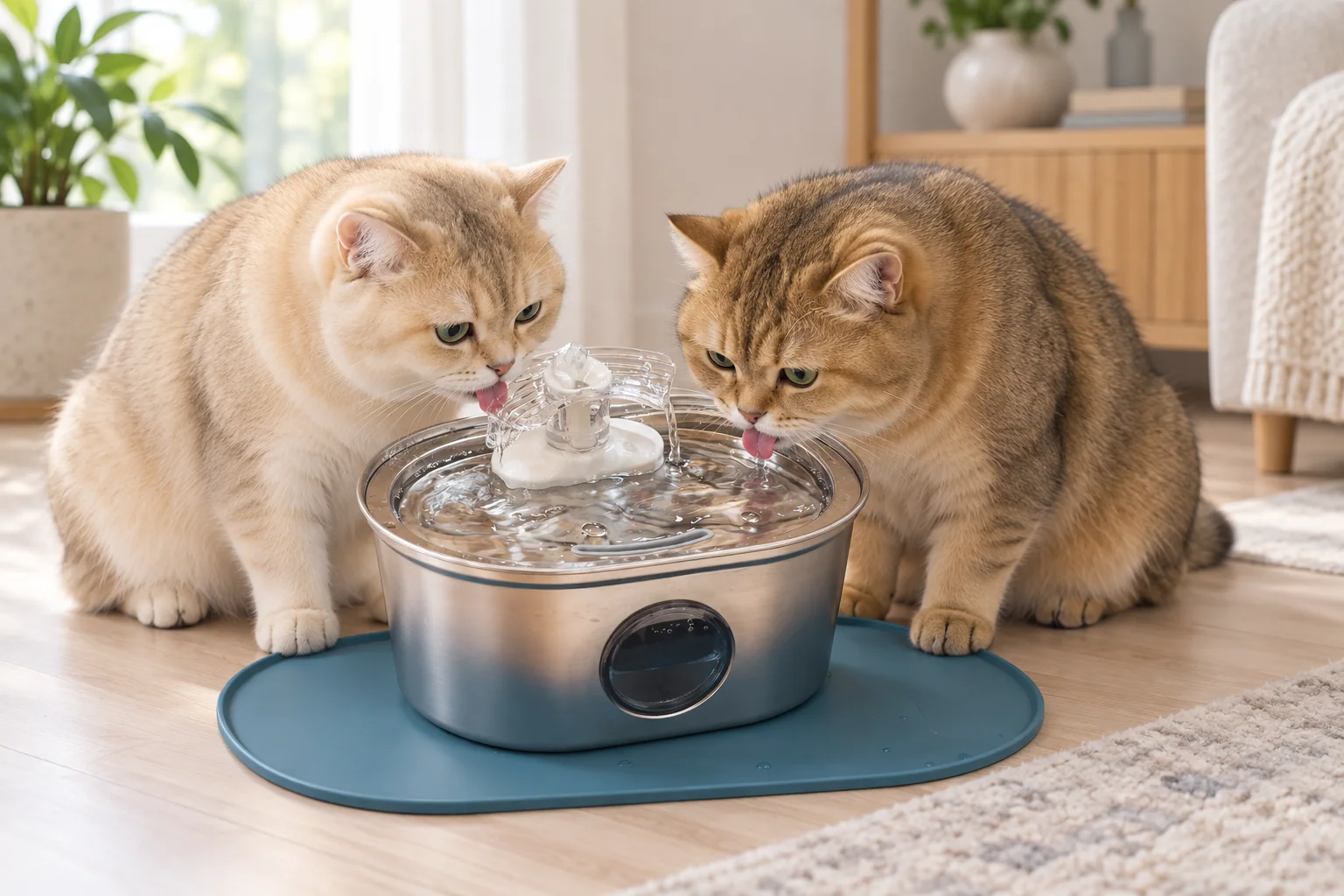
A fountain can look like a convenient upgrade and still raise reasonable questions. There is electricity near water, a pump hidden in the reservoir, a filter that stays wet, and several surfaces that may collect residue. Add worries about scratched plastic, damaged cords or a cat that likes to paw at water, and a plain bowl can suddenly seem simpler.
Most cat water fountains are safe for everyday use when they are designed for pets, cleaned regularly, kept filled above the pump intake, placed on a stable surface and used according to the manufacturer's instructions. The main risks come from poor cleaning, low water, damaged cords, unsuitable or degraded materials, old filters, unstable placement and relying on the fountain as the only available water source.
A pet water fountain is a small water appliance, so it needs more attention than a set-and-forget bowl. The checks below cover hygiene, electrical parts, materials, pump and filter condition, placement, cat behavior and backup water. There is also a separate specification list for brands choosing a fountain platform.
Are Cat Water Fountains Safe for Everyday Use?
Most cat water fountains are safe when they are cleaned regularly, kept filled, placed safely and used according to the manual. The main risks are poor cleaning, damaged cords, low water, old filters, unsuitable or degraded materials, dry-run risk and relying on the fountain as the cat's only water source.
Keep a backup water bowl available, especially during power outages, cleaning, travel or while a cat is still learning to use the fountain.
What Does “Safe” Mean for a Cat Water Fountain?
“Safe” is the result of several conditions working together, not a label that one feature can guarantee. A fountain can use a suitable material but be hard to clean. It can have a protected pump but an unsafe cord route. It can circulate clear water while residue remains beneath the tray.
| Safety area | What can go wrong | What to check |
|---|---|---|
| Hygiene | Old water, residue or hidden wet surfaces | Freshness, odor, film and cleaning access |
| Material | Scratches, cracks, chips or unsuitable contact surfaces | Material declaration and current condition |
| Electrical | Wet plug area, damaged cord or wrong adapter | Dry connections, cable route and specified power parts |
| Pump | Low water, blocked intake or dry running | Water range, sound, flow and accessible intake |
| Filter | Wrong fit, clogging or overdue cartridge | Exact reference, preparation and replacement plan |
| Placement | Tipping, splash, traffic or litter proximity | Stable base, mat and quiet access |
| Cat behavior | Pawing, chewing, avoidance or conflict | Observe the individual cat and multi-cat access |
| Backup water | Outage, pump stop, cleaning or refusal | Independent clean bowl in another suitable location |
| B2B specification | Unclear parts, warnings or market documents | Approved platform, manual, components and compliance scope |
During a product review, we ask whether a user can keep the exact platform clean, filled, powered and correctly assembled during normal use. That gives a more useful answer than judging every fountain as one category.
Hygiene Safety: Water, Slime, Biofilm and Cleaning
Moving water does not clean a fountain. Hygiene depends on fresh water and regular cleaning of every wet part. Circulation may keep water moving, but it does not remove every contaminant or clean the surfaces it passes.
The CDC's pet-supply cleaning guidance uses daily cleaning as a baseline for pet water bowls and advises more frequent attention for higher-risk animals. A fountain has additional components, so follow its manual for full disassembly while still checking water condition every day. The CDC's household water guidance also explains that germs can live in biofilm, the slime that can attach to moist surfaces and water-using devices.
Inspect the reservoir, tray, outlet, filter holder, pump cover and any user-accessible impeller area. Replace stale water; do not merely top it up indefinitely. If the surface feels slippery or water develops odor, cloudiness or unexplained color, stop normal use, provide clean backup water and work through the cat water fountain slimy or moldy guide. Persistent surface foam or unusual bubbles have a different diagnostic path in the cat water fountain foaming or bubbling guide. For the full routine, use the cat water fountain cleaning guide.
In the samples we handle, cleanability is easiest to judge after the lid, outlet and permitted pump parts are separated. A wide reservoir opening is helpful, but it does not prove that the narrow water channels are equally accessible.
Electrical Safety: Cord, Adapter, Pump and Water Exposure
Electric cat fountains can be used safely when the specified power parts are intact, connections stay dry where required, and the unit is unplugged before cleaning or disassembly. Low voltage does not justify ignoring cord damage, wet contacts or an unsuitable adapter.
Unplug before cleaning or disassembly.
Stop use if damaged or wet where the manual requires dryness.
Inspect the cable for tooth marks, crushed insulation and loose connectors. Route it away from the drinking edge, walkways and places where a cat repeatedly pulls or chews. Keep the adapter, wall outlet and power strip outside likely spill paths. Stop using the fountain if the cord or adapter is damaged or water reaches an electrical part that should remain dry.
The official Catit stainless fountain manual, for example, tells users to disconnect power with dry hands before removing, cleaning or maintaining the pump, and warns against dry pump operation. That instruction supports a handling principle, not a claim that every fountain shares the same construction. If water is appearing near power parts, diagnose the source with the cat water fountain leaking, splashing or tipping guide. Do not splice or improvise repairs to a damaged cord or adapter.
Pump Dry-Run and Low-Water Safety
A fountain pump should not run outside the water range stated for the model. When water drops below an intake, the pump may draw air, become noisy, lose flow, run warmer or fail; the exact behavior depends on its architecture and protective features.
Low-water warnings and shutoff features are helpful only when the exact model includes them and they work as intended.
Check the level daily, particularly in warm conditions, multi-cat homes or smaller reservoirs. Use visible MIN/MAX markings where provided, but do not assume a viewing window proves the intake is covered unless the model documentation connects the two. Low-water alarms and automatic shutdown can reduce risk, yet they still need a maintained sensor, correct assembly and a user who responds.
Abnormal sound is a reason to inspect water level, intake blockage and assembly before continuing. The cat water fountain pump troubleshooting guide separates low water, trapped air, debris and pump faults. If the unit is intended for long operation, the decision framework for leaving a cat water fountain on all the time covers overnight checks and power interruptions.
Material Safety: Stainless Steel, Plastic and Ceramic
No material makes a fountain safe by itself; suitability, surface condition and cleanability matter together. The reservoir may be stainless steel while the base, outlet, pump housing, seals and filter holder use other materials, so a headline description never tells the whole story.
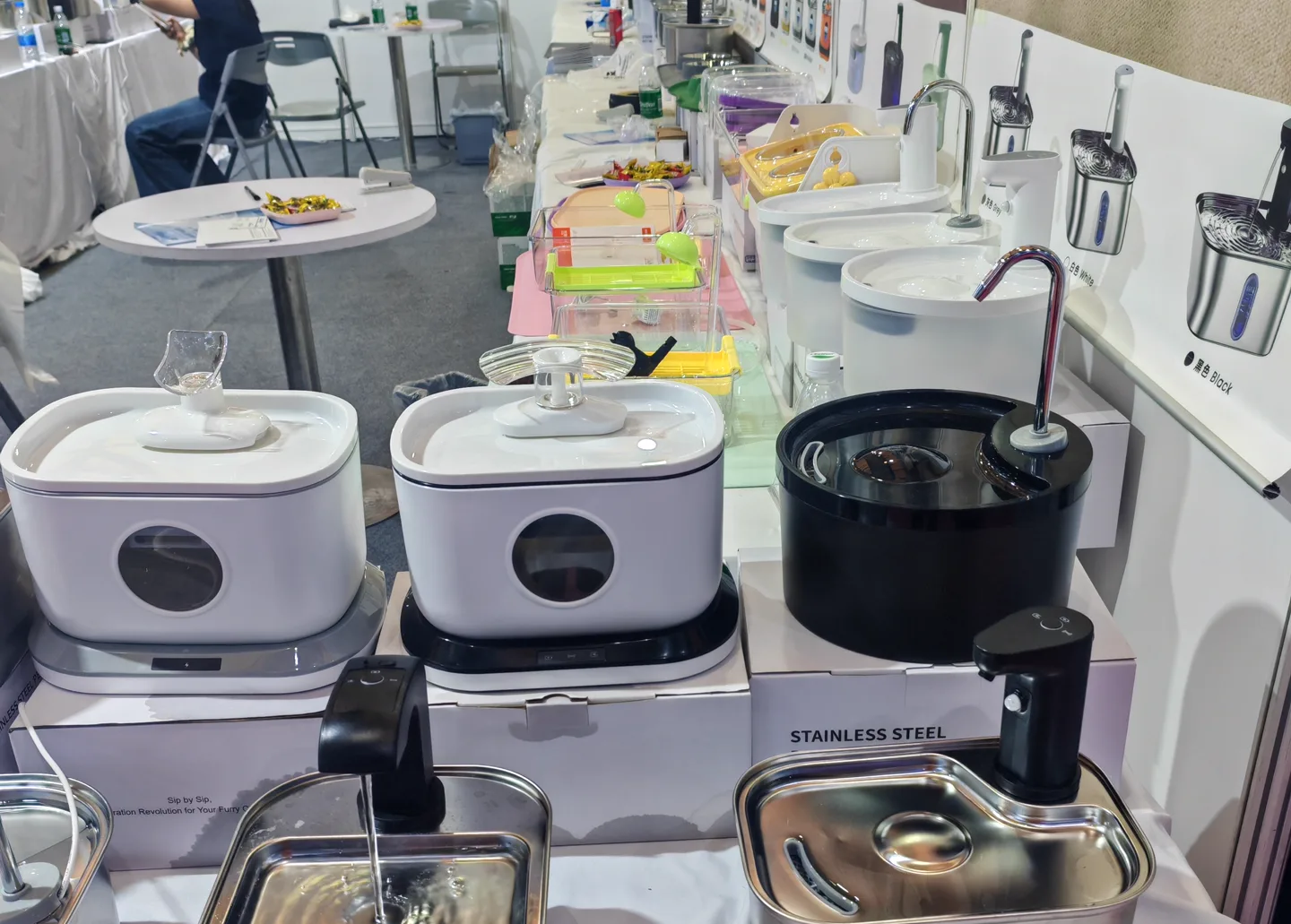
Stainless steel
Stainless steel is durable and generally easy to wipe, but seams, windows, outlets and pump components still require cleaning. Check for sharp edges, deformation and corrosion or finish changes that the manual does not describe.
Plastic
Plastic may be suitable when its water-contact grade is appropriate and it remains smooth and intact. “BPA-free” addresses one material question; it does not guarantee construction quality, cleanability or electrical safety. Replace cracked, warped or deeply scratched parts that can no longer be cleaned reliably.
Ceramic
Ceramic can provide a smooth, heavier body, but chips, cracks and glaze damage need inspection. A heavy fountain may resist tipping while still requiring careful placement and handling.
The FDA's food-contact overview explains that food-contact safety considers intended use, migration and exposure. It should not be turned into a claim that a pet fountain is “FDA approved” unless a specific, verified basis supports that wording. For product trade-offs, see the stainless steel vs plastic cat water fountain guide.
Filter Safety: What Filters Do and Do Not Do
A filter may manage hair, particles, taste or odor depending on its media, but it does not sterilize the water or replace cleaning. The cartridge stays wet, so correct preparation, fit and replacement matter.
Confirm the exact cat water fountain filter format. Similar shape, thickness or advertised filtration layers do not establish compatibility. A gap can let water bypass the cartridge; an over-tight fit may restrict flow. Rinse or soak only as directed, and never wash disposable media with soap unless the instructions explicitly permit it.
Replacement timing depends on the model, water condition and use, as explained in the cat water fountain filter replacement guide. Some fountains can operate without a cartridge only when the manufacturer says so; the guide to using a cat water fountain without a filter explains why removal is not the same as a purpose-built filterless design.
Placement Safety: Tipping, Splashing, Cords and Resource Location
Safe placement keeps the fountain stable, keeps power connections away from water and gives the cat an easy route to drink. Put it on a flat surface, use a washable waterproof mat where appropriate and keep the cable outside chewing and foot-traffic paths.
Flat base and enough room around the fountain
Waterproof mat; plugs and power strips outside splash paths
Cord kept away from chewing and household traffic
Away from litter; accessible without resource conflict
Avoid placing water directly beside a litter box. Food and water do not always need to share one station either. The AAFP/ISFM environmental-needs guidance supports separating key resources and providing multiple locations, especially where cats share a home. The practical cat water fountain placement guide covers room, traffic and resource choices in more depth.
Observe what the cat actually does. A lightweight unit that stays still for one cat may slide when another paws at the stream. A tall outlet can create droplets without a reservoir leak. Repositioning, stabilizing or choosing a wider base may be more useful than blaming the pump.
Is a Cat Fountain Safe to Leave On?
Often yes, when the model supports continuous operation, the water level is safe, the pump is operating normally and the cord and adapter are in good condition. “Always on” should describe an approved operating mode, not a promise that the fountain can be ignored.
Turn it off and unplug it for cleaning, disassembly, low water, unusual noise, damaged power parts or water where the manual requires a dry area. Rechargeable and sensor models may not provide continuous flow on battery even if they do while connected to power. Confirm mode and architecture rather than using “cordless” as a safety shortcut.
During travel or extended absence, arrange a person to check water, cleanliness and operation. A large reservoir does not protect against a blocked pump, spilled water or power outage.
Are Fountains Safe for Kittens, Older Cats or Cats With Health Issues?
Many kittens, adult cats and older cats can use a fountain, but safety and acceptance depend on the individual animal. Introduce the product while a familiar bowl remains available and watch the cat drink rather than assuming moving water will be preferred. If the cat avoids the new setup, use the cat not using a water fountain guide instead of removing its familiar bowl too soon.
Kittens may climb, chew or play with a stream, so supervise early use and pay attention to stability and cord routing. Older cats may benefit from a quiet location, a lower approach and a broad drinking area that does not demand awkward posture. In a multi-cat home, use enough water locations that a confident cat cannot block every route.
Cornell Feline Health Center notes that a running water source may encourage some cats to drink more. “May encourage” is the boundary: a fountain is not a treatment for kidney disease, urinary disease, diabetes or dehydration. Cats with diagnosed conditions, medication-related water needs, prescribed fluid management or sudden drinking changes need veterinary guidance. Do not replace that plan with a product claim.
Do You Still Need a Backup Water Bowl?
Yes, a clean backup bowl is one of the simplest ways to keep water available if the fountain stops. It covers a power outage, pump fault, filter blockage, cleaning session, low-water event or a period when the cat refuses the fountain.
Normal daily source
Independent of pump and power
during cleaning, outage or refusal
Place the backup in another suitable location instead of crowding both sources onto one small mat. This also helps in multi-cat homes and prevents one spill or blocked approach from affecting all available water. Wash and refill the bowl; a backup source still needs daily attention.
In the manuals and project briefs we review, we prefer to state the backup-water plan plainly. Every powered fountain depends on its pump, power source and water level, so the user should know what to do when one of those is interrupted.
10-Point Safety Checklist Before Buying or Using a Fountain
Use this checklist on the exact fountain rather than judging it from a category name or product photo. A good material choice cannot make up for a damaged cord, an inaccessible pump or unclear cleaning instructions.
| Check | What good evidence looks like |
|---|---|
| 1. Water-contact material | Declared for intended use; surfaces intact and free from cracks, chips or deep damage |
| 2. Cleaning access | Reservoir, tray, outlet and hidden wet areas can be reached as the manual describes |
| 3. Pump access | Intake and user-serviceable pump parts can be inspected without improvised disassembly |
| 4. Water level | Clear operating range or model-specific level guidance |
| 5. Dry-run risk | Warning, shutdown or clear instructions, without relying on an unverified feature |
| 6. Cord and adapter | Specified components; dry, undamaged and safely routed |
| 7. Filter plan | Exact compatible format, preparation and replacement instructions |
| 8. Stable base | Flat placement, low tipping risk and controlled splash area |
| 9. Backup water | Another clean source accessible during interruption or refusal |
| 10. Manual and warnings | Clear cleaning, pump, filter, power and troubleshooting boundaries |
If a product cannot answer several of these questions before purchase, ask the seller for the manual, filter reference, adapter specification and cleaning instructions. A visually appealing fountain is incomplete evidence.
What Brands and Retailers Should Specify Before Launch
For a private-label program, safety must be written into the approved configuration, manual and after-sales process. Complaints often come from the interaction between design and use: a difficult pump cover, unclear minimum level, mismatched filter, vague cleaning boundary or support script that does not match the current version.
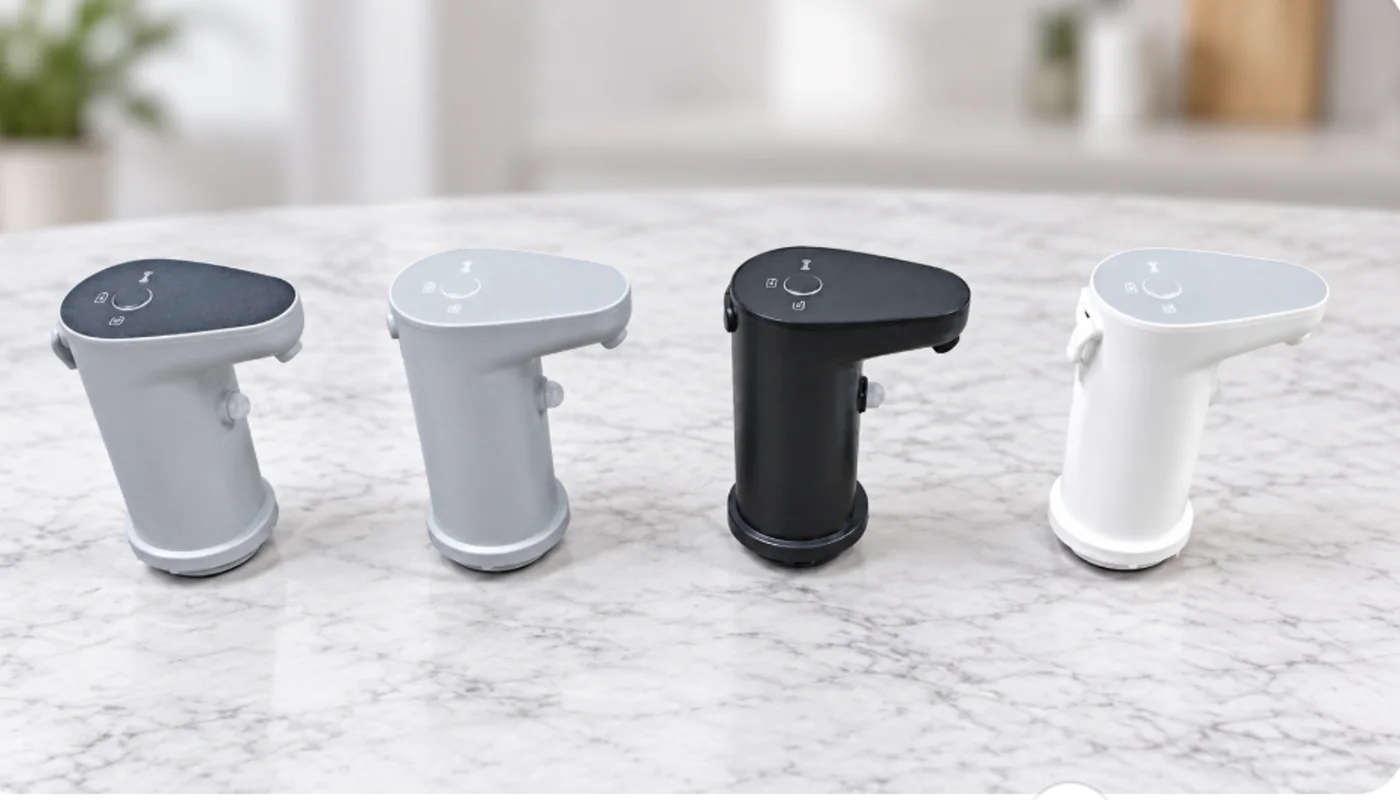
When we review a fountain platform for an OEM project, we separate drinking-water contact, pump operation, cord and adapter layout, cleaning access and manual warnings. We identify the selected voltage and adapter, power architecture, low-water behavior, outlet, filter reference, accessible pump parts and replacement path. We also check that instructions distinguish washable housings from disposable filter media and dry electrical areas.
Brands should request water-contact material information appropriate to the product and market, confirm cord routing and strain relief, document any verified low-water warning or dry-run protection, and test the real pack-out and instructions. Replacement pumps or electronics should be promised only where separate supply and user replacement are actually supported. After-sales teams need model-specific questions: Is the reservoir low? Is the pump drawing air? Is the cord damaged? Was the filter prepared correctly? Which parts may the user open?
For EU sales, buyers and importers should confirm the obligations that apply to their role and target market. The EU's General Product Safety Regulation overview notes that the framework applies from December 13, 2024 and includes product characteristics, design, instructions and warnings. Electrical, electronic, battery and producer-responsibility requirements may also apply. This article is a product-planning guide, not a substitute for market-specific compliance review.
Frequently Asked Questions
Are cat water fountains safe?
Yes, most cat water fountains can be safe when they are designed for pets, cleaned regularly, kept filled, placed safely and used according to the manual. Safety depends on the whole setup: water-contact surfaces, pump, filter, cord, adapter, water level and the cat's behavior. Keep another clean water source available in case the fountain stops or the cat avoids it.
Can cat water fountains make cats sick?
A fountain is unlikely to make a healthy cat sick by itself, but dirty water, attached residue, visible growth, old filters or hard-to-clean parts can create hygiene concerns. Empty and clean the fountain if water becomes cloudy, develops an odor or leaves slippery film. Provide fresh backup water while the fountain is out of service, and ask a veterinarian about illness or sudden drinking changes.
Are electric cat water fountains safe to leave plugged in?
They can be when the exact model supports continuous operation, the water is within its permitted range, and the cord, adapter and pump are undamaged. Keep plugs and power strips dry, route the cable away from chewing and unplug the fountain before cleaning or disassembly. Stop using it after damage, abnormal heat, exposed wiring or water in an electrical area.
Are plastic cat water fountains safe?
Plastic can be suitable when the water-contact material is intended for that use and the parts remain smooth, intact and cleanable. BPA-free is useful product information, but it does not prove every aspect of a fountain is safe. Replace cracked, deeply scratched, warped or degraded parts, and follow the cleaning limits for the exact material.
Is stainless steel safer than plastic for cat fountains?
Stainless steel is durable and often easy to wipe, but it does not make a fountain maintenance-free. Plastic may also be suitable when its composition and condition are appropriate. Compare the whole product: seams, pump access, filter holder, base, electrical architecture and replaceable parts. Surface condition and cleanability matter alongside the headline material.
Do cat water fountain filters make the water safe?
Filters can catch hair and debris or affect taste and odor, depending on their media. They do not sterilize water, clean the reservoir or replace pump maintenance. Use the correct cartridge, prepare and replace it as instructed, and clean the surrounding holder. A misshapen cartridge or one with similar layers is not automatically compatible.
Can a cat water fountain run dry?
A pump should not be operated outside the water range specified by the manufacturer. Low water can expose an intake and may cause air intake, noise, weak flow, heat or pump failure depending on the model. Check the level routinely and treat low-water warnings or automatic shutoff as helpful features rather than substitutes for observation.
How often should you clean a cat water fountain to keep it safe?
Check the water daily and follow the model's cleaning schedule, adjusting for pet count, food debris and visible residue. The reservoir, tray, outlet, filter holder and permitted pump parts may need different attention. If you see slime, cloudiness, odor or debris before the planned interval, clean sooner rather than waiting for the calendar.
Are cat water fountains safe for kittens or older cats?
Many kittens and older cats can use fountains, but the setup should match the individual. A kitten may paw at or tip a light fountain; an older cat may need a low, easy approach and a quiet location. Supervise introduction, keep a familiar bowl available and seek veterinary advice when mobility, disease, medication or prescribed fluid management affects drinking.
Should I still leave a water bowl if I use a cat fountain?
Yes. A clean backup bowl is a simple safety measure for power outages, pump problems, cleaning periods, low water, filter blockage or a cat that refuses the fountain. In multi-cat homes, separate water locations can also reduce competition and keep one event from blocking every source.
So, Are Cat Water Fountains Safe?
Cat water fountains are generally safe when users can keep the water fresh, reach the wet parts, maintain the filter and pump, protect electrical connections, inspect material condition and provide another water source. The answer depends on the exact design, its instructions, its condition and how the cat uses it.
Choose a model whose safety questions can be answered plainly. Check it, clean it, keep it filled and stop using it when something looks wrong. Keep another water source available so one pump is never the household's only route to drinking water.
Editorial and Safety Note
This guide provides general product-use and sourcing information. It does not diagnose illness, replace veterinary advice or certify a product for a particular market. Follow the manual for the exact fountain. Seek veterinary advice for diagnosed disease, prescribed fluid management or sudden changes in drinking, urination, appetite or behavior.
Sources and References
- CDC — Cleaning and Disinfecting Pet Supplies
- CDC — Preventing Waterborne Germs at Home
- Catit — Stainless Steel Flower Fountain Manual
- U.S. FDA — Food-Contact Substances: Information for Consumers
- AAFP/ISFM — Feline Environmental Needs Guidelines
- Cornell Feline Health Center — Feline Heat Safety
- EUR-Lex — General Product Safety Regulation overview