

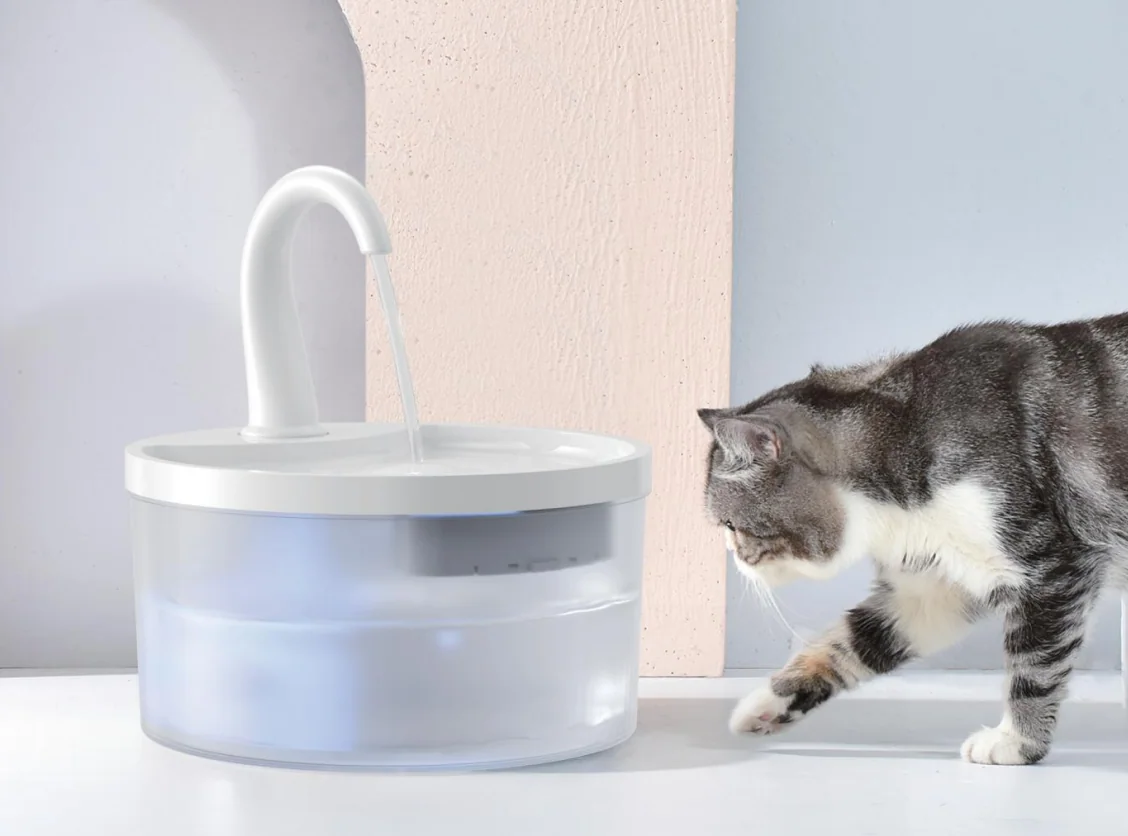
You fill the fountain before bed, hear the pump running quietly and pause before turning out the light. Should it keep flowing until morning? The same question comes up before work or a day away: leaving it on preserves the normal water presentation, but only if the water level, pump, power parts and operating mode can support that time unattended.
In many homes, you can leave a cat water fountain on all the time when the exact model is designed for continuous operation, the water stays above the pump intake, the pump sounds normal, and the cord and adapter remain dry and undamaged. Motor operation alone does not prove the setup suits 24/7 use. The model instructions, minimum water level, dry-run protection and actual flow all matter.
This guide separates four decisions: safe continuous operation, whether to turn a cat drinking fountain off at night, how to calculate electricity use, and how plug-in continuous flow differs from battery or sensor modes. It also covers dry-run warnings, power outages, backup water and the claims a brand should confirm before describing a fountain as suitable for always-on use.
Can You Leave a Cat Water Fountain On 24/7?
Usually, yes—if the exact fountain supports continuous operation and the pump remains safely covered by water. Turn it off or unplug it for cleaning, low water, abnormal noise, weak flow, damaged power parts, water near the electrical area, or whenever the manual requires disconnection.
For a cordless fountain, confirm whether “continuous” is available only while it is connected to external power. Battery operation may use a sensor or timed cycle instead of running the pump all day.
Do Cat Water Fountains Need to Stay On All Day?
No. A fountain does not have to run every minute simply because it can, although many plug-in models are intended for continuous flow. Turning one off stops circulation; it does not by itself damage a correctly shut-down fountain. The cat still needs water access, and the unit must be restarted and maintained as its manual describes.
Do not infer the routine from the word “automatic”: it can describe continuous pumping, a timer, a proximity sensor or simply an electric pump. The practical question is whether this exact cat drinking fountain can operate safely in its selected mode until you next check the reservoir, pump intake and power arrangement.
When Is It Safe to Leave a Cat Water Fountain On?
Continuous use is a reasonable choice only when the fountain is in the configuration its manufacturer permits and its operating conditions remain normal. No online answer can convert a sensor-only battery mode into a 24/7 mode or establish that damaged power parts are safe.
| Condition | Why it matters | What to check |
|---|---|---|
| Manual permits continuous operation | Confirms the intended power and operating mode | Exact model number, power source and mode wording |
| Water is within the permitted range | Keeps the pump intake covered and preserves the intended water path | MIN/MAX marks, window or reservoir level |
| Sound and flow are normal | A change can signal low water, debris, poor seating or a pump issue | Compare with the fountain’s normal filled operation |
| Pump and filter path are maintained | Debris or scale can restrict water movement | Follow the model cleaning and filter instructions |
| Power parts are dry and undamaged | Cords, plugs and adapters should remain in serviceable condition | No cuts, looseness, heat damage or water around electrical parts |
| Placement is stable | Reduces tipping, cable strain and water reaching the power area | Level surface, suitable indoor location and safe cable route |
| Backup water is available | Preserves access if power, battery or the pump stops | A separate clean bowl in an accessible location |
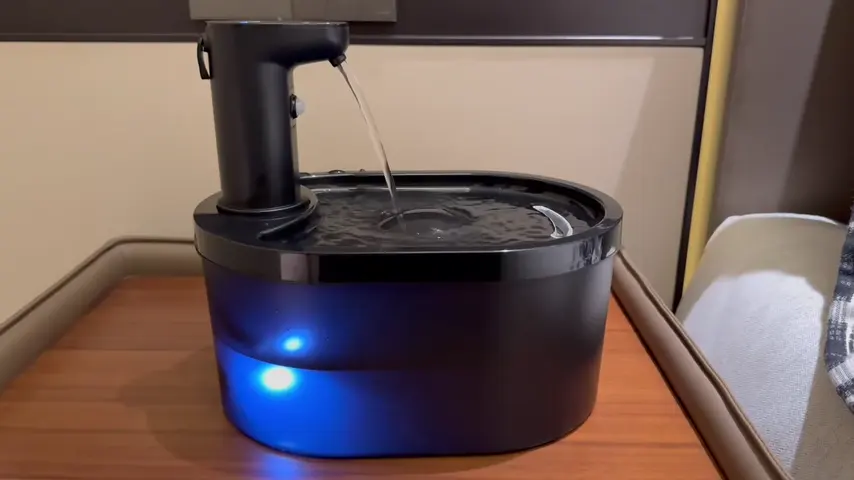 Visible flow
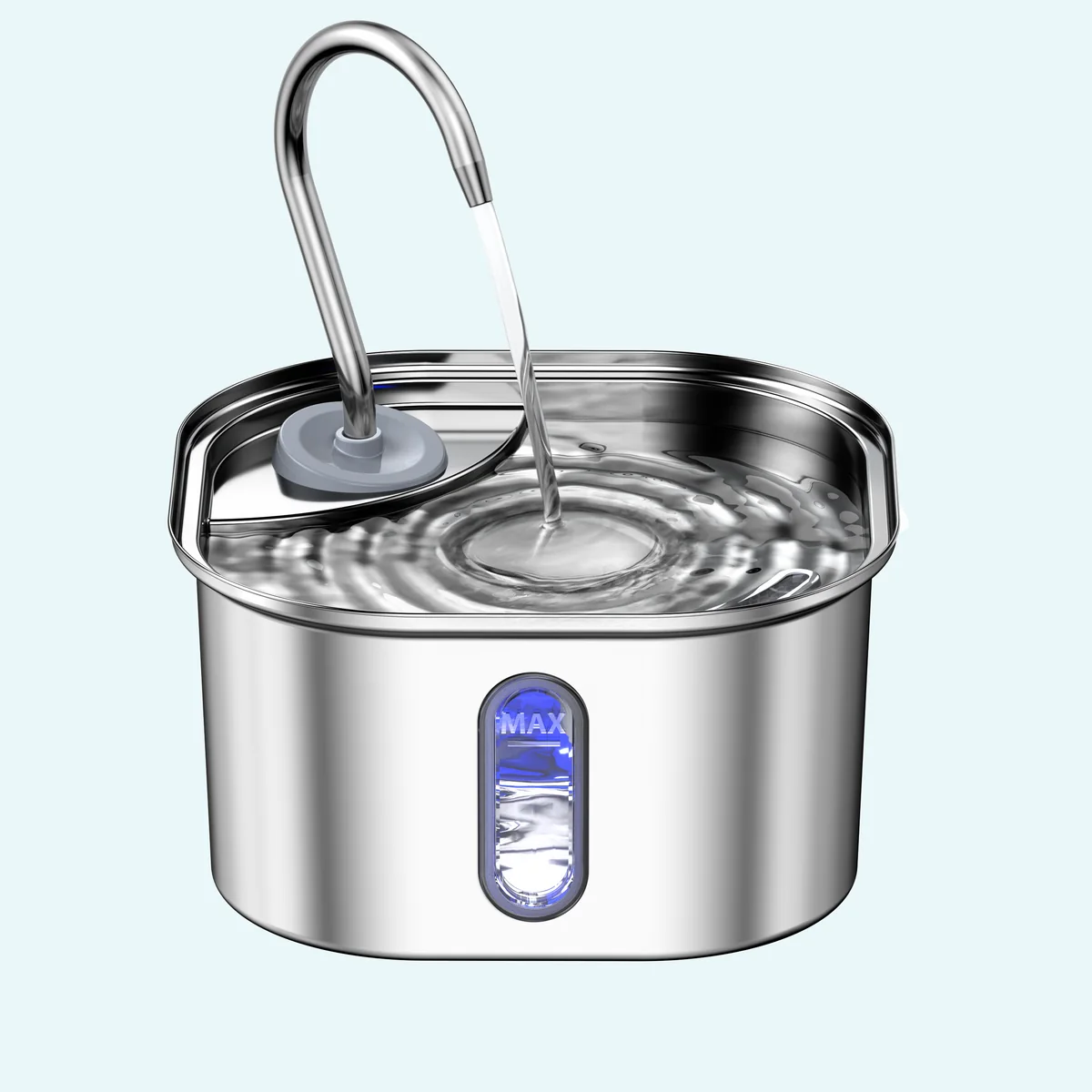 Visible water level
Check the exact manual. Product-family descriptions and advice for a similar-looking fountain do not override the instructions for your model and revision.
A stable location makes these checks easier. Keep the water indicator visible and the power connection away from splash paths. The cat water fountain placement guide covers access, outlet position and maintenance space without assuming one room suits every household.
When Should You Turn a Cat Fountain Off?
Turn the fountain off and disconnect it when the manual requires disconnection, before cleaning or disassembly, and whenever the water or electrical condition makes continued operation questionable. Correct the cause before switching it back on.
- The level is below the permitted minimum. Refill only as instructed and confirm the pump intake is covered.
- The pump is exposed, unusually loud or intermittent. Do not normalize a new rattle, buzz or dry sound.
- The stream is weak or blocked. Check water level, assembly, filter loading and accessible pump parts under the manual.
- The water or wet surfaces need attention. Odor, visible residue or accumulated debris calls for water replacement and cleaning rather than continued circulation.
- The cord, plug or adapter is damaged. Stop using the affected power part and follow the manufacturer’s replacement guidance.
- Water has reached an electrical area. Disconnect safely with dry hands when the instructions permit and address the spill before reuse.
- Your time away exceeds a realistic water and maintenance window. Tank capacity is not permission to leave the fountain unchecked indefinitely.
The cat water fountain pump troubleshooting guide separates low water, blockage, impeller access and reassembly. This section is the stop decision; it is not a substitute for diagnosis.
Should You Turn a Cat Water Fountain Off at Night?
Usually, no. If the fountain is designed for continuous operation, filled correctly, quiet, stable and electrically sound, there is no universal reason to switch it off every night. The decision changes when noise, light, low water or an unsuitable mode creates a practical problem.
Moving a fountain farther from a bedroom may solve normal water sound, but do not hide it where the level becomes difficult to see. Treat a new mechanical noise as a warning. If an LED is disruptive, use only a control the model provides; do not cover sensors or a warning indicator.
Leave it on
Continuous mode is supported, water is adequate, and sound and power condition are normal.
Turn it off
Water is low, operation is abnormal, power parts are damaged, or the instructions require it.
Use sensor/timed mode
The exact model provides that mode and it suits the household’s overnight setup.
If you switch the fountain off overnight, leave another clean water source accessible. A cat may drink outside the times you normally observe.
Do Cat Water Fountains Use a Lot of Electricity?
Many small fountain pumps have low rated wattage, but there is no universal monthly cost. Use depends on the complete product’s rating, operating hours and whether sensors, LEDs, charging electronics or control boards also draw power.
Calculate from the exact pet water fountain’s label or manual. The EIA kilowatthour definition describes one kilowatt-hour as 1,000 watts used for one hour.
Electricity use formula
Example: A 3 W pump running for 24 hours uses 0.072 kWh per day before considering LEDs, sensors, charging systems or standby power.
Sensor operation may use less energy because the pump runs for fewer hours, but battery capacity cannot quantify the saving. For a precise estimate, use the whole-product rating or an appropriate plug-in energy meter.
How Much Electricity Does a Cat Water Fountain Use 24/7?
For continuous operation, multiply rated watts by 24 and divide by 1,000. The examples show energy only; multiply the result by your local price per kWh for estimated cost.
| Rated power | Per day | 30 days | 365 days | Cost method |
|---|---|---|---|---|
| 1.5 W | 0.036 kWh | 1.08 kWh | 13.14 kWh | kWh × local tariff |
| 3 W | 0.072 kWh | 2.16 kWh | 26.28 kWh | kWh × local tariff |
| 5 W | 0.120 kWh | 3.60 kWh | 43.80 kWh | kWh × local tariff |
| 10 W | 0.240 kWh | 7.20 kWh | 87.60 kWh | kWh × local tariff |
These are calculations, not product measurements. Sensor cycles, LEDs, charging losses and other electronics can change consumption.
A 5 W label produces 0.12 kWh per day only if 5 W is drawn continuously. Check whether the number rates the whole product, the pump or an adapter’s maximum output.
Continuous Flow vs Sensor Mode: Why Power Mode Matters
Continuous, sensor and timed modes describe when water moves. Plug-in, rechargeable and battery-powered describe where energy comes from. A fountain may combine them in more than one way.
The official PETLIBRO Dockstream support page says continuous flow is available while plugged in. On battery, sensing activates the water instead. The PETLIBRO PLWF115 product page also distinguishes radar induction from externally powered continuous flow. That describes PLWF115, not every cordless model.
Continuous flow
Pump operates throughout the selected period
Often external powerSensor mode
Flow starts after a detected approach
Often used to preserve batteryTimed / interval mode
Flow follows a programmed cycle
Model-specific scheduleWhen we review fountain platforms for OEM projects, we separate continuous-flow claims from battery-runtime claims because a rechargeable fountain may not run continuously in battery mode. A large battery may extend sensor-mode service without providing continuous flow on battery power. Wireless-pump architecture also does not automatically mean cordless operation. Compare the cordless vs plug-in cat water fountain guide and the wireless pump vs cordless fountain comparison for those distinctions.
Battery-powered does not always mean 24/7 continuous flow. Confirm battery and external-power modes separately.
What Happens If a Cat Water Fountain Runs Dry?
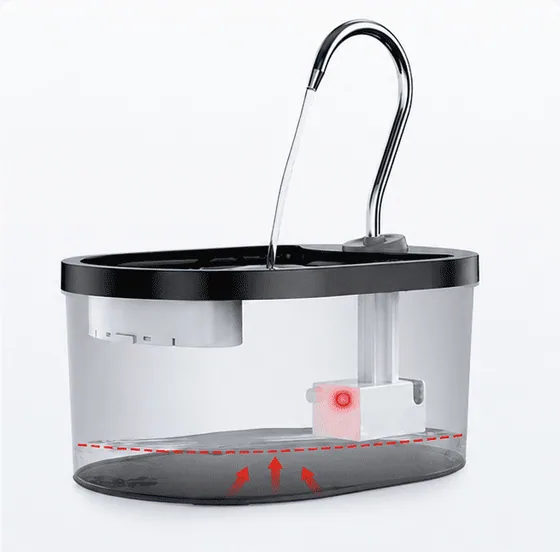
A fountain should not be allowed to run dry. Once the pump intake is no longer covered as required, flow can weaken or stop, noise can increase, and the pump may overheat or fail depending on its construction and protection system.
Do not let the pump run dry. Low-water protection can help, but it does not replace checking the water level. If the pump intake is exposed, the fountain may become louder, lose flow, overheat or fail depending on the model.
PETLIBRO’s PLWF115 product guidance tells users to fill between MIN and MAX and warns that its pump will fail if it runs dry. The Catit PIXI fountain product documentation lists a low-water indicator and auto-shutdown for that model, while the Catit PIXI fountain manual provides its operating instructions. These examples demonstrate two documented safeguards and warnings; they do not prove that every fountain has low-water shutoff.
The exact MIN/MAX position and protection behavior vary by model.
In product evaluation, abnormal pump noise is one of the first signs we check before assuming a fountain can continue running unattended. Low water is one possible cause, but debris, trapped air, vibration or poor assembly can produce a similar symptom. Switch off, inspect the condition and follow the manual rather than repeatedly restarting the pump.
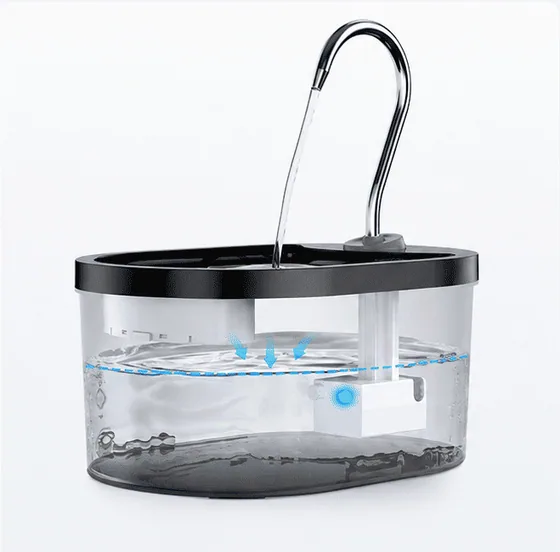 Normal indication
 Low-water warning
What About Power Outages or Leaving Home?
An electrically powered fountain may stop circulating during an outage. A rechargeable model may continue only when its battery is charged and its selected mode supports operation. Do not assume a fountain will restart in the same mode after power returns unless its documentation confirms that behavior.
Before leaving, fill only to the permitted level, estimate how long the usable water above MIN normally lasts, and consider other cats, evaporation and splash. A nominal tank capacity is not the same as the operating reserve above the minimum level. In a multi-cat home, the cat water fountain capacity guide for multiple cats explains why actual refill history is more useful than a litres-per-cat rule.
Normal configured operation
Independent of power and pump
during an outage or unexpected stop
Leave a separate clean bowl where the cat can reach it without depending on the fountain’s power, battery, pump, app or cloud connection. A backup source is simple redundancy, not a prediction that the fountain will fail. On return, check the level, flow, indicator state and whether the model resumed normally before treating circulation as restored.
8 Things to Check Before Leaving a Fountain On All the Time
Use this checklist after filling and reassembly, and repeat it whenever the fountain’s sound, flow or location changes. It turns a generic “safe or unsafe” answer into a model-specific operating decision.
- Does the manual allow continuous operation?
Confirm the exact model and power mode. A product may support continuous flow only under external power.
- Which power mode is active?
Identify plug-in, battery, sensor or timed behavior. Do not use the word “wireless” as a substitute for this check.
- Is the water safely above the pump intake?
Use the permitted operating range, not a guess from the top tray. Refill before the pump is exposed.
- Does the pump sound normal?
A new rattle, buzz or intermittent sound is a reason to stop and inspect, especially after a refill or reassembly.
- Is the flow normal?
Compare the visible stream with normal clean operation. Weak flow can reflect low water, debris, filter restriction or incorrect seating.
- Are the cord, adapter and outlet area dry and undamaged?
Route the cable without strain and keep electrical parts away from standing water. Stop using damaged power parts.
- Has the fountain been cleaned recently?
Continuous circulation does not clean the reservoir, tray, filter holder or pump. Follow the cat water fountain cleaning guide and the model manual.
- Is another water source available?
A clean backup bowl preserves access during a power outage, empty battery, blocked pump or unexpected shutdown.
What Brands and Retailers Should Specify for Always-On Use
For a brand, “can it stay on all the time?” affects more than the pump wattage. The answer connects the operating-mode claim with the adapter, minimum water level, warning system, instructions, cleaning access and after-sales response.
Before sampling cat water fountain platforms, record whether each configuration supports continuous plug-in flow, sensor operation, timed operation or battery use. Confirm any low-water warning or automatic shutdown on the exact version, and document restart behavior after a power interruption rather than assuming it. Pump service references should be described only where separate support is available.
For private-label programs, we prefer to confirm the operating mode, low-water behavior and manual wording before retail packaging claims are finalized. A claim such as “30-day battery” and a claim such as “24/7 continuous flow” describe different conditions and should not be blended into one headline. The cat water fountain manufacturer checklist shows how to tie those details to the approved model and repeat orders.
Frequently Asked Questions
Can you leave a cat water fountain on all the time?
Usually, when the model supports continuous operation, water is adequate, flow is normal and power parts are sound. Turn it off for cleaning, low water or abnormal operation.
Should I turn my cat water fountain off at night?
Not automatically. A suitable continuous-flow fountain can remain on overnight. If you turn it off, leave another clean water source available.
Do cat water fountains use a lot of electricity?
Many use low-wattage pumps, but check the complete product rating. Multiply watts by operating hours and divide by 1,000 for kWh, then multiply by the local electricity price.
How much electricity does a cat water fountain use?
A 3 W product running continuously uses 0.072 kWh per day and 2.16 kWh in 30 days. This is an arithmetic example; the actual rating and operating cycle decide real use.
Is it safe to leave a cat water fountain plugged in?
Only if its instructions permit it and the water level, placement, cord, plug and adapter remain suitable. Disconnect damaged power parts or wet electrical areas.
Can a cat water fountain run dry?
It should not. Low water can expose the pump intake, reduce flow and increase noise, and may lead to pump failure depending on the model. Low-water protection does not remove the need to inspect the reservoir.
Will a cat water fountain pump burn out if the water is low?
It may fail if it runs dry, depending on the model, but low water does not prove immediate failure. PETLIBRO specifically warns of pump failure for PLWF115; do not continue testing a pump dry.
Can a cordless cat water fountain run continuously?
Some models provide continuous flow only while connected to external power. PETLIBRO’s PLWF115 uses continuous flow when plugged in and sensor activation during battery-powered operation.
What happens to a cat water fountain during a power outage?
A plug-in fountain stops circulating. A rechargeable model continues only with sufficient charge and a supported mode. Check how it restarts after power returns.
Should I leave a backup water bowl if I use a fountain?
Yes, especially when the cat otherwise depends on one powered fountain or when you are away. Place it where the cat can access it independently of the fountain.
So, Should You Leave a Cat Water Fountain On All the Time?
In many homes, yes—when the fountain is designed for continuous use, the reservoir stays above the required minimum, the pump is not running dry, the power parts are sound and cleaning remains current. Those conditions matter more than a universal on/off rule.
Turn it off for cleaning, low water, abnormal noise, weak flow, damaged power parts or whenever its instructions require disconnection. For cordless models, confirm whether continuous operation exists only while plugged in. And if the fountain is the cat’s main water source, keep a separate clean bowl available for outages and unexpected stops.
About This Guide
This guide combines current official model documentation with Fountelio’s product-configuration perspective. Manufacturer examples are kept model-specific. The electricity figures are calculations from stated wattages, not laboratory measurements of the products shown.
Sources & References
- PETLIBRO — Dockstream Cordless PLWF115 continuous and battery-powered modes
- PETLIBRO — Dockstream Cordless PLWF115 product and dry-run guidance
- Catit — PIXI Drinking Fountain product features and low-water shutdown
- Catit — PIXI Fountain official instruction-manual page
- U.S. Energy Information Administration — kilowatt-hour definition