

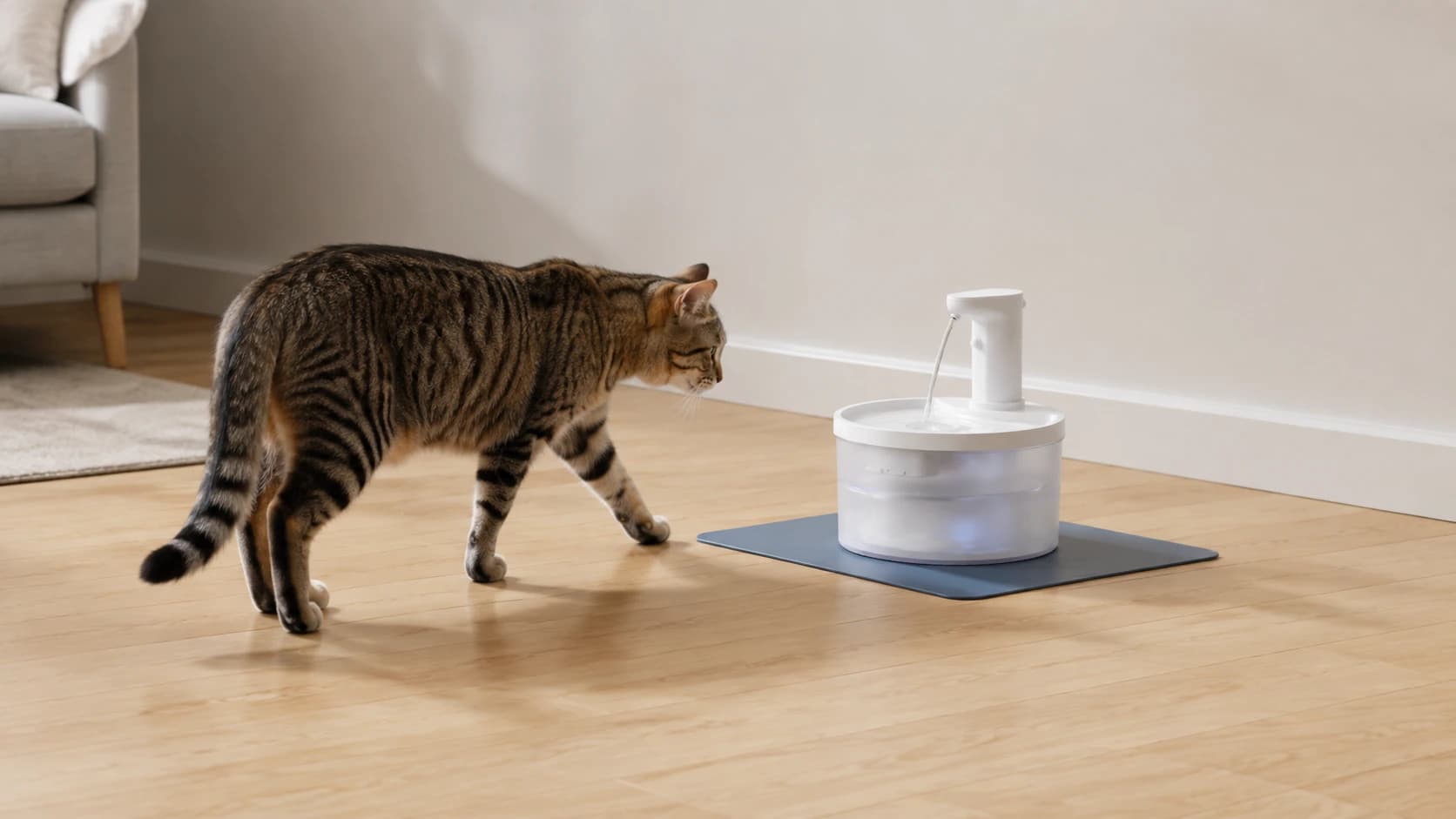
The empty space beside a cabinet may look like an obvious place for a fountain. Then you notice the door swings across it, the water window faces the wall, or the cat has to squeeze behind a chair to drink. A fountain can fit the floor space without fitting the daily routine.
To decide where to put a cat water fountain, choose a calm, accessible spot on a level, water-resistant surface, separate from food and litter. Plan the cable or charging route, keep strong sunlight off the reservoir and, on sensor models, face the detection area toward the cat's usual approach.
When I review a setup, I consider the approach to the tray and the route to the sink together. Both need to work after the novelty wears off. If the location is still shaping your purchase, our guide to how to choose a cat water fountain covers the wider product decision.
What Is the Best Place to Put a Cat Water Fountain?
The best spot is quiet, stable and easy to reach, away from the litter box and not directly beside food. Leave enough open space for the cat to see the room and move away comfortably, while keeping the fountain convenient for refilling, cleaning and safe power access.
Look for: clear approach, easy exit, stable footing, separate resources and visible water status.
Reconsider: a busy doorway, noisy appliance, litter corner, cramped wall position, strong sunbeam or cable across a walking route.
Better candidate
- Quiet but still visible
- Open approach and exit
- Separate from food and litter
- Level, wipeable surface
- Practical refill and power route
Reconsider this spot
- Busy doorway or appliance
- Trapped against furniture
- Touching the food bowl or litter zone
- Soft or uneven support
- Cord crossing the walkway
Conceptual home zones. Use the actual room layout and the fountain manual rather than treating these as fixed distances.
What Should You Check Before Choosing a Fountain Location?
Check the cat's access, separation from other resources, equipment requirements and your own maintenance route. A location only works when it fits the cat, the fountain and the maintenance routine.
- Cat comfortCan the cat approach, pause and leave?
- Resource separationDoes water have its own accessible zone?
- Fountain requirementsDo power and detection fit this position?
- Owner maintenanceCan you inspect, refill and remove parts?
| Factor | What to look for |
|---|---|
| Cat access | Unobstructed approach and departure |
| Noise | Away from sudden appliance activity |
| Food / litter | Separate, independently accessible zones |
| Surface | Level, firm and water resistant |
| Sun / heat | Out of strong direct sun and heat |
| Traffic | Outside the main walking route |
| Plug-in power | Reachable outlet; protected cable route |
| Cordless power | Practical charging and backup access |
| Sensor / radar | Expected approach inside the specified field |
| Maintenance | Water status visible; parts easy to lift |
| Multiple cats | More than one separated drinking location |
Should a Cat Water Fountain Be Near Food?
It can be in the same room, but it is usually better not to place the fountain directly beside the food bowl. The AAFP/ISFM environmental needs guidelines treat food and water as separate resources, while International Cat Care specifically lists a water source in the same room as food as an option when it is not directly next to the food.
Separation also has a practical purpose. Dry crumbs, food smells and splashes from wet food can reach water placed on the same small mat. A double feeder fixes both vessels into that close arrangement. Catit's placement guidance likewise recommends giving water its own position rather than treating it as one half of a feeding station.
In a small apartment, use a different corner of the same room or a separate stretch of wall with a clear approach. If your cat already drinks reliably beside food, avoid making a sudden long-distance move. Shift the fountain gradually while leaving familiar clean water available, then watch whether the new position remains easy to use.
| Setup | Usually OK? | Why |
|---|---|---|
| Touching the food bowl | Less suitable | Crumbs, smell and a shared approach keep both resources together |
| Same room, separate corner | Often practical | Creates separation without hiding water in an unfamiliar room |
| Different room | Can work well | Adds a distinct water station if the room remains accessible |
| Double feeder bowl | Usually avoid | Food and water stay fixed directly beside each other |
Should a Cat Water Fountain Be Near the Litter Box?
No, keep a cat water fountain away from the litter box. International Cat Care recommends quiet water locations away from litter trays, and Catit similarly advises against placing food or water beside the cat's toileting area.
The reason is straightforward rather than alarming: litter odor may make the drinking spot less inviting, and tracked litter or dust can enter an open tray. Grouping litter, food and water into one convenient owner-facing station also means one route or one occupied area controls access to several resources.
In a compact home, meaningful separation matters more than an unsupported number of feet or meters. Put the fountain on the opposite side of the room, use furniture as a visual divider without creating a narrow trap, and keep the cat's route to water from running directly past the litter tray. If that is not possible, another consistently open room is a better candidate.
A single bottleneck still controls access.
Keep usable routes between each resource and the cat.
Conceptual zones, not a floor plan or minimum-distance rule.
The diagram shows separate zones and approach routes, not a required floor-plan measurement. Keep an established water source available while testing a new location.
Quiet Corner or Busy Area: Which Is Better?
A quiet, low-traffic area is usually better, provided the fountain is not hidden in a cramped dead end. International Cat Care recommends water sources away from doors, noisy appliances and thoroughfares, where a cat can approach without repeated interruption.
Avoid the space beside a washing machine, dryer, dishwasher, slamming door or loud refrigerator compressor. A narrow hallway can also be difficult because people, dogs or other cats repeatedly cross the route. By contrast, the low-traffic edge of a living room or a home office can keep the fountain visible without placing it in the center of activity. A bedroom may work when the cat has access and the owner is comfortable with the pump, falling-water sound and any light at night.
Observe behavior rather than judging the room only when it is empty. A relaxed cat usually approaches, pauses and leaves without repeatedly stopping to scan the route. If the cat advances cautiously, startles when an appliance cycles or waits for people to pass, try a calmer position. The cat-not-using-a-fountain troubleshooting guide covers noise, flow and transition factors that placement alone cannot explain.
How Can You Tell Whether the Area Is Too Busy?
Check the proposed spot during the household's busiest periods, not only when the room is quiet. Watch doors, foot traffic, chair movement, appliance cycles and the routes used by other pets.
A location beside a walkway may be acceptable when the fountain is recessed from the path and the cat retains two easy directions of travel. Move it when the unit is bumped, the cord crosses the route, the cat repeatedly abandons an approach or a sensor fountain is triggered by passing activity. If splashes or movement make the area unsafe, the leaking, splashing and tipping guide separates placement problems from actual leaks.
Should a Cat Water Fountain Be Kept Out of Direct Sunlight?
Avoid strong direct sunlight where practical. Catit's guidance for the PIXI Stainless Steel UV-C Fountain recommends keeping that model out of direct sun because exposure can warm the water, encourage growth on wet surfaces and age plastic components.
The Catit product Q&A is a model-specific example, not evidence that a brief sunbeam makes water unsafe. Check where sunlight falls later in the day; moving to shade does not replace cleaning.
What Surface Should a Cat Water Fountain Sit On?
Use a firm, level, water-resistant surface that supports the whole base. An uneven or soft support can tilt the tank and change how water sits around the intake or level indicator. A wipeable surface also makes small splashes easier to manage.
Tile or a suitable sealed floor with a thin waterproof mat is practical. If carpet is unavoidable, use a rigid, stable waterproof barrier rather than a soft towel alone, and check underneath for moisture. Keep the fountain away from furniture edges.
How Much Should Cleaning and Refilling Affect Fountain Placement?
Maintenance access should help decide the location from the start. You need to see the water status, reach the controls and lift the removable parts without tipping them around furniture. A spot that hides the reservoir also hides reminders to refill it.
When I review a setup, I include the lift-out space. A tank that fits below a shelf may still be awkward to remove when full. Try the removal motion before settling on that position, following the model's power-off and handling instructions.
For refilling, work through the motion the model actually permits: can you pour without reaching over electronics, or must the reservoir come off the base? Leave room for that action, and face the water window or indicator toward a route you regularly use. Check whether you can wipe around and beneath the base without moving a chair or cabinet first; easy tank removal does not help with splashes left out of reach.
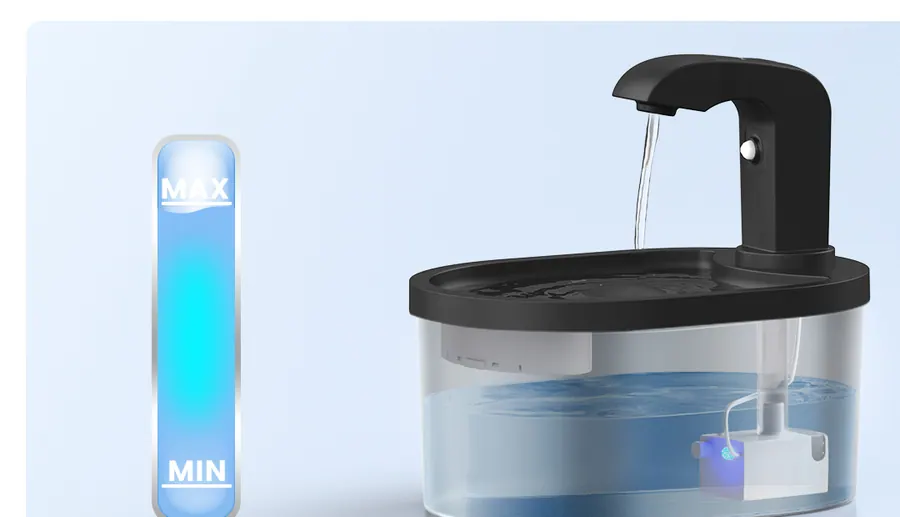
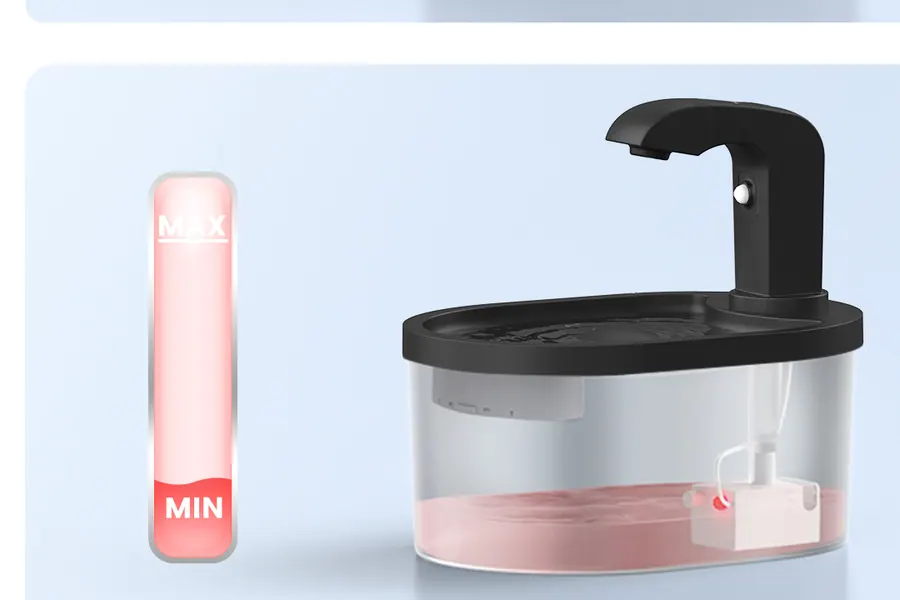
Consider the carrying route to the sink and somewhere dry to leave the electrical base. Our cat fountain cleaning guide explains which wet parts and pump areas need access.
Where Should You Put a Plug-In Cat Water Fountain?
Choose a position near a suitable outlet where the cord reaches without stretching across a walking path. Keep the adapter and electrical connections dry as the manual specifies. Avoid doors or furniture that repeatedly pinch, pull or trap the cable.
Trace the whole route, including the connector at the fountain. Leave the amount of slack needed for normal positioning without creating a loose loop in the cat's approach. The plug should remain reachable when you disconnect the unit for cleaning.
Outlet proximity is useful only when the route is practical. A socket just across a doorway may be a worse choice than one a little farther along the same wall. Use the supplied cord's reach to compare positions, including where you will stand to disconnect it. If routine cleaning means reaching behind heavy furniture or handling a connection beside a wet tank, reconsider the station before making it permanent. Follow the model's instructions for keeping the adapter and connections dry.
Route beside the wall
Keep the connector dry and the plug reachable.
Route across the walkway
Reposition the station to avoid the crossing.
Illustrative route comparison. Follow the product's electrical and cable instructions.
Where Does a Cordless Cat Water Fountain Have an Advantage?
Cordless operation helps when the cat-preferred drinking spot is far from an outlet or a permanent cable would cross an awkward route. It is useful for testing open-room positions, but the fountain still needs a stable surface, a charging routine and the same cleaning attention as a plug-in unit.
If the fountain will permanently sit beside a suitable outlet with an unobstructed cord route, the placement advantage may be small. Use cordless flexibility to improve access or resource separation rather than assuming every cable-free spot is suitable. Check which operating modes remain available on battery in the cordless versus plug-in cat water fountain guide.
| Fountain type | Placement advantage | Placement caution | Best use case |
|---|---|---|---|
| Plug-in | Consistent power near an outlet | Keep cord out of walkways and plug or adapter dry | Stable station with a safe cable route |
| Rechargeable cordless | Tests positions away from outlets | Plan charging and backup water | Open room or separate water zone |
| Wireless-pump platform | Pump module can be separated from the external cable path | Base and reservoir requirements remain model-specific | Approved platform layout with the matching base |
Cat access in use. The rug shown still needs a stable support and moisture-protection check.
No permanent cable between the two during battery operation. Keep the drinking zone clear of traffic.
Conceptual layout, not a minimum-distance rule. Battery mode and charging arrangements remain model-specific.
The Fountelio wireless-pump platforms illustrate the distinction: a rechargeable base needs a charging plan, while a USB continuous-flow base needs connected power. Their related pump architecture does not make the bases interchangeable. The cat water fountain safety checklist covers dry-hand, cord and adapter precautions in more detail.
Does Cordless Mean You Can Put the Fountain Anywhere?
No. Battery operation removes the permanent-outlet constraint, but the fountain still needs stable footing, suitable indoor conditions, cat access and regular attention. A sensor model also needs an appropriate approach direction.
Decide what supplies water during charging. If the normal station must be moved or switched off, leave another clean water source accessible.
How Does a Motion-Sensor Fountain Change Placement?
Position a sensor fountain so the cat enters its active detection area on the way to the tray. Being physically close to the fountain does not guarantee being inside that field. Direction, range and the selected mode all matter.
Range describes how far detection may reach under the specified conditions; angle describes how wide the field is. A front approach may enter it early, while a side approach may enter only near the tray. A rear approach can remain outside a directional field altogether. Those are placement specifications, not just feature-list numbers: they help determine which orientation suits the route from the cat's usual resting area. Use the exact model's diagram rather than assuming the housing shape reveals the sensor direction.
The PETLIBRO Dockstream 2 FAQ describes missed drinking registration when a pet drinks from behind in sensor mode and suggests wall placement for that situation. That example concerns detection and recording; a missing app entry alone does not prove no water was available.
Approach enters the field
Check whether the selected mode starts as intended.
Approach stays behind it
Close to the tray can still be outside detection.
Conceptual directional sensor example, not a Fountelio sensor-location drawing or a measured coverage map.
Observe the approach your cat actually takes. Reorienting a fountain may be enough; forcing the cat into a cramped route to satisfy the sensor is a poor trade. Check activation separately from any app record, using the manufacturer's setup procedure.
Where Should You Put a Radar-Sensing Cat Water Fountain?
Face the specified detection area toward the expected approach, while considering movement farther into the room. Radar range and angle are configuration-specific. A wide field offers coverage, but it also means the placement check extends beyond the footprint of the tank.
For Fountelio's rechargeable CWF-W1 radar configuration, the stated angle is 150° and the approximate range is 2–3 m. The USB continuous-flow version does not have radar. These numbers describe the selected platform; they are not a guarantee of detection throughout every room.
Use that nominal sector to compare the cat's route with the rest of the room. A position facing a busy doorway may expose more passing movement to the field than one turned toward a quieter approach. That does not mean every person or pet passing will activate it; sensitivity, trigger logic and the actual layout determine the response. Try to preserve an easy cat approach while reducing exposure to traffic unrelated to drinking.
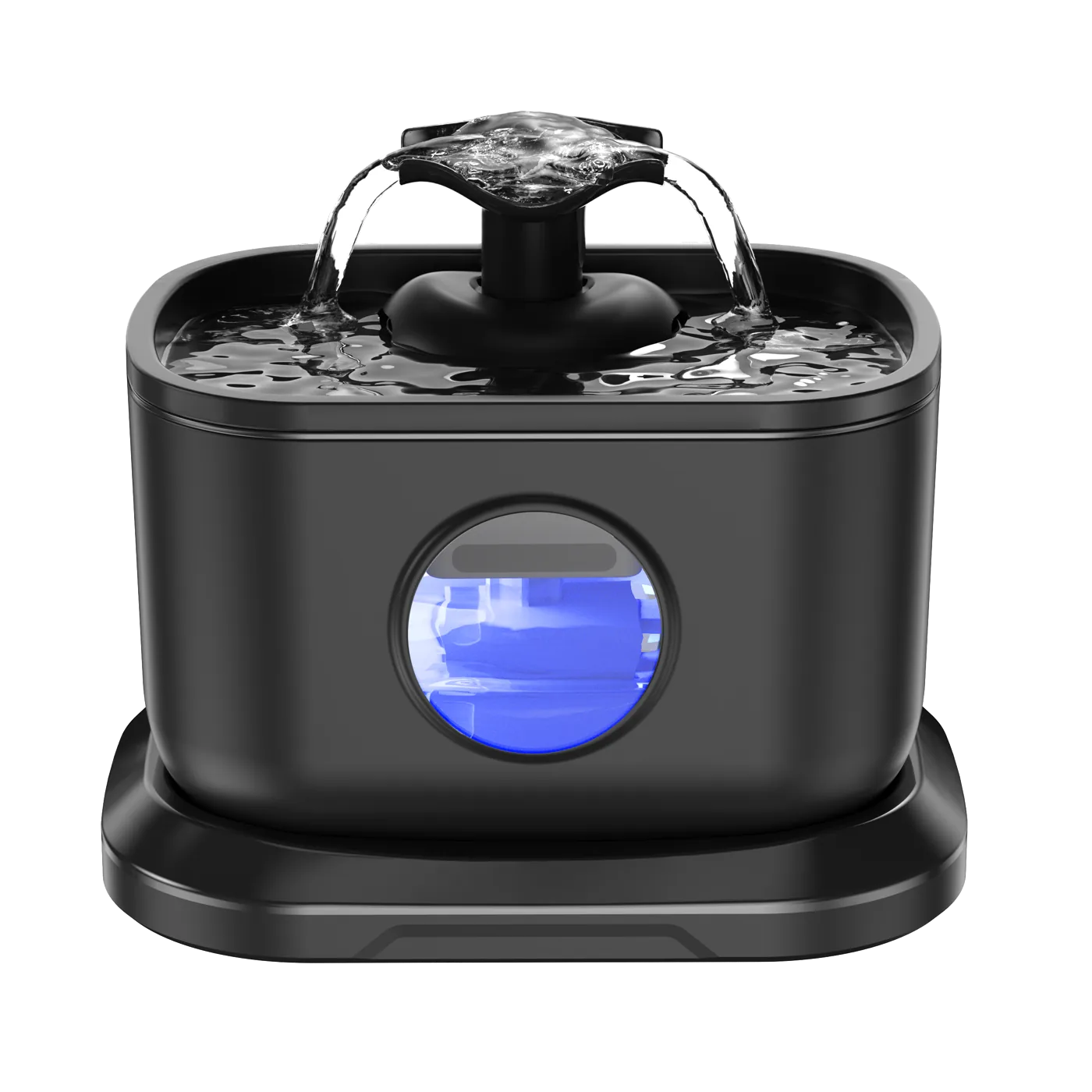
Rechargeable radar version only. The USB continuous-flow version has no radar.
Nominal rechargeable-radar specifications. The sector is conceptual, not measured room coverage or a diagram of the sensor's physical location.
With a wide field, I also ask what crosses it during the day. Try the intended orientation with normal household movement before judging it. Do not assume detection through furniture or walls, or infer the sensor's location from an exterior photograph. The wireless pump versus cordless guide separates pump design from sensing.
Observe two situations separately: the intended approach to the tray, and ordinary movement nearby when no cat is drinking. That distinguishes useful activation from avoidable pumping without labelling every extra cycle a sensor fault. If an orientation reduces passing activations but makes the cat approach from outside the field, it has not solved the placement problem.
| Model / configuration | Published field | Placement implication |
|---|---|---|
| Catit PIXI Stainless Steel UV-C | 120° in front; within 1 m | Arrange approach through the front field |
| Fountelio CWF-W1 rechargeable radar | 150°; approximately 2–3 m | Review the wider approach and passing traffic |
Can Fountain Placement Affect Battery Runtime on a Sensor Model?
It can. If the position causes more activations, the pump may run longer in total and need charging sooner. The effect depends on trigger logic, cycle duration and the battery system.
The relationship runs from placement to activation frequency, then to total pump operating time and potentially the interval between charges. If each extra activation starts a fresh fixed-length cycle, more triggers add pumping time. If the controller ignores repeat movement during an active cycle or uses a waiting period, the same passing traffic may have much less effect. A room name alone cannot predict which behavior occurs.
Compare positions using the same permitted mode and observe whether cycle frequency actually changes. Our cordless versus plug-in guide explains why runtime claims depend on operating conditions as well as battery capacity.
Observe unnecessary cycles before blaming battery capacity. There is no defensible fixed percentage for how much a hallway or room changes runtime.
Should You Put a Cat Water Fountain Against a Wall?
It can be near a wall, but it should not be jammed into a corner or placed where the cat must drink with its back to the room. International Cat Care recommends easy access from all sides where possible, and Catit similarly advises leaving space around bowls and fountains.
A wall can still be useful for keeping the station outside foot traffic or orienting a front-facing sensor. Leave enough side space for the cat to approach and turn away, and enough working room for you to lift the reservoir, remove the tray and reach the connector. Avoid the narrow gap between a sofa and cabinet, even when that gap looks tidy from standing height.
A washable mat can define the water zone and manage small splashes without becoming a barrier. Keep the mat flat and wider than the base, then check that its edge does not curl into the approach. PETLIBRO's wall suggestion in the sensor example above addresses a specific detection issue; apply the clearances and orientation required by your own model.
Avoid
One narrow approach
Better
Two usable approaches
Best access
Room for cat and cleaning
Conceptual access comparison. Use the clearances and electrical instructions for the exact fountain.
Is the Kitchen a Good Place for a Cat Water Fountain?
A quiet kitchen zone can work if water is separate from food and away from cooking heat, busy doors and appliances. A washable floor and nearby sink are useful. The space beside a repeatedly opened dishwasher is less useful, even in the same room.
Can You Put a Cat Water Fountain in a Bedroom?
Yes, if the cat can access it and the sound and lights suit the household. Listen during the actual operating mode at night. Pump starts, falling water and LEDs may be more noticeable then; cordless operation does not inherently make a fountain quieter.
Is a Hallway a Good Location for a Cat Fountain?
A wide, quiet hallway can work if the station sits clear of the walking route. A narrow corridor may expose it to bumps, blocked access and extra sensor activations. Check whether doors remain open when the cat needs access.
Which Rooms Usually Work Best for a Cat Water Fountain?
No room wins by name. Choose the usable zone within that room by comparing cat access, household disturbance, power safety and your refill routine.
A kitchen can be convenient because the sink and wipeable floor are nearby, but avoid the food bowl, bin, hot cooking area and dishwasher route. A living-room edge often balances familiarity with open access when it is away from speakers and children's play. Bedrooms and home offices can be calm because the cat already spends time near the owner; check night noise, LEDs, chair wheels and whether the door stays open.
Hallways are often the weakest choice because a narrow route is easy to kick and hard for a cat to leave. Bathrooms can work only when they stay clean, ventilated, accessible and electrically safe. Laundry rooms are usually less suitable when washers or dryers start suddenly. If a room fails one test, look for a better zone before ruling out the entire room.
| Room | Works when | Avoid when | Best setup tip |
|---|---|---|---|
| Kitchen | A quiet wipeable zone is available | Food, bin, heat or dishwasher traffic is close | Use a separate corner near the sink |
| Living room | The edge is open and low traffic | Speakers or play activity startle the cat | Keep two approach directions clear |
| Bedroom | The door stays open and sound is acceptable | Pump sound or light disturbs sleep | Test the actual night mode first |
| Hallway | It is wide and genuinely quiet | People, doors or pets repeatedly pass | Recess the station outside the walking line |
| Bathroom | It is clean, ventilated and safely powered | Litter, chemicals or splash zones are nearby | Keep it away from the toilet and wet outlets |
| Laundry room | Machines are rarely used near the station | Noise and vibration are frequent | Choose another room if cycles cause caution |
| Home office | The cat rests there and cables are controlled | Chair wheels block the route | Use a visible edge outside the chair path |
Where Should You Put Water Fountains in a Multi-Cat Home?
Use more than one water station when possible and place them in different areas so one cat cannot block access. International Cat Care recommends at least one water source per cat plus one extra, spread through the home, with at least one on every floor. This is a water-source guideline, not a requirement to buy one powered fountain for every cat: clean bowls and fountains can form the network together.
The 2024 AAFP intercat tension guidelines also support multiple visually separated feeding and water stations. Several vessels lined up together still depend on one shared approach. Watch whether a cat waits at a doorway or turns back when another cat occupies the route; another station reached from a different direction can be more useful than a larger tank in the same place.
Visual separation adds something that extra capacity cannot: the cats do not have to use water stations in direct view of one another. Different usable zones, sometimes divided by a room boundary or furniture, can help provide that choice. Preserve clear entry and exit around any divider. Two stations in different rooms still share a bottleneck if both can only be reached through the same narrow doorway.
A single bottleneck still controls access.
Use separate rooms or suitable visual separation.
Conceptual zones, not a floor plan or minimum-distance rule.
Fit the arrangement to the cats and available space. The diagram shows separate access routes; it does not prescribe a fountain for each cat.
Should a Fountain and Water Bowl Be Placed Together?
For separate location choice, different suitable spots are more useful than side-by-side vessels. A clean bowl beside a fountain can still provide backup water if the pump stops, but it does not provide an alternative access route.
Think of choice and backup as two separate benefits. Different water presentations side by side offer a fountain-or-bowl choice, but both remain exposed to the same traffic or blocked route. Placing the bowl in another suitable zone adds location choice as well as water that remains available during charging or pump maintenance. Both stations still need fresh water and cleaning.
Using a fountain and a bowl in separate zones is a practical application of resource separation. The guidelines do not prescribe that exact combination.
What Should You Change If Your Cat Ignores the Fountain?
Change one factor at a time and keep the old clean water bowl available during the transition. Placement can be the problem, but sound, flow, cleanliness and unfamiliar equipment can produce the same response.
- Keep the old water bowl available.
- Place the fountain near the cat's previous drinking area.
- Let the cat inspect the fountain before turning it on.
- Add water but leave the motor off briefly if the new sound causes caution.
- Turn it on when the cat is relaxed rather than carrying the cat toward it.
- Check the water level and listen for pump noise.
- Try a quieter room or a calmer edge of the same room.
- Clean the pump and rinse or replace the filter as the manual directs.
- Test a different suitable location before deciding the cat dislikes fountains.
- Ask a veterinarian if drinking changes suddenly or substantially.
- InspectResources → traffic → approach → sensor → power
- Adjust one thingPosition, orientation or permitted flow setting
- ObserveVoluntary use, easy exit and manageable refilling
The pump noise and weak-flow troubleshooting guide helps separate location from equipment problems, while the cat-not-using-a-water-fountain guide covers the full transition process. If the fountain normally runs continuously, the leave-a-cat-water-fountain-on-all-the-time guide explains water-level and backup-water planning.
How Do You Know the Location Is Working?
Look for repeated voluntary use, an uncomplicated approach and departure, and a refill routine you can sustain. There is no minimum visit count that proves success. An abrupt change in drinking or signs of illness needs veterinary advice rather than repeated furniture rearrangement.
How Much Space Should You Leave Around a Cat Water Fountain?
Allow room for the cat to turn away and for you to lift the tank, remove the top and reach the connector. Exact clearance depends on the removal direction and model instructions.
Check upward space under shelves as well as floor space. Do a gentle lift-out check with the unit switched off and emptied as instructed, rather than discovering the obstruction while carrying a full reservoir.
What Should Brands and Retailers Explain About Fountain Placement?
Placement instructions should cover both the cat's access and the supplied hardware. Show food and litter separation, a stable surface, the cable route, charging steps, keep-dry components, sensor direction and the space needed to refill and remove parts. A short QR setup guide can demonstrate the same points more clearly than a generic lifestyle photograph.
I would ask for a setup drawing for each version during private-label sample review. A shared housing can conceal different power and control arrangements, so placement advice should follow the exact model from the cat water fountain platform range rather than one universal illustration. Retail education can also link movement-related questions to the evidence-based explanation of why some cats show interest in running water.
What Cat Water Fountain Placement Mistakes Should You Avoid?
Avoid choosing solely by unused floor space. Common placement mistakes include:
- Combining food, water and litter in one station.
- Hiding the fountain where neither access nor water level is easy to check.
- Crossing a doorway with the cord.
- Assuming cordless means any indoor or outdoor location is suitable.
- Pointing a sensor without observing the approach.
- Changing several factors at once during a trial.
What Is the Final Checklist Before You Place a Cat Water Fountain?
Check the complete setup before leaving the station in daily use.
- The cat can approach and leave freely.
- Food and litter have separate locations.
- The base is level and splashes are manageable.
- Power connections and charging follow the manual.
- The selected sensor mode works from the expected approach.
- You can see water status and remove parts comfortably.
- Another clean water source remains available when needed.
What Are the Most Common Questions About Cat Water Fountain Placement?
Can I put a fountain on a shelf?
Only if the model permits it, the shelf is secure and the cat can access and leave it comfortably. Keep it away from an edge.
Should the fountain be next to the food bowl?
Usually no. Give water its own accessible position rather than keeping both on one small feeding mat.
Can the fountain be near the litter box?
Place it in a separate clean zone. A different part of the room may work when space is limited, provided the cat does not have to pass the litter tray to drink.
Should I move it every day?
A stable trial position makes use easier to assess. Move it to address a specific problem, then observe before changing another factor.
Can an indoor cordless fountain go on a balcony?
Battery operation does not establish outdoor suitability. Check the model's environmental rating and instructions.
What Should Decide Where You Put a Cat Water Fountain?
Choose a zone the cat can use comfortably and you can maintain consistently. Separate the resources, then fit the cable, charging and detection requirements to that location. If one check fails, adjust the setup and observe again.
About This Guide
Written by Tony Kong, R&D Engineer at Fountelio. Fountelio manufactures cat water fountains. Product observations and setup priorities are based on Fountelio product materials; feline resource guidance is attributed to AAFP/ISFM and International Cat Care. Manufacturer examples apply to the named models and configurations.
The home scene is an illustrative placement example. Spatial diagrams explain relationships, not exact room dimensions or measured sensor coverage. Follow the current manual for your fountain.
Sources & References
- AAFP and ISFM Feline Environmental Needs Guidelines (2013)
- 2024 AAFP Intercat Tension Guidelines
- International Cat Care: Encouraging Your Cat to Drink
- Catit: Why You Shouldn't Place Your Cat's Food and Water Together
- Catit PIXI Stainless Steel UV-C Fountain Q&A
- PETLIBRO Dockstream 2 product FAQ
- Fountelio CWF-W1 platform specifications