

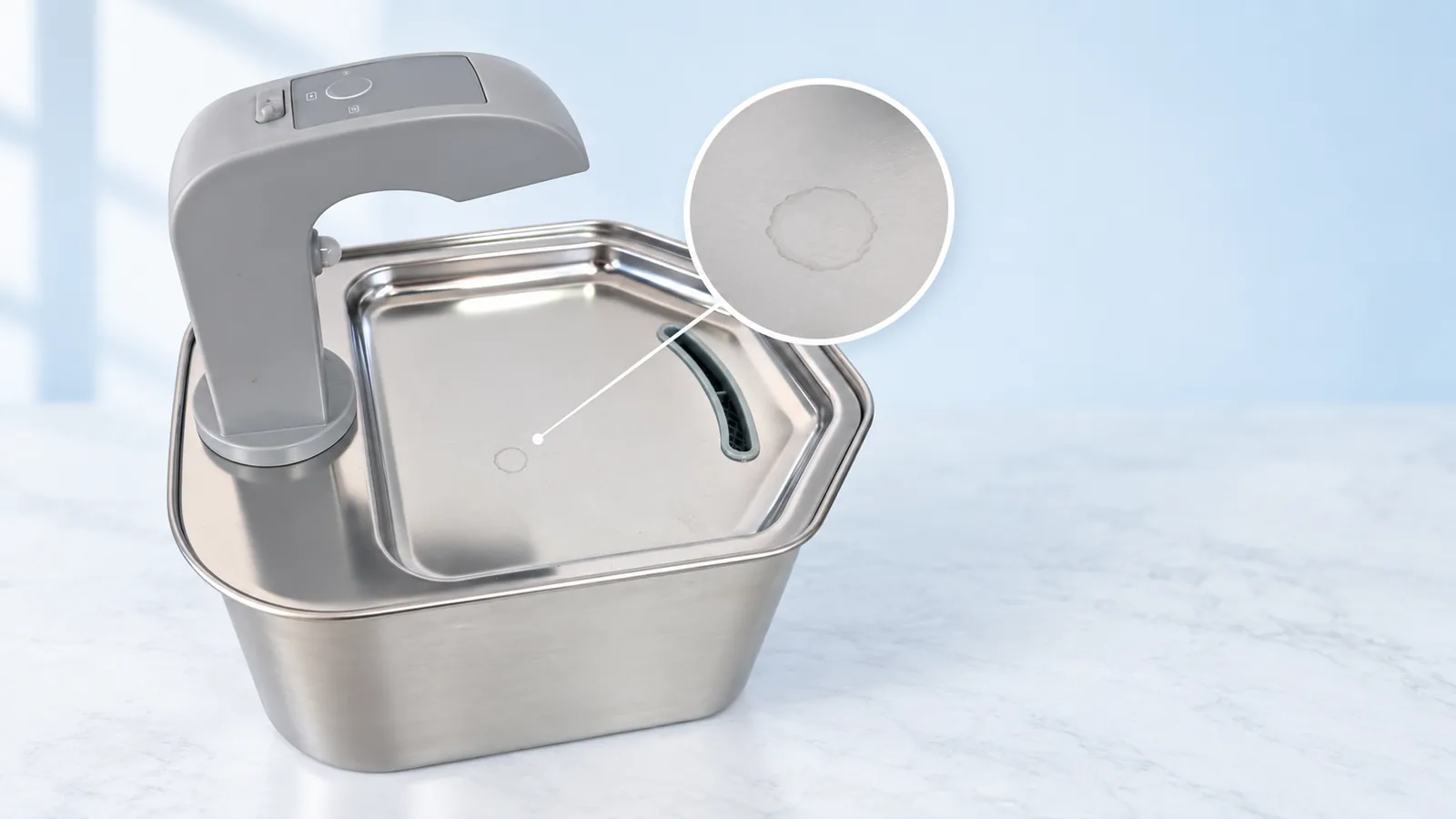
You clean the fountain, refill it and then notice a pale ring around the tray, a chalky line near the spout or a crust inside the pump area. It can make a recently cleaned fountain look dirty again. The useful first question is not simply “How do I scrub this off?” It is whether the white material is mineral scale, soap residue, filter dust or something organic.
White residue in a cat water fountain is often limescale or mineral buildup from hard water. Hard water contains dissolved minerals, especially calcium and magnesium, which can remain as white or gray-white deposits after water evaporates. That is different from slime, mold or foam, so it calls for a different cleaning and troubleshooting response.
This guide shows how to separate those problems, where hard-water deposits collect, how they may interfere with flow, and which parts can be washed, descaled or only wiped. It also covers what brands and retailers should say when a customer finds white residue in a cat drinking fountain, without treating every mark as a defect or every vinegar method as universal.
Why Does a Cat Water Fountain Get White Residue or Limescale?
White residue is often caused by hard-water minerals such as calcium and magnesium. As water evaporates, those minerals can leave a chalky film or hard ring on the tray, spout, pump area, filter holder or waterline.
Check the texture and location before cleaning. Follow the model manual, use diluted vinegar only where the manufacturer permits it, scrub gently and rinse until no cleaner or vinegar remains.
Limescale vs Slime vs Mold vs Foam: What Are You Seeing?
Limescale is usually dry, chalky or crusty; slime feels slippery; mold-like residue is more likely to look spotty or fuzzy; foam is a collection of bubbles. None of those clues identifies a substance with certainty, but together they tell you which inspection to do first.
Minerals left after evaporation
Attached organic residue
Needs cleaning and inspection
Air, cleaner or water-path issue
| Sign | Likely issue | Texture | Typical appearance | Common cause | First action |
|---|---|---|---|---|---|
| White chalky crust | Limescale | Hard or brittle | White / gray-white | Hard-water minerals | Descale approved parts; rinse |
| White powdery film | Mineral or dried residue | Powdery | Pale film | Evaporation or cleaner residue | Wipe, rinse and observe return |
| Clear slippery film | Slime / biofilm-like buildup | Slimy or sticky | Clear / cloudy | Organic residue on wet surfaces | Clean the full water path |
| Green, black or fuzzy spots | Unidentified growth or grime | Spotty / fuzzy | Dark or colored | Moisture, light, missed cleaning | Stop use; deep-clean and inspect |
| Bubbles or white foam | Foaming / aeration | Bubbly | Surface bubbles | Air, cleaner, filter or water-path issue | Run a pump-off diagnosis |
| Gray dust after a new filter | Possible filter fines | Loose particles | Gray / black dust | Filter preparation or media | Follow filter rinsing instructions |
Smell, timing and location matter. A ring that appears where water repeatedly dries points toward minerals. A slippery coating under the pump cover points elsewhere. Use the cat water fountain slimy or moldy guide for attached film and the cat water fountain foaming or bubbling guide when the material floats or gathers as bubbles.
Do not identify “black mold,” algae or a bacterial species from color alone. If residue remains after model-safe cleaning, returns unusually fast, smells musty or sits in a damaged surface, keep the fountain out of use while you ask the manufacturer about the part.
What Does Hard Water Mean?
Hard water is water with a relatively high amount of dissolved minerals, especially calcium and magnesium. The USGS water-hardness explanation defines hardness in terms of dissolved calcium and magnesium and describes the scale those minerals can leave in equipment and plumbing.
“Hard” does not mean the water feels physically hard. It describes its mineral content. The level varies by water source and location, so two customers using the same fountain can see very different rates of buildup. A household that also finds pale spots on faucets, kettles, shower glass or drinking glasses has another clue that the fountain residue may be hard-water related.
Hard water by itself is not proof that a cat’s drinking water is unsafe, and this article does not assess a local water supply. Questions about drinking-water suitability belong with the local utility or a veterinarian where an animal has special needs. Here, hardness matters because evaporation and repeated wet-and-dry cycles can leave scale on the fountain.
Calcium and magnesium travel with the water
Water leaves exposed edges and outlets
A white or gray-white ring becomes visible
Repeated wet-and-dry cycles harden the residue
Why Does White Residue Appear in a Cat Water Fountain?
A fountain continually moves mineral-containing water across exposed edges, so evaporation leaves some dissolved material behind. The first trace may look like a thin ring. Repeated refilling without removing it can build a harder layer.
The waterline and outlet experience frequent wet-and-dry cycles. The tray loses water across a broad exposed surface. Small amounts may also dry inside the filter holder, narrow channels or pump chamber. Topping up replaces evaporated water but does not remove the minerals already left on those surfaces.
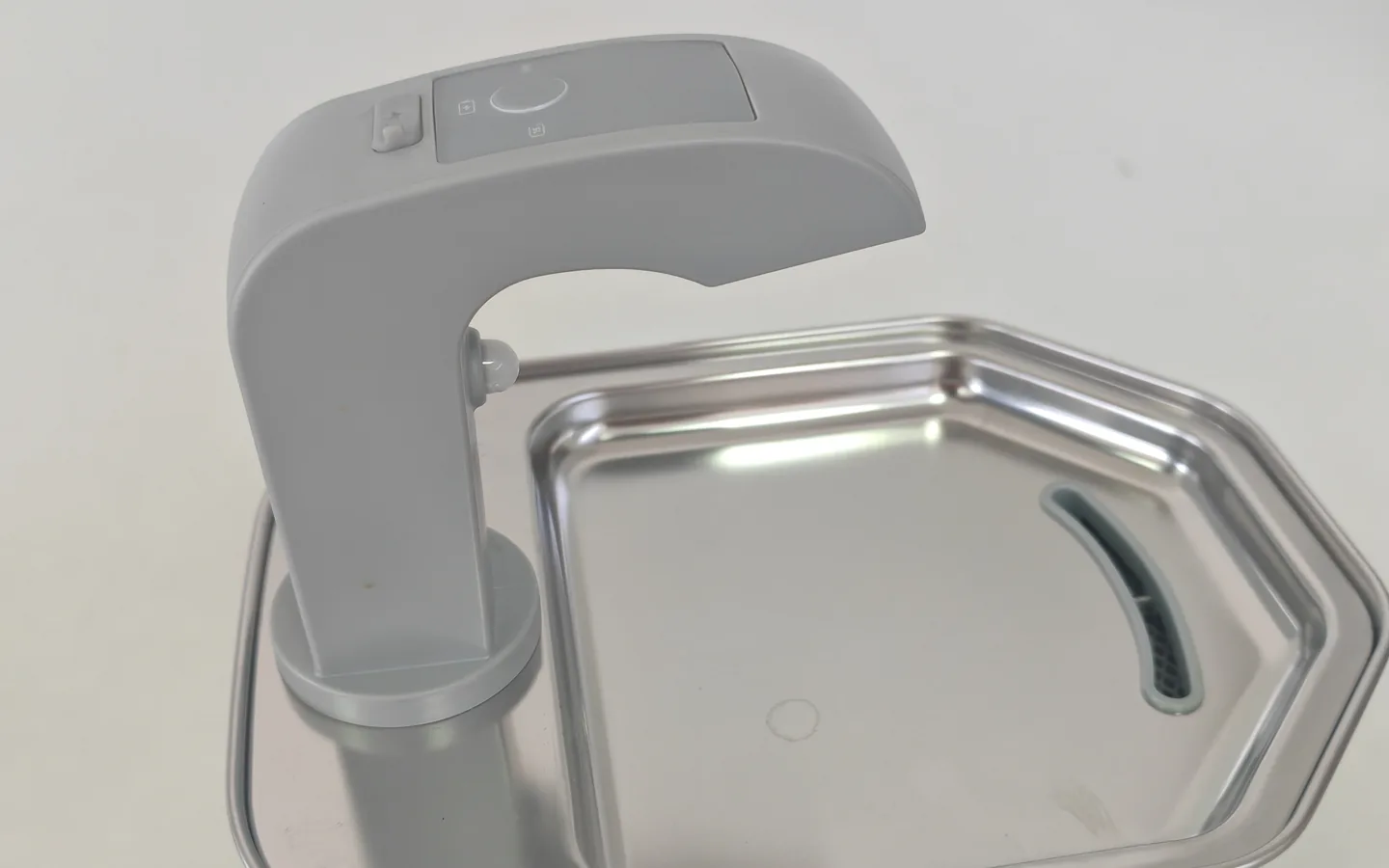
The faint ring in the real product photo is useful because early deposits are not always dramatic. When I inspect a mark like this, I check whether it wipes away, feels chalky after drying, appears at an evaporation edge and also exists on other household fixtures. I would not call it limescale from the photograph alone.
A soft white haze may also be dried soap, cleaner, filter dust or surface wear. That is why the diagnosis begins before the vinegar bottle: rinse one small safe area, feel the residue and note where it returns.
Where Does Limescale Usually Build Up?
Look first at surfaces where water evaporates or passes through a small clearance. The tray edge may show scale earliest, while a pump cavity can hide buildup until flow or noise changes.
Fast wet/dry cycling
Evaporation at the waterline
Restricted corners
Small clearances
Rotation needs free movement
Narrow internal path
| Fountain area | Why buildup appears | What to inspect | Cleaning note |
|---|---|---|---|
| Water outlet | Frequent wet/dry cycling | Lip, bore and underside | Remove only if the manual permits |
| Tray edge / waterline | Evaporation leaves a ring | Chalky line and roughness | Wipe before the layer hardens |
| Pump cavity | Minerals enter with circulating water | White film around accessible chamber | Unplug; follow pump instructions |
| Impeller area | Small moving clearance | Restricted rotation or pale crust | Open only user-serviceable parts |
| Filter holder | Corners stay wet and collect residue | Rails, seat and drain path | Remove the cartridge first |
| Silicone tube | Narrow channel and joins | Film at ends or inside bore | Flush or brush only as approved |
| Stainless steel surface | Water spots are easy to see | Rings around flow impact | Use a non-scratching cloth |
| Plastic corners | Molded recesses hold water | Chalk in seams or texture | Use a soft detail brush |
Not every platform has a separate tube, visible impeller, filter holder or removable outlet. The inspection should follow the product’s actual water path rather than a generic parts list.
Can Limescale Affect Cat Fountain Pump Flow?
Yes. Mineral deposits can reduce flow if they form inside the pump cavity, around the impeller or in a narrow water channel. A motor may still hum even when the impeller cannot turn freely.
PetSafe’s pump-cleaning instructions say that hard water can leave white mineral deposits on or inside the pump and that the buildup may eventually stop the impeller from turning properly. That is a model-specific support example, but the mechanical lesson is useful: small clearances need to remain clean.
Mineral scale around a user-accessible impeller chamber may restrict movement or flow. Hair, slime, a clogged filter, low water and ordinary wear can cause similar symptoms.
Possible signs include weaker flow, intermittent output, a change in pump sound, vibration or a fountain that still performs poorly after only the visible tray has been washed. If flow is weak, check the water level, filter condition, pump cleaning and possible mineral buildup before replacing the pump.
Limescale is only one possibility. Hair, food debris, slime, a clogged filter, a dirty impeller, an air pocket, incorrect assembly, low water and ordinary pump wear can create similar symptoms. When I review weak-flow troubleshooting, I check the approved pump cover and impeller access as part of that wider diagnosis. The cat water fountain pump troubleshooting guide separates those causes, while the cat water fountain lifespan guide helps with the repair-or-replace decision.
How Do Fountain Materials Show Hard-Water Stains Differently?
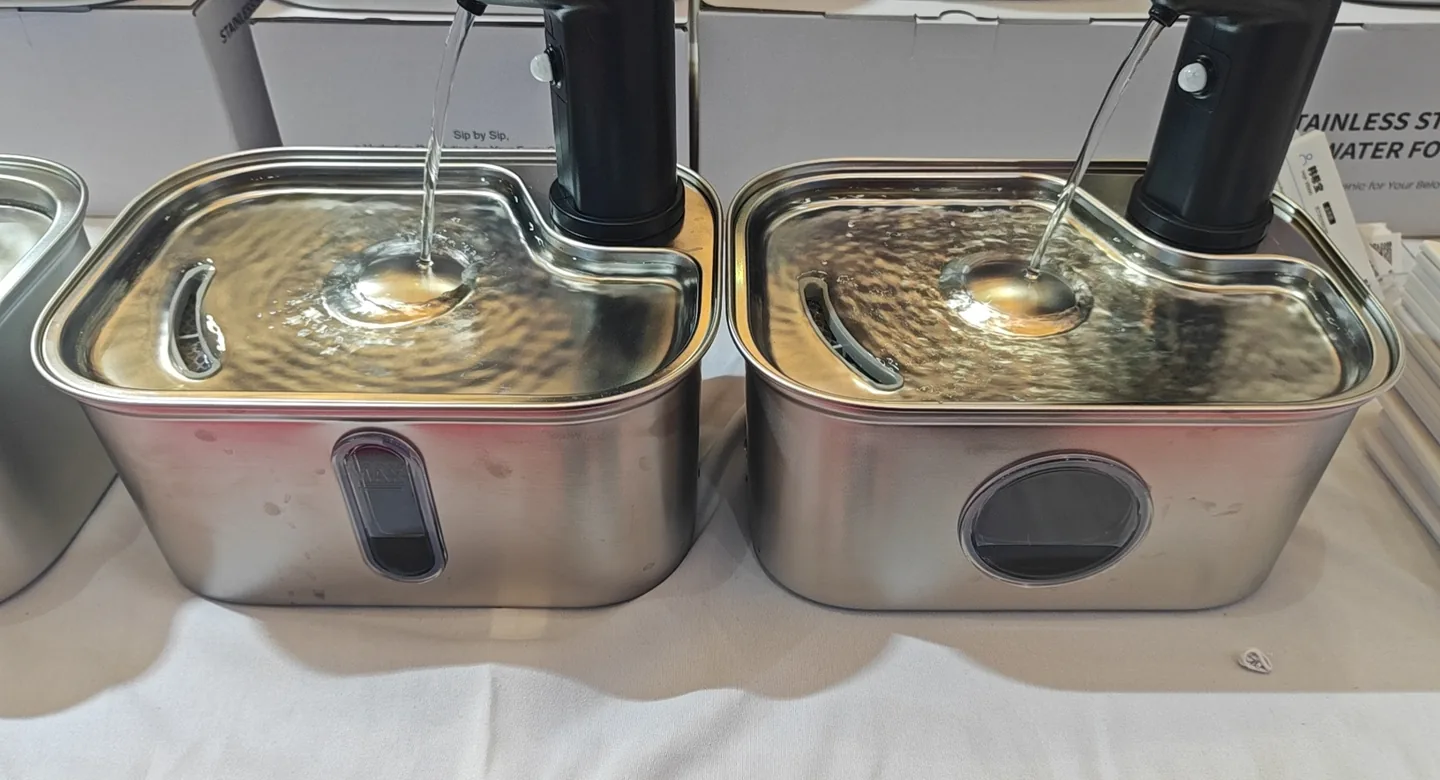
Material changes how clearly scale appears and how the surface can be cleaned; it does not prevent minerals from arriving with the water. Shape, seams, finish and access often matter as much as whether the main body is steel, plastic or ceramic.
| Material or surface | How scale may appear | Cleaning caution | Retail note |
|---|---|---|---|
| Stainless steel | Visible water spots or pale rings on a reflective tray | Use a soft cloth; avoid scratching finishes | Easy visibility can prompt earlier wiping |
| Smooth plastic | White film around corners, waterlines or molded joins | Avoid harsh or abrasive tools | Explain access to seams and holders |
| Textured plastic | Deposits can sit in shallow texture | Use a soft detail brush | Surface texture affects cleaning effort |
| Glazed ceramic | Pale ring on intact glaze | Check chips and manufacturer care | Glaze condition matters |
| Transparent parts | Cloudy-looking mineral film is highly visible | Confirm cleaner compatibility | Do not promise scratch-free descaling |
| Silicone parts | Pale crust near joins or flex points | Remove only when designed to be removed | Replacement policy should be clear |
Stainless steel does not stop limescale, plastic does not create hard water and ceramic is not automatically the easiest choice. The fair comparison is how easily the wet surfaces, corners and pump path can be reached without damaging the finish.
How Do You Clean Limescale From a Cat Water Fountain Safely?
Unplug the fountain, remove the filter and electrical modules, wash the approved parts, use a manufacturer-approved diluted vinegar solution only where appropriate, then rinse everything thoroughly. The exact dilution, soak time and washable parts belong to the model manual.
- Switch off and unplug. Work with dry hands and keep the adapter and plug away from water.
- Empty the fountain. Provide fresh water in a clean bowl while the unit is out of service.
- Remove the filter. Do not soak a disposable cartridge in soap or vinegar unless its instructions explicitly allow that treatment.
- Separate washable parts. Remove the tray, reservoir, outlet and user-accessible pump pieces only as the manual directs.
- Wash ordinary residue first. Warm water and mild dish soap may be suitable for approved hard parts.
- Treat mineral scale carefully. Use the manufacturer’s vinegar dilution and soak time on compatible pieces. A soft cloth or brush is safer than an abrasive tool on most finishes.
- Rinse until neutral. Soap and vinegar should not remain in the water path or filter holder.
- Dry, inspect and reassemble. Check seals, cable routing and part fit before refilling.
- Test the flow. Observe the outlet and pump sound before returning the fountain to normal use.
PetSafe’s Hydrosphere cleaning instructions use a 50/50 water-and-white-vinegar soak for mineral buildup on specified bowl, tray or pump parts, while also warning that the base is not waterproof or submersible. PETLIBRO’s fountain-maintenance guide gives a different mild vinegar dilution for wiping certain areas. These examples show why one internet ratio should not be applied to every product.
If the exact manual gives no descaling ratio, ask the supplier which parts and dilution it approves. The broader cat water fountain cleaning guide covers routine cleaning beyond mineral scale.
Which Fountain Parts Should Not Be Soaked or Scrubbed?
Keep adapters, plugs, cable connectors, charging contacts, battery bases, control panels, sensor modules, LED or UV electronics and other sealed electronics out of soak water. A component that looks removable is not necessarily submersible or dishwasher safe.
| Part | Can it soak? | Can it be scrubbed? | Main caution |
|---|---|---|---|
| Adapter and wall plug | No | Dry wipe only if instructed | Disconnect; keep completely dry |
| Cable connector | No | Dry wipe only if instructed | Protect the connection from water |
| Battery or charging base | Usually no | Wipe approved surfaces | Protect contacts and electronics |
| Control / sensor / LED / UV module | No unless explicitly rated | Gentle exterior wipe | Do not open or immerse sealed electronics |
| Pump body | Model-specific | Only approved accessible surfaces | Cable and seals may limit immersion |
| Impeller and pump cover | Model-specific | Soft detail brush if removable | Do not force magnetic or fragile parts |
| Reservoir and tray | Often washable, but confirm | Soft cloth or brush | Dishwasher status varies |
| Silicone seals / tubes | Model-specific | Gentle cleaning | Stretching or incorrect refit can cause leaks |
| Coated / printed parts | Confirm first | Avoid abrasives | Cleaner may damage finish, logo or markings |
| Disposable filter | Follow filter instructions | Generally do not scrub | Soap or vinegar may remain in media |
The PetSafe cordless example above makes the distinction clearly: selected bowl and tray parts may be dishwasher safe, the pump needs hand washing and the fountain base must not be submerged. Another model can divide the parts differently.
Electrical safety matters even when the cleaning issue is only a white ring. The cat water fountain safety guide covers dry hands, damaged cords, low water and placement around electrical connections.
How Can You Reduce Hard-Water Buildup?
Remove early water spots before they harden and clean the pump path before the flow changes. Hard-water scale can return after a good clean because the local water still contains the same minerals.
- Replace rather than continually top up old water.
- Wipe the waterline, tray edge and outlet during routine cleaning.
- Inspect the user-accessible pump cavity before flow becomes weak.
- Keep the pump at the water level specified in the manual.
- Use filtered source water only if it suits the cat and product instructions; it may reduce some minerals but does not guarantee zero scale.
- Prepare and replace the correct filter on schedule.
- Rinse cleaning products fully so dried cleaner is not mistaken for scale.
- Use a small soft brush that reaches the actual outlet, holder and corners.
- Record faster recurrence by market when planning customer support.
A fountain cartridge should not be advertised as a universal water softener. Filter media and performance vary, and even filtered source water can acquire hair, food residue and dust after it enters the fountain. Use the cat water fountain filter replacement guide for cartridge timing rather than treating descaling as a filter-only problem.
When Is White Residue Not Limescale?
White or pale residue can also be dried cleaner, filter dust, attached film, food debris, surface wear or another material. If it feels slippery, floats as foam or appears immediately after installing a cartridge, start with that clue.
| Appearance | Possible cause | Quick check | What to do |
|---|---|---|---|
| Loose gray-white dust after filter change | Filter fines | Did it appear immediately after installation? | Follow cartridge preparation instructions |
| Slick pale film | Slime / mixed residue | Does it feel slippery when wet? | Clean the complete water path |
| Bubbles that persist after washing | Soap or cleaner residue | Does foam remain when the pump stops? | Discard water and rinse again |
| Dry white smear | Dried soap or cleaning product | Does it dissolve during a plain-water rinse? | Rinse all parts thoroughly |
| Pale rough patch that does not lift | Surface wear or damage | Is the finish scratched, chipped or cloudy? | Ask about part replacement |
| Mixed particles near food | Crumbs, hair or dust | Do particles move rather than cling? | Clean and reconsider placement |
| Colored, fuzzy or musty residue | Unidentified growth | Is there odor or rapid recurrence? | Stop use; deep-clean and inspect |
The timing after cleaning or filter replacement is often more useful than the color. Foam after washing belongs in the foaming diagnosis. Slippery film belongs in the slime diagnosis. Residue that persists in a scratched or cracked part may require that supported part to be replaced rather than scrubbed harder.
What Should Retailers and Brands Explain About White Residue?
Customer-facing instructions should explain that white residue may be hard-water mineral buildup and is not automatically mold or a manufacturing defect. They should also show how the answer changes when the residue is slippery, foamy, odorous or colored.
It may be hard-water mineral buildup rather than mold. Check texture and location, clean the approved parts, and rinse thoroughly.
- Show the model-specific cleaning steps
- Identify parts that must stay dry
- Explain filter and pump checks separately
- Link to the correct replacement references
A useful FAQ starts with a photograph or plain description of chalky scale, then directs the owner to the exact model’s removable parts. It should name the safe cleaner or approved vinegar method, list parts that must stay dry, and insist on thorough rinsing. If flow has weakened, it should add a pump-cavity and impeller check instead of telling the customer only to buy another filter.
For a private-label program, I would approve this guidance with the product configuration rather than copy a generic cleaning paragraph at the artwork stage. The manual, QR support page, product listing and customer-service script should agree on the same pump access, filter reference, vinegar dilution and non-submersible parts.
Support teams also need a clean escalation path. Ask for the model, affected location, water source, time since cleaning, filter age, photographs and whether the residue is chalky or slippery. That information helps separate maintenance from a damaged finish, assembly issue or pump fault.
Fountelio’s cat water fountain platforms use different power and pump architectures. A standard powered model, rechargeable base and wireless-pump platform should not share one unverified cleaning diagram.
What Should Buyers Confirm for Hard-Water Markets?
Buyers should review descaling access and support wording before packaging is finalized. A care claim is only useful when the approved sample, manual and spare-parts map support it.
| Checklist item | Why it matters | Ask the supplier |
|---|---|---|
| Cleaning instructions | Customers need a complete sequence | Which parts separate and in what order? |
| Vinegar / descaling guidance | Ratios and soak times are not universal | What dilution and contact time are approved? |
| Pump cleaning access | Scale can hide beyond the tray | Which covers are user-removable? |
| Impeller access | Small clearances affect flow | Can the user remove and clean it safely? |
| Material and finish | Scale visibility and tools vary | Which cloths, brushes and cleaners are suitable? |
| Filter format | Similar filters may not fit | What is the exact service reference? |
| Replacement filters | Maintenance continues after launch | What pack formats and reorder plan apply? |
| Manual wording | Generic diagrams create errors | Does the guide match this exact version? |
| After-sales FAQ | White residue is easily misunderstood | What evidence should support request? |
| Spare pump policy | Some flow issues need a service part | Where is separate supply supported? |
| Market water conditions | Recurrence may vary by destination | Should local FAQ wording mention hard water? |
| Support script | Diagnosis should be consistent | How are scale, slime, foam and damage separated? |
For high-hardness markets, include a simple symptom guide and the approved descaling steps in both the manual and digital support. For lower-hardness markets, the same information can remain available without implying that every customer will see scale.
Frequently Asked Questions
What is the white residue in my cat water fountain?
White residue is often mineral buildup from hard water, especially calcium and magnesium deposits left after water evaporates. Check whether it is chalky or crusty and whether it sits on the waterline, tray edge or outlet. Soap, filter dust and surface wear can also look pale, so do not identify it by color alone.
Is white residue in a cat fountain mold?
Not necessarily. Limescale is usually chalky, white or gray-white and mineral-based. Slime feels slippery, while mold-like material may look spotty or fuzzy and can have an odor. If the substance is colored, smells musty or quickly returns after cleaning, stop use and inspect the full water path.
Why does hard water leave stains in a fountain?
Hard water carries dissolved minerals. When exposed water evaporates from the tray, outlet or waterline, some minerals remain. Repeated cycles can turn a faint film into a harder ring or crust.
Can limescale affect the pump?
Yes. Deposits inside a pump cavity, around a user-accessible impeller or in a narrow channel can restrict movement and reduce flow. Hair, slime, low water, a clogged filter and pump wear can cause the same symptoms, so inspect the whole system.
How do I remove limescale from a cat water fountain?
Unplug the fountain, remove the filter and electrical modules, separate the approved washable parts, use the manufacturer’s descaling method, scrub gently and rinse thoroughly. Do not apply a universal vinegar ratio or soak parts the manual says must stay dry.
Can I use vinegar to clean a cat fountain?
Only where the model instructions permit it. Several manufacturer guides use diluted white vinegar for mineral deposits, but their ratios, parts and soak times differ. Keep vinegar out of disposable filters and unapproved electronics, then rinse until no odor or residue remains.
Which fountain parts should not be soaked?
Do not soak the adapter, wall plug, charging contacts, battery base, control panel, sensor module or sealed electronics. Pump immersion, dishwasher use and removable impeller access are model-specific.
Does a fountain filter stop limescale?
Not automatically. Some source-water or fountain filters may reduce certain minerals, but media and performance vary. A filter also does not remove scale already attached to the tray, outlet or pump.
Why does limescale come back after cleaning?
The local water still contains minerals, so the next evaporation cycle can leave another deposit. More frequent wiping can stop a thin film from becoming a hard crust, but no cleaning routine changes the source water itself.
What should retailers tell customers about white residue?
Explain that a chalky white ring may be hard-water scale rather than mold, show the exact model’s safe cleaning method, identify parts that must stay dry and provide pump and filter troubleshooting as separate steps.
Treat the Deposit You Have, Not the One You Fear
White residue is often a mineral problem, but the correct response begins with texture, location and timing. A chalky ring at an evaporation edge points toward limescale; slippery film, persistent foam, odor or colored growth calls for a different diagnosis.
Clean only the parts the model allows, keep electronics dry, use the approved descaling method and rinse thoroughly. If flow remains weak after the water level, filter, intake and permitted pump parts are checked, contact the manufacturer before forcing open a sealed component.
About This Guide
Tony Kong is an R&D Engineer at Fountelio. This guide combines the USGS definition of water hardness, model-specific manufacturer cleaning instructions and a product-structure review of common fountain surfaces. It does not test a residue sample, assess local drinking-water safety or replace the manual for a specific model.
Sources & References
- USGS water hardness explanation. Defines hardness mainly by dissolved calcium and magnesium and explains scale formation.
- PetSafe fountain pump cleaning instructions. Model-specific guidance on white mineral deposits, impeller movement and vinegar cleaning.
- PetSafe cordless fountain cleaning instructions. Distinguishes washable parts from a non-submersible base and gives a model-specific descaling method.
- PETLIBRO fountain maintenance guide. Manufacturer guidance on mild vinegar use for stains and mineral deposits.