

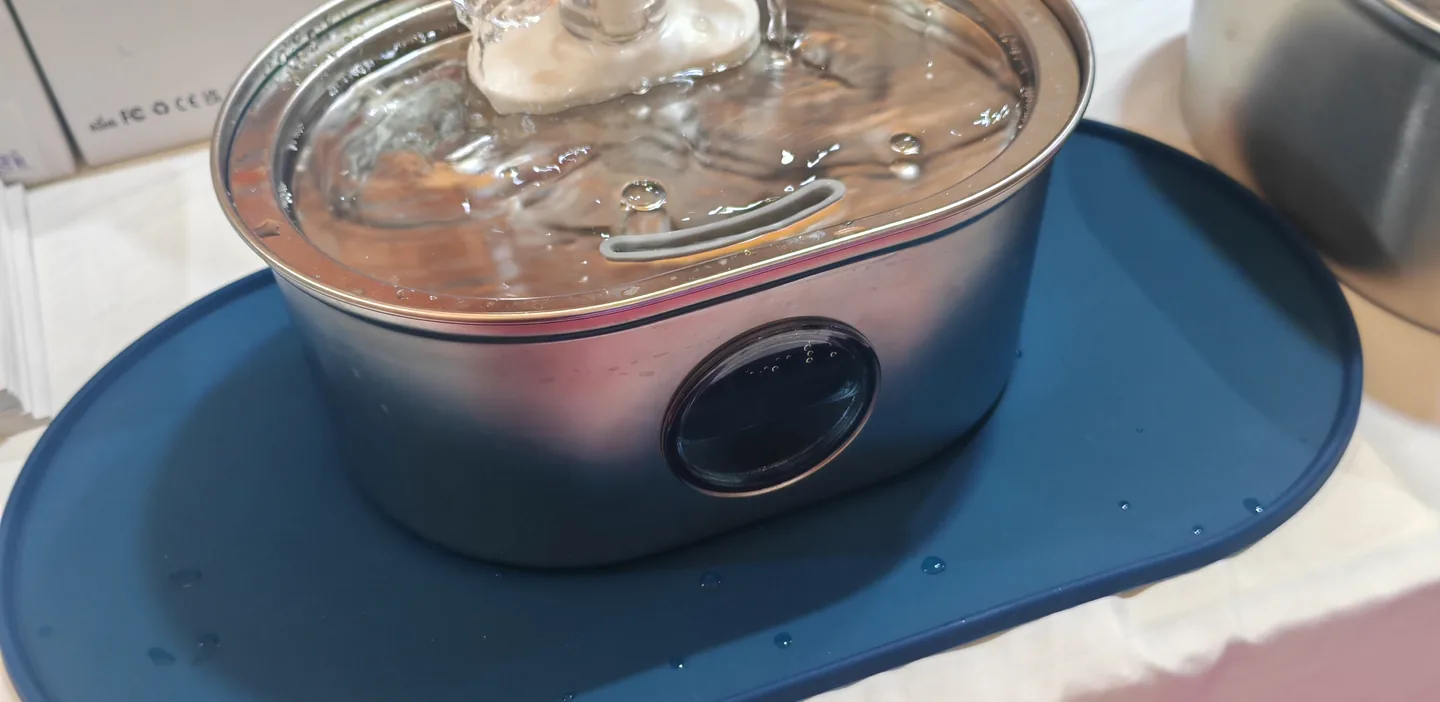
You rinse the fountain, refill it and run a finger along the tray or reservoir wall. The water may still look clear, yet the surface feels slippery. Sometimes the film is under the pump cover or around the filter holder; sometimes it returns only a few days after what seemed like a thorough clean.
A cat water fountain gets slimy when saliva, food particles, hair, minerals and microbes collect on wet surfaces. That mixture can form an attached, biofilm-like layer, especially in pump chambers, filter holders, seams, corners and other areas a quick wipe does not reach. Slimy does not always mean visible mold, but it does mean the fountain should be emptied, cleaned and inspected.
This guide separates slippery film from mold-like growth, explains why buildup returns, and traces the parts that matter: reservoir, tray, spout, pump cover, impeller chamber, filter holder, silicone pieces and water path. The aim is to diagnose a slimy cat drinking fountain without guessing at an organism from its color.
Why Does a Cat Water Fountain Get Slimy?
A slimy cat water fountain is usually a surface-cleaning problem, not just a water-change problem. Changing the water helps, but the slippery film can remain on the pump, impeller chamber, filter holder, tray edges, spout and seams until those parts are scrubbed.
Empty and clean the fountain. If you also find odor, cloudiness, colored or fuzzy growth, or film that rapidly returns after a complete clean, keep it out of service until it is fully inspected.
Slimy vs Moldy: What Is the Difference?
Slimy describes texture; moldy describes suspected visible growth. A slippery, sticky or coated surface is not automatically mold. Visible fuzz, spots, musty odor or discoloration calls for closer attention, but neither texture nor color identifies the substance by itself.
| What you see or feel | Likely category | What to do first |
|---|---|---|
| Clear slippery film | Attached surface buildup | Empty; scrub every wet surface |
| Sticky film around tray or spout | Organic residue or mixed buildup | Remove the outlet; clean its underside |
| Slime in pump chamber | Hidden water-path buildup | Unplug; open only permitted pump parts |
| Pink or orange film | Unidentified colored residue | Stop use; clean without identifying by sight |
| Black or dark spots | Grime, material transfer or mold-like growth | Stop use; inspect damage and removable parts |
| Green film | Unidentified environmental buildup | Clean; review light exposure and recurrence |
| White crusty residue | Often mineral scale | Follow model-safe scale-removal guidance |
| Musty smell | Persistent contamination warning | Provide backup water and deep-clean |
| Cloudy water | Suspended residue or water-quality change | Discard water; inspect the complete path |
Do not call pink film a particular bacterium, dark spots “black mold,” or green film algae based only on appearance. If unexplained color, odor, cloudiness or growth remains after cleaning, replace the affected removable part or ask the manufacturer about the exact model.
What Is the Slippery Film in a Cat Water Fountain?
The slippery layer is usually attached surface buildup, so changing the water alone may leave it behind. “Biofilm-like” is a useful description for material that adheres to a continually wet surface instead of floating freely. The CDC’s biofilm explanation describes germs living together and producing a slimy, glue-like substance that helps them stick to surfaces. The NCBI MeSH definition of biofilms describes microbes embedded in an extracellular polymeric matrix on surfaces or in bodies of water.
Those sources explain the general mechanism; they do not prove that every slippery pet-fountain surface is the same biofilm or contains a particular organism. In a fountain, saliva, food residue, hair, dust and minerals can be present too. The useful conclusion is simpler: the film is attached to a surface, so pouring out the water alone will not remove it.
Feel and location often tell you more than color. Trace the reservoir wall, tray rim, outlet underside, filter slot and permitted pump parts. If the bowl feels clean but the film returns quickly, an upstream recess may be reseeding the rest of the water path.
Why Can a Fountain Get Slimy Faster Than a Water Bowl?
A fountain can develop slippery buildup faster because it has more continuously wet parts and hidden interfaces than a simple bowl. Water moves through a reservoir, tray, outlet, filter holder, pump cover, intake, impeller chamber, tube and joins. Each transition creates an underside, edge, corner or low-flow area where residue can remain after the obvious drinking surface has been wiped.
Touch points and shallow edges
Narrow passages and wet undersides
Corners below the visible waterline
Intake slots and the permitted inner chamber
Movement carries hair and small particles through the system. A filter can collect some of that material, but it does not sterilize the water or wash the walls. Multi-pet use, food crumbs near the fountain, lower water level, direct sunlight and longer intervals between full disassembly may make buildup appear sooner.
This does not mean fountains are inherently less hygienic than bowls. It means their maintenance has to match their part count. A clean-looking tray is incomplete evidence when the pump chamber and underside of the lid stay continuously wet.
Where Does Slime Hide in a Cat Water Fountain?
Start with the hidden water path, not only the surface the cat drinks from. When we review fountain samples, we do not stop at the easiest surfaces. We check the pump cover, permitted impeller access, filter holder, water channel and underside of the tray, which users are likely to skip once the visible bowl looks clean.
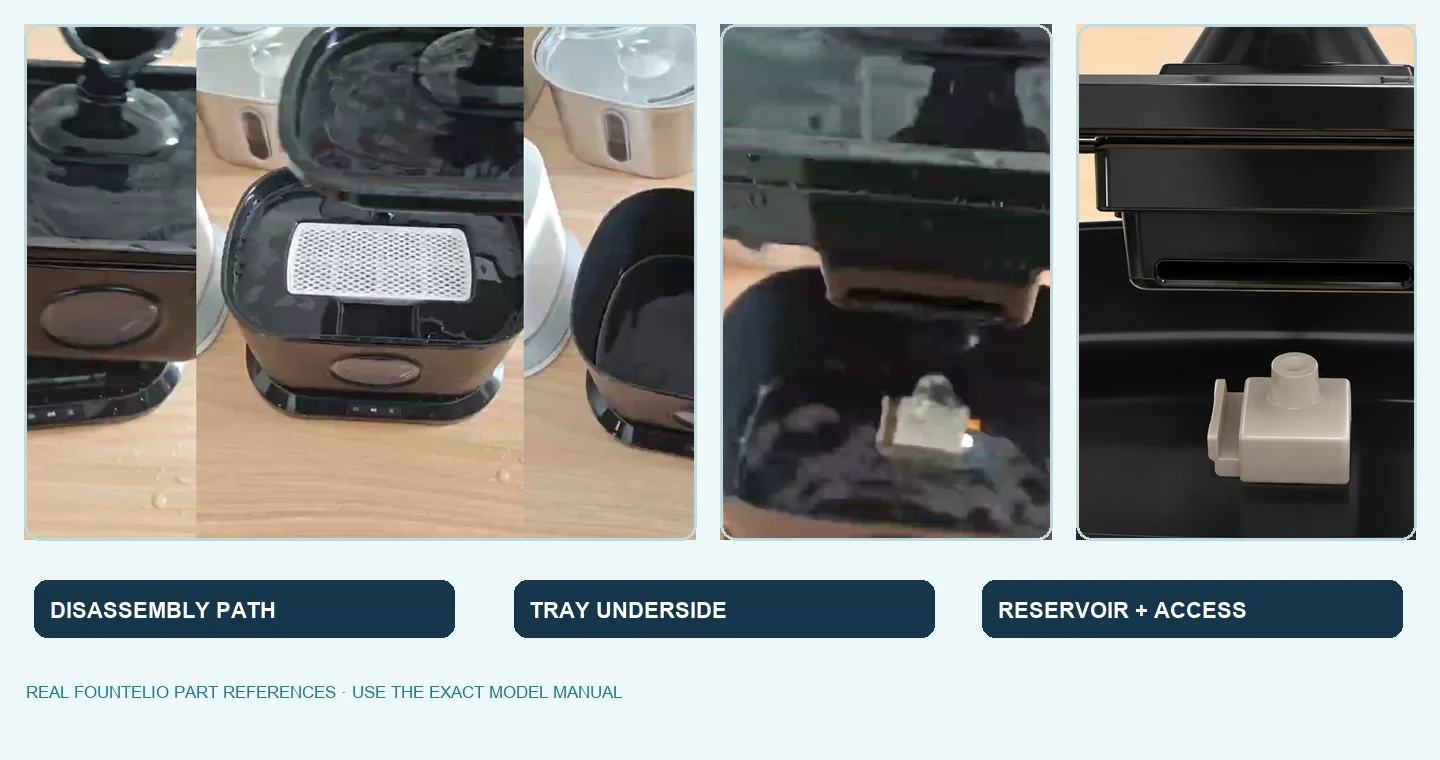
| Part | Why buildup collects there | What to clean or check |
|---|---|---|
| Reservoir wall | Continuously wet, broad surface | Feel below the waterline; scrub corners |
| Drinking tray | Saliva, hair and food contact | Wash the top and drainage path |
| Tray rim | Shallow seam retains film | Use a small brush along the edge |
| Spout or outlet | Narrow passage and hidden underside | Remove if permitted; brush the bore |
| Filter holder | Debris collects before or around media | Remove cartridge; wash the holder |
| Filter slot | Tight rails and wet corners | Brush rails; inspect fit and residue |
| Pump cover | Intake slots catch hair | Unplug; remove only as instructed |
| Impeller chamber | Small moving wet cavity | Use a small brush if user-accessible |
| Tube or water channel | Restricted visibility and flow | Flush and brush as the manual permits |
| Silicone gasket or ring | Edges can trap moisture and residue | Remove only if designed to be removed |
| Lid underside | Wet surface hidden during use | Turn over and inspect joins |
| Corners and seams | Large cloth or sponge misses them | Use a correctly sized detail brush |
| Mat under fountain | Spills keep the surrounding area damp | Wash and dry the mat and floor |
Why Does Slime Come Back After Cleaning?
Slime often returns because a hidden wet part was not fully cleaned or the same source of residue remains. Changing water removes suspended material; wiping the tray removes only the visible endpoint. A pump cover, impeller well, filter slot, spout or silicone edge can retain the attached film.
Other possibilities include an overdue filter, a reused sponge carrying residue, a brush too large for narrow parts, food crumbs near the fountain, several pets using one source, or mineral scale that leaves a rougher deposit for organic material to cling to. Scratched plastic may also be harder to clean, though a scratch does not prove contamination.
Clean one level deeper before shortening the interval again. The full cat water fountain cleaning guide covers model-safe disassembly and cleaning. If a complete clean with fresh water and a suitable filter still produces rapid odor or visible growth, document the model and affected part and contact the manufacturer.
Does the Filter Prevent Slime?
No filter prevents all slime. A cartridge may capture debris and, depending on its verified media, address taste or odor. It does not scrub the reservoir, pump chamber, tray edge, spout or silicone parts. A filter is one component in the water path, not a self-cleaning system.
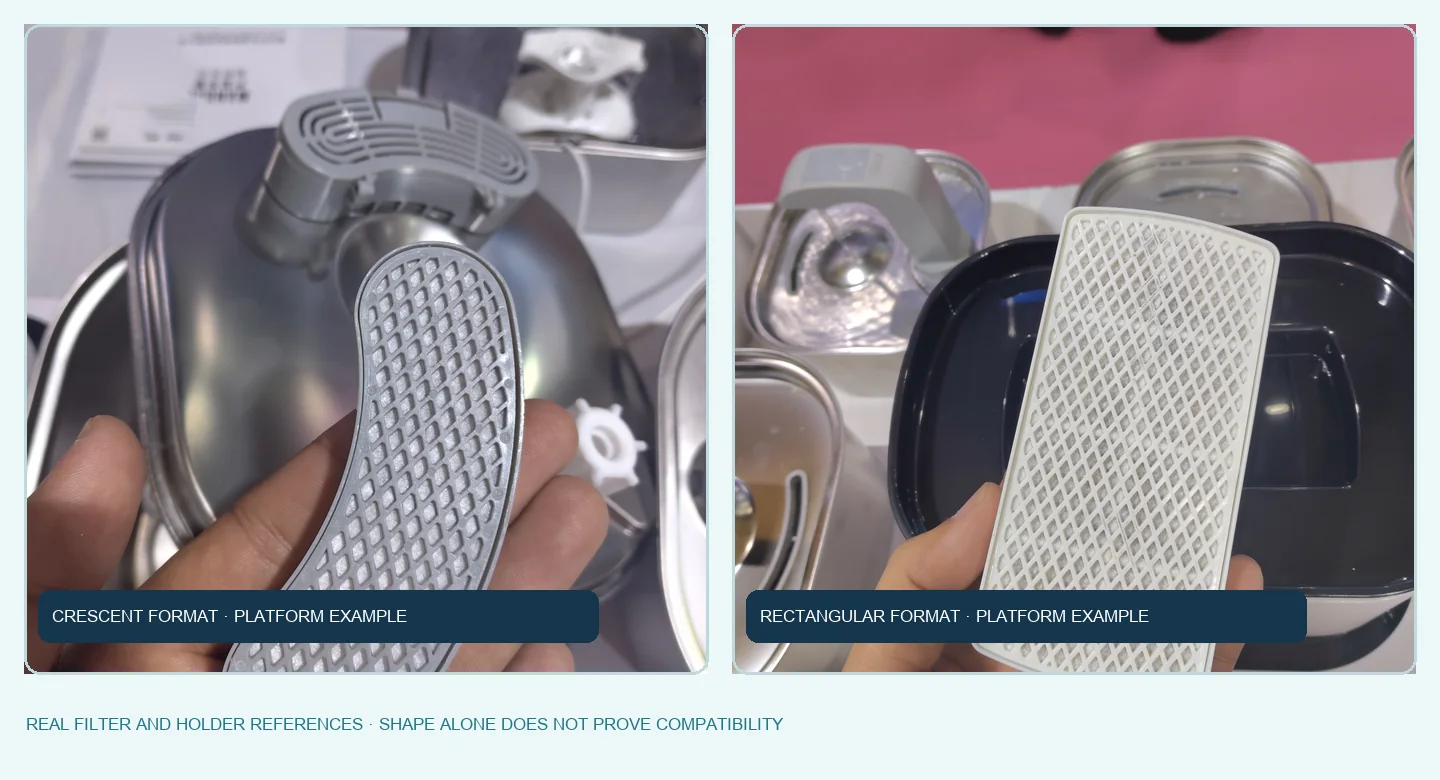
An old, clogged or incorrectly prepared cartridge can itself hold debris or restrict flow. Check the correct model reference using Fountelio’s cat water fountain filter formats, and keep replacement timing in the separate cat water fountain filter replacement guide. Similar shape or media does not prove compatibility.
Never wash a disposable cartridge with soap unless its own instructions explicitly allow that method. Replace a visibly damaged or slimy cartridge rather than expecting rinsing to restore it beyond its intended service life.
Pump, Impeller and Water-Path Buildup
The pump area is one of the most commonly missed cleaning points because it can look like a sealed black box. On serviceable pumps, the removable faceplate, intake slots, impeller or rotor and impeller well can collect hair, small food particles, mineral deposit and slippery film. Access varies: never force a cover or open sealed electronics.
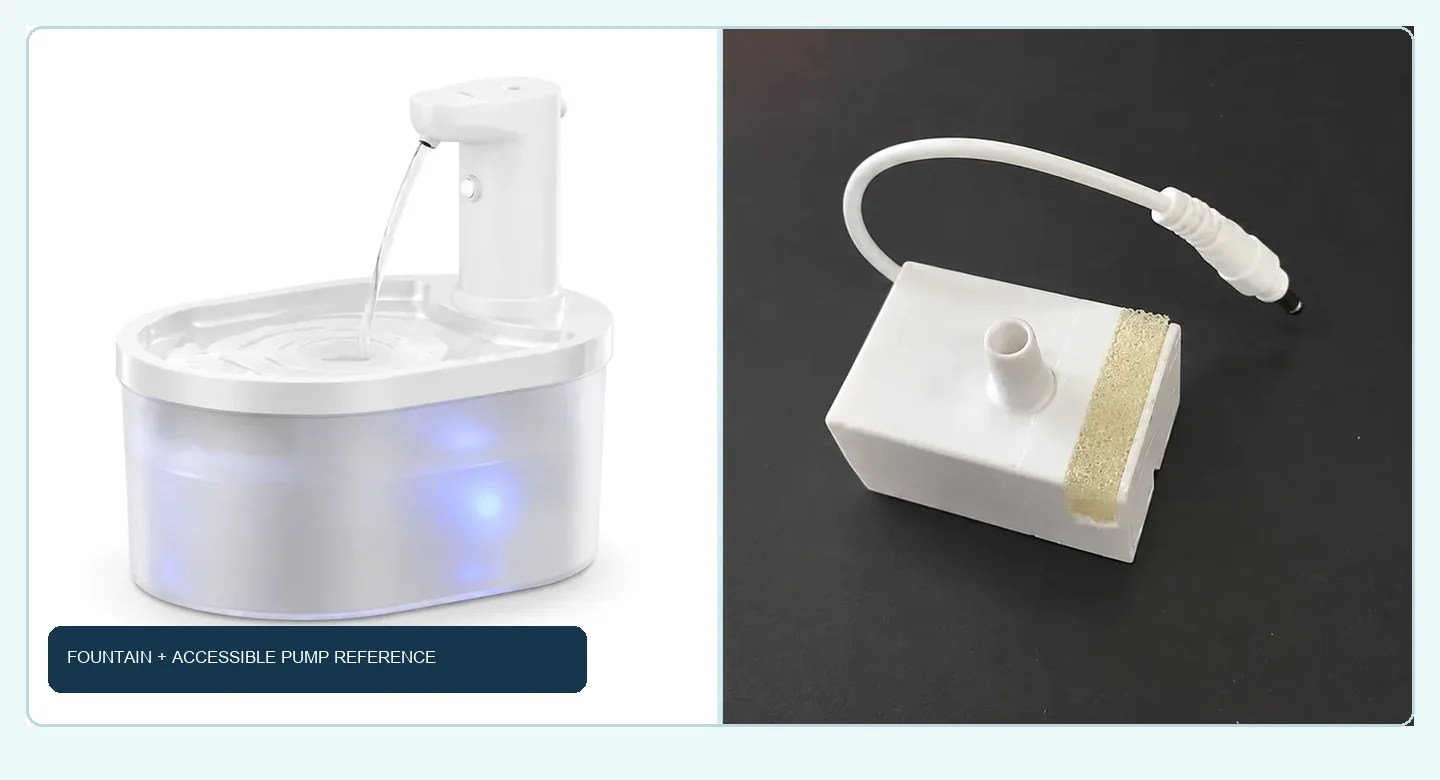
PetSafe’s model-specific slimy-fountain support tells owners of the named Drinkwell models to clean fountain and pump parts, crevices, corners and the area where the impeller sits. Its separate pump cleaning guide shows the faceplate, stator and impeller for those pumps. That is useful evidence for hidden-part cleaning, but its vinegar procedure is not a universal instruction for every fountain material or pump.
Weak flow, pulsing or new pump noise can accompany buildup, but those symptoms have other causes. Use the cat water fountain pump troubleshooting guide for the separate no-flow and noise diagnosis. From our side of product review, normal reassembly matters too: a clean part fitted incorrectly can change the flow without being dirty.
Plastic, Stainless Steel or Ceramic: Does Material Matter?
Material changes cleanability, but no body material removes the need to clean the complete water path. Stainless steel is smooth and easy to wipe, yet its viewing window, outlet, tray interface and plastic pump still need attention. Plastic is light and supports complex shapes, while scratches or deep molded corners may become harder to clean. Glazed ceramic can be smooth, but chips, joins and the separate pump assembly still require inspection.
Still inspect tray interfaces, windows, outlets and pump parts.
Watch for scratches, molded corners and hard-to-reach seams.
Inspect the glaze, chips, joins and separate pump assembly.
The better buying question is not “Which material never gets slimy?” No such promise is credible. Ask whether the reservoir, tray, outlet, filter holder and pump can be disassembled and brushed without awkward blind areas. See the broader stainless steel vs plastic cat water fountain guide for material tradeoffs beyond this maintenance symptom.
What About Pink, Black, Green or White Residue?
Color alone cannot identify what is growing or collecting inside a fountain. Pink or orange film can reflect a mixture of environmental microbes, minerals and organic residue. Black or dark spots might be grime, material transfer, debris or mold-like growth. Green film may be associated with light and environmental buildup.
White crust is often consistent with mineral scale, especially in hard-water areas, but scale can coexist with slippery organic residue. Texture helps: hard, chalky deposit is different from a slick layer, although both may appear in the same seam.
Treat colored, fuzzy, musty, recurring or unexplained material as a reason to stop, empty and clean the fountain. If it cannot be removed from a scratched, cracked or porous part, replace the part if supported or contact the manufacturer. Do not reach for bleach, vinegar or another strong cleaner unless the exact product instructions permit it; material, seals, coatings and electronics differ.
When Is Slime or Mold a Warning Sign?
Pause use when residue comes with odor, cloudiness, visible growth, damage or electrical exposure. A sticky layer that remains after cleaning, slime inside the accessible pump chamber, or rapid return after a full part-by-part clean is also a reason to investigate rather than keep topping up.
Give the cat fresh water in a clean bowl while the fountain is out of service. If the cat refuses water, seems unwell, vomits, or shows an unusual change in drinking, contact a veterinarian; this page cannot diagnose the animal. The cat not using water fountain guide helps separate product presentation from a behavior or health change.
For general hard-surface hygiene, the CDC advises using soap and water or a product appropriate for the surface. A pet fountain adds manufacturer-specific restrictions, so its manual takes precedence for detergents, dishwasher use, descaling, seals, pumps and electrical parts.
What Should You Do Now If the Fountain Is Slimy?
Give the cat fresh backup water first, then switch off the fountain and clean the entire accessible water path. Work in a fixed order so the visible tray does not distract from the filter slot, outlet and pump chamber.
- Provide backup water. Put down a clean bowl before taking the fountain apart.
- Turn off and unplug. Keep wet hands and water away from live connections.
- Empty the fountain. Do not recirculate questionable water.
- Remove the filter and disposable parts. Follow the filter instructions; replace an old, damaged or slimy cartridge.
- Disassemble the washable water path. Separate the tray, reservoir, lid, outlet and only the pump parts the manual identifies as user-accessible.
- Scrub attached film. Use a small brush for seams, filter rails, intake slots and the impeller well.
- Rinse thoroughly. No cleaner residue should remain in the water path.
- Inspect before refilling. Look for scratches, cracks, trapped residue or a part that cannot be cleaned.
- Refill with fresh water. Reassemble correctly and observe flow, odor and recurrence.
If you also see foam or persistent bubbles, the separate cat water fountain foaming or bubbling guide uses timing and a pump-off test to distinguish air from persistent surface material.
How Can You Slow Slime From Coming Back?
You can slow recurrence by removing residue before it becomes established in hidden parts. The routine should cover water replacement, filter care, pump access and the surrounding environment.
- Change the water regularly instead of only topping it up.
- Clean the pump cover and permitted impeller parts, not just the tray.
- Rinse and replace the correct filter according to its instructions.
- Keep food crumbs and dusty litter traffic away from the fountain where practical.
- Avoid direct sunlight when the model and room layout allow.
- Maintain the marked water level so the pump and flow remain stable.
- Use a clean small brush for corners and do not reuse a dirty kitchen sponge.
- Inspect scratches, cracks, silicone edges and removable joins during deeper cleaning.
- Wash and dry the mat or floor beneath the fountain.
No schedule prevents slime forever. The right interval depends on the model, water, environment and number of animals. The useful signal is what you observe at the next disassembly: if hidden parts are coated before the visible tray, the maintenance routine needs to reach those parts sooner.
What Should Brands and Retailers Check Before Launch?
For a brand, slime complaints often reveal a cleanability problem rather than a simple material choice. In OEM review, we look at whether the pump cover, filter holder, outlet, tray underside and water channel can be reached with ordinary cleaning tools. Easy disassembly and brush access matter after the attractive top surface leaves the showroom.
A private-label manual should show the actual model’s removable parts, safe pump access, filter orientation and cleaning sequence. A generic diagram can create support problems when the product version changes. We also prefer to map replacement filters and service references before launch, so customer service can distinguish “replace the cartridge” from “clean the pump chamber.”
For buyers, review internal corners, seam count, silicone pieces, scratch resistance, water-level marks and whether the included brush reaches the narrowest washable channel. Then verify the cleaning illustrations against the approved sample. Fountelio’s filter and spare-parts planning guide covers the after-sales SKU side of that decision.
No platform should be marketed as never getting slimy. The credible promise is clearer: the cat water fountain platform, instructions and replacement program should make routine maintenance understandable and practical.
Frequently Asked Questions
Why does my cat water fountain get slimy?
Saliva, food particles, hair, minerals and microbes collect on wet surfaces and can form a slippery attached film. Pump chambers, filter holders, tray edges and spouts are common hiding places.
Is slime in a cat water fountain mold?
Not always. Slime often describes surface buildup or biofilm-like residue; mold commonly describes visible fuzzy growth, odor or spots. Appearance alone cannot identify an organism.
Why does my cat fountain get slimy so fast?
The visible tray may be clean while the pump cover, impeller chamber, filter slot, spout or seam retains film. Food proximity, several pets, an overdue filter, mineral scale and cleaning tools that miss narrow areas can also contribute.
Why is there slime in the pump?
The pump is continuously wet and its intake and impeller area move debris through a small cavity. Unplug the unit and clean only the user-accessible parts described in the model manual.
Does the filter prevent slime?
No. A filter may capture some debris, but it does not scrub the reservoir, tray, spout, pump chamber or seals. It also needs correct preparation and replacement.
Can a stainless steel cat fountain still get slimy?
Yes. Stainless surfaces can be easy to wipe, but attached film can still develop, and the pump, holder, outlet and seals may use other materials.
What is the pink slime in my cat fountain?
It cannot be identified reliably by color alone. Treat unexplained pink or orange film as a cleaning and inspection signal, not a species diagnosis.
What should I do if I see black or green residue?
Stop use, provide fresh water separately, empty and clean the complete water path. If the residue remains, recurs quickly or sits in a damaged part, contact the manufacturer or replace the supported part.
Should I stop using the fountain if it smells moldy?
Yes, pause use while you investigate. A musty odor is a warning sign: discard the water, clean the washable parts and pump access, replace the filter if required and do not restart until the odor is gone.
Is there a cat water fountain that does not get slimy?
No responsible design can promise zero buildup. Look for smooth surfaces, few blind seams, accessible pump and filter parts, clear instructions and a water path you can actually inspect.
Trace the Surface, Then Trace the Water Path
A slippery fountain is a surface diagnosis before it is a color diagnosis. Start with texture and location, then inspect the tray, outlet, reservoir, holder, pump cover and permitted impeller chamber. Changing water without removing attached film leaves the main problem in place.
Slimy does not always mean mold, but it does mean the water-contact surfaces need attention. Stop for odor, cloudiness, colored or fuzzy growth, rapid recurrence, damage or electrical concerns. Clean part by part, follow the exact manual, keep backup water available and ask the manufacturer when a component cannot be safely accessed or restored.
About This Guide
Tony Kong is an R&D Engineer at Fountelio. This guide combines public health definitions, model-specific manufacturer support and Fountelio’s product-structure perspective. It does not identify microorganisms, diagnose a cat or replace the instructions for a specific fountain.
Sources & References
- CDC biofilm and drinking-water guidance. General explanation of slime that helps groups of germs adhere to moist surfaces.
- NCBI MeSH biofilm definition. Scientific terminology for microbes embedded in an extracellular polymeric matrix.
- PetSafe slimy-fountain support. Model-specific guidance to clean the pump, impeller area, crevices and corners.
- PetSafe pump cleaning guide. Model-specific pump disassembly and impeller access.
- CDC hard-surface cleaning guidance. General guidance to use soap and water or products appropriate to the surface.