

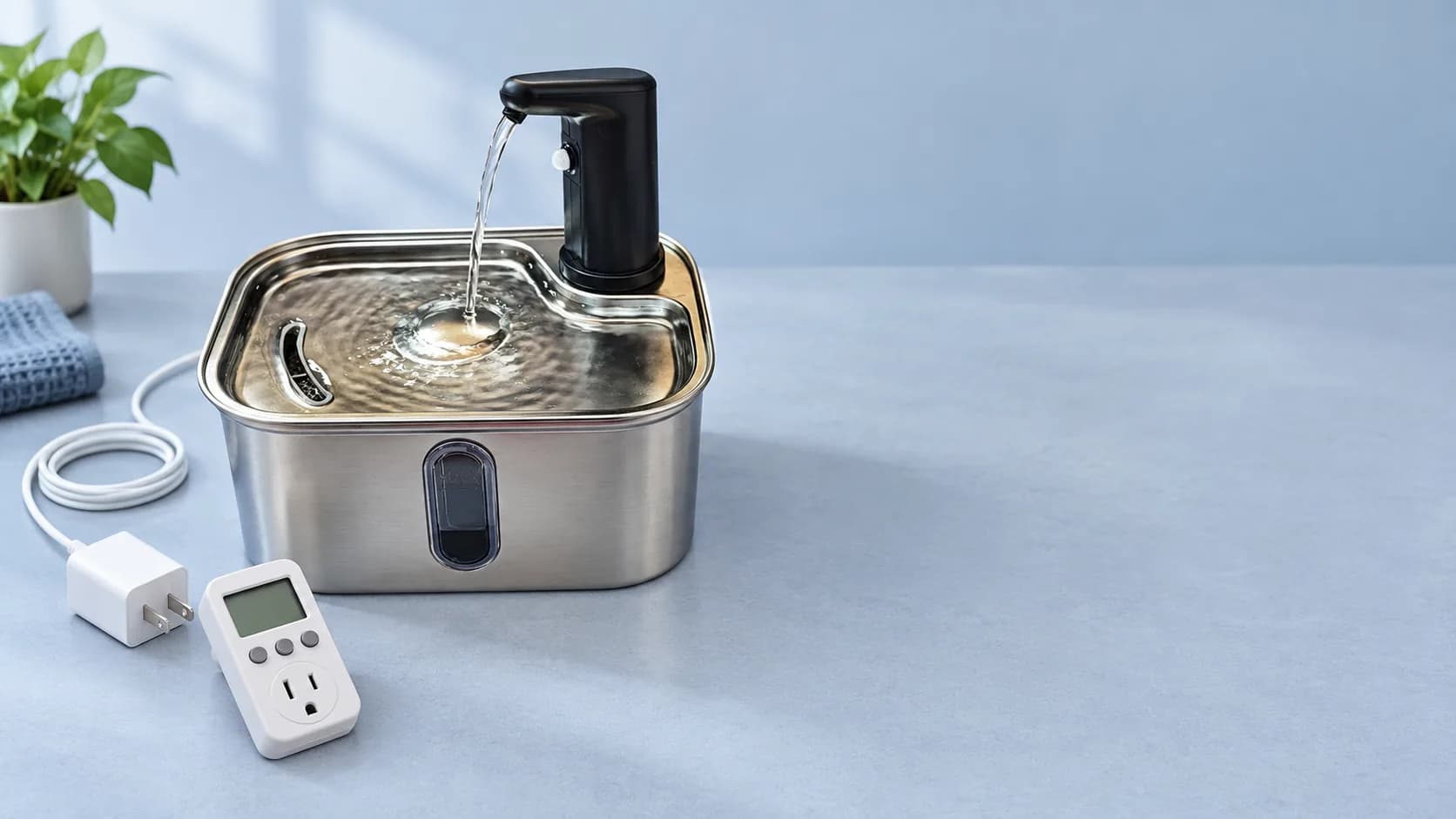
A stream running all day looks as if it should add a noticeable amount to the electricity bill. That concern often comes up after someone buys a plug-in fountain, and it also appears in retail projects when a buyer has to explain the difference between a continuously powered model and a rechargeable one.
Most cat water fountains do not use a lot of electricity because they rely on a small pump rather than a heating or cooling appliance. The exact cost still depends on the rated wattage, daily runtime, local electricity tariff and any extra electronics, such as lights, displays, UV modules or sensors. The product label or manual should provide the starting specification.
The useful answer is therefore a calculation, not a promise that a pet water fountain is “free to run.” This guide shows how watts become kilowatt-hours, compares plug-in and cordless power paths, and explains why low energy use does not remove the need to maintain the water level, filter and pump. It also gives brands a clearer way to write manuals and listings.
Do Cat Water Fountains Use a Lot of Electricity?
Usually no. Most cat fountains use a small, low-power pump, so their electricity use is modest compared with large household appliances. To estimate the real cost, multiply the fountain's watts by its operating hours per day and the days in the billing period, then divide by 1,000. Multiply the resulting kWh by your local electricity rate.
A 5W device running 24 hours a day for 30 days uses 3.6 kWh. That is a calculation example, not a claim that every fountain draws 5W continuously.
What Does Wattage Mean for a Cat Fountain?
Wattage describes the rate at which a device uses electrical power at a particular moment. It does not tell you the monthly energy total by itself. A 5W pump does not use 5 kWh merely because it is switched on; runtime must be included.
The U.S. Energy Information Administration's electricity guide distinguishes power in watts from energy over time in watt-hours. One kilowatt-hour is 1,000 watts used for one hour. Electricity bills normally price the accumulated kWh, which is why both the product rating and operating schedule matter.
| Term | Meaning | Why it matters |
|---|---|---|
| W (watt) | Power used at a moment | Starting figure for a running-cost estimate |
| Wh / kWh | Energy used over time | The quantity commonly billed by utilities |
| Hours per day | How long the device runs | Continuous and intermittent modes differ here |
| Electricity rate | Price for each kWh | Varies by location, tariff and time |
| Adapter output | Maximum supported output such as volts and amps | Not automatically the same as actual continuous draw |
A label reading 5V/1A describes an output limit of up to 5 watts under the simple DC relationship of volts × amps. It does not prove that the connected pump draws 5W at every moment. Control electronics, pump load and operating mode influence actual consumption, so use a verified device rating or a suitable power meter when precision matters.
How Much Electricity Does a Cat Water Fountain Use?
The only reliable starting point is the specification for the exact fountain, pump and operating mode. Small fountain pumps often carry ratings of only a few watts, but there is no single wattage that applies to every cat drinking fountain.
Look at the pump label, product manual and power-supply section of the product page. Confirm whether the published number covers only the pump or the complete device. A plain pump-and-flow design can differ from a model that also powers a display, status light, sensing circuit, UV module or rechargeable battery system.
Model-specific examples show why broad claims need limits. The PETLIBRO replacement-pump page lists a 5V/1A output for particular PLWF003, PLWF004 and PLWF006 models. Its Dockstream cordless specifications also list a 5V/1A adapter and a 5,000mAh battery, but battery capacity and adapter output are not the same measurement as monthly kWh. Neither example defines all pet fountains or Fountelio platforms.
At Fountelio, when a buyer asks whether a fountain is low power, I prefer to put the model, pump rating, control features and available modes on the same specification sheet. One isolated adapter number is easy to misread.
How Do You Calculate Monthly Electricity Cost?
Multiply watts by daily operating hours and days in the billing period, then divide by 1,000 to get kWh. Multiply that result by the local price per kWh.
Use the rated power and operating time for the exact fountain, then replace the example tariff with your local rate.
5W × 24 hours × 30 days ÷ 1,000 = 3.6 kWh per month
At an example tariff of $0.15/kWh: 3.6 × $0.15 = $0.54 per month.
Use the rate shown on your utility bill. Taxes, fixed charges, time-of-use pricing and currency are outside this simple device estimate. The formula estimates the fountain's variable energy cost; it does not predict the whole household bill.
For intermittent or sensor operation, replace 24 hours with estimated active pump time. If the control board remains powered while the pump is idle, a plug-in energy meter gives a better whole-device measurement than pump runtime alone. Measure under normal use over several days rather than extrapolating from one short cycle.
What Would 3W, 5W, 10W and 15W Cost per Month?
The table below compares four calculation examples running continuously for 30 days. The wattages are scenarios for using the formula, not a claim about the specification of any Fountelio model or the whole market.
| Example wattage | Monthly kWh | Cost at $0.15/kWh | Cost at $0.30/kWh | Interpretation |
|---|---|---|---|---|
| 3W | 2.16 kWh | $0.32 | $0.65 | Low-power example |
| 5W | 3.60 kWh | $0.54 | $1.08 | Common calculation example |
| 10W | 7.20 kWh | $1.08 | $2.16 | Higher-power example |
| 15W | 10.80 kWh | $1.62 | $3.24 | Feature-rich or higher-load example |
Example only: 24 hours per day for 30 days. Cost depends on your local electricity rate.
These are examples only. Replace the sample electricity rate with your local utility rate. Rounded costs may differ by one cent. A product that cycles on and off will normally accumulate fewer active pump-hours than the 24/7 column, but standby electronics and charging losses can still use energy. If a manufacturer publishes measured whole-device consumption, use that value and its stated test conditions.
How Can You Verify the Fountain's Actual Electricity Use?
A suitable plug-in energy meter can measure the complete fountain at the wall instead of estimating from the pump label. This is useful when the device also has a light, display, sensor, wireless connection or control board that the pump rating does not include.
Choose a meter that is compatible with the local outlet, voltage and expected load, then follow its instructions. Keep the meter, plug and adapter away from splashes and handle them with dry hands. Do not place test equipment underneath a reservoir or create a cord route where a person or pet can pull it.
Measure long enough to capture normal behavior. A continuous fountain may settle into a stable reading quickly, while a sensor or timed fountain needs several days if you want the average to include standby periods and real trigger frequency. For a rechargeable model, measuring one complete charging cycle can show wall energy for that charge, but monthly consumption still depends on how often charging occurs.
Record the model, mode, water level, filter condition and measurement period. Without those conditions, a single meter result is easy to misapply to another configuration. Also expect small differences between the printed rating and measured draw: a rating may state a maximum, while real load varies with design and operation.
If you cannot measure at the outlet, use the verified whole-device wattage. When only pump wattage is available, describe the result as a pump-based estimate and note which other electronics are excluded. That distinction makes a retail cost example much more credible.
Does Leaving a Cat Fountain On All Day Cost Much?
For a correctly specified low-wattage fountain, continuous use is usually a small part of a household electricity bill. The exact amount still depends on wattage and the local tariff, so the formula is more useful than a universal monthly figure.
Electricity cost is only one part of the decision. A fountain left running needs enough water to keep the pump within its permitted operating level, a clear intake, the correct adapter and regular cleaning. Unusual noise, weak flow or a low-water warning should be investigated rather than dismissed because the pump uses little power.
Our guide to leaving a cat water fountain on all the time covers overnight operation, backup water and dry-run precautions. Follow the exact manual because some rechargeable fountains offer continuous flow only while connected to power, while battery mode may use a sensor or intermittent cycle.
How Does Plug-In Electricity Use Differ From Cordless Use?
A cordless fountain still uses electricity; it draws energy during charging and then runs from stored battery energy. That makes its consumption pattern different from a plug-in fountain, not zero.
Plug-in
- Outlet
- Adapter
- Pump + controls
- Water flow
Energy is drawn while the fountain operates.
Cordless rechargeable
- Outlet
- Charger
- Battery storage
- Sensor or timed flow
Energy is drawn during charging and used later.
Conceptual power paths. Charging losses, control electronics and operating modes vary by model.
| Type | How it uses power | What affects the estimate | Buyer note |
|---|---|---|---|
| Plug-in | Draws from the adapter while operating | Rated load, runtime and added electronics | Calculate with watts and hours, or measure at the outlet |
| Rechargeable cordless | Charges a battery, then runs from stored energy | Battery capacity, charging loss and operating cycle | State charging input and tested runtime conditions separately |
| Motion-sensor cordless | Uses control power and runs after eligible triggers | Trigger frequency, cycle length and standby draw | Do not promise one runtime for every household |
| Wireless-pump platform | Transfers power through a matched base or uses the platform's battery architecture | Base, pump module and selected mode | Confirm the complete matched configuration |
The PETLIBRO Dockstream 2 page, for example, offers continuous and pet-activated sensor modes and limits its 30-day battery statement to a fully charged cordless model used by one pet in sensor mode. That is a useful example of stating the conditions, not a battery-life promise for other fountains.
For architecture and placement differences, see the cordless vs plug-in cat water fountain guide and the wireless pump vs cordless fountain comparison.
What Do USB, Low Voltage and Adapter Ratings Tell You?
They describe how power reaches the device, but they do not by themselves reveal actual monthly consumption. A USB-style connector may supply a low-voltage pump, while the wall adapter converts local mains input to the required output.
Read both sides of the specification. Adapter input can show a wide mains range, such as 100–240V and 50/60Hz, while output may be stated as 5V and a maximum current. The output ceiling helps determine whether an adapter is suitable. Actual energy use still depends on the connected device and mode.
- Use the manufacturer-recommended adapter.
- Keep plugs, adapters and connections dry.
- Disconnect power with dry hands before cleaning.
- Stop using damaged cords or adapters.
- Do not substitute a connector merely because it fits.
- Confirm destination-market plug and electrical requirements.
Low voltage is one part of product design; it does not eliminate electrical precautions. The cat water fountain safety guide covers cord condition, dry handling, placement and backup water in more detail.
What Can Increase a Fountain's Power Consumption?
Higher rated loads, longer runtime and extra powered features are the main reasons one fountain may use more electricity than another. Maintenance problems can also reduce flow or make the pump work outside its intended condition, though a clogged pump does not translate into one predictable cost increase.
| Factor | Possible effect | What to check |
|---|---|---|
| Higher-wattage pump | Raises energy use for the same runtime | Exact pump or whole-device rating |
| Higher flow setting | May alter pump load on adjustable models | Permitted settings and measured draw |
| LED, display or UV module | Adds an electrical load | Whether specifications include the feature |
| Sensor or connectivity | Adds standby electronics but may reduce pump runtime | Trigger logic, standby draw and usage pattern |
| Battery charging | Includes conversion and charging losses | Rated charging input and real charge frequency |
| Clogged intake or impeller | Can reduce flow and strain operation | Clean permitted pump parts |
| Low water level | May introduce air, noise or dry-run risk | Refill to the instructed level |
| Wrong adapter | Can cause incorrect or unsafe operation | Use the approved output and polarity |
Do not infer efficiency from flow strength alone. A weak stream could result from low water, a loaded filter, trapped air, residue around the impeller or a worn part. Diagnose the water path before comparing the electricity bill.
Why Does Pump Care Matter Even When Electricity Use Is Low?
A small low-wattage pump still depends on adequate water, a clear intake and regular cleaning. Low power does not make dry running, hair, mineral scale or slime harmless.
Keep the pump submerged as the manual directs.
Replace or clean only as specified for the model.
Remove hair, scale and residue from permitted parts.
Investigate weak or noisy flow instead of ignoring it.
PetSafe's replacement-pump maintenance guidance recommends disassembling and cleaning the named pump every two weeks to help extend its life. PETLIBRO gives the same two-week cleaning interval for the compatible models on its replacement-pump page. Those intervals are manufacturer instructions for named products, not a universal schedule for every fountain.
Start with the manual for your model. If flow falls, clean the accessible pump and impeller areas, check the filter and confirm the reservoir is correctly seated. The cat water fountain pump troubleshooting guide separates power, noise and flow symptoms. The cat water fountain cleaning guide covers the water path, and the cat water fountain lifespan guide helps decide when cleaning is no longer enough.
In the projects we review, a question about electricity sometimes turns out to be a maintenance question: the bill has not changed, but the pump sounds louder because the water level or intake needs attention.
Do Sensor, Timer and Continuous Modes Use the Same Amount of Electricity?
No. Their pump runtime differs, and standby electronics may continue drawing a smaller amount of power between cycles. The result depends on the control design and how frequently the mode activates.
Runs steadily while powered.
Runs in scheduled cycles.
Runs after a qualifying trigger.
Illustrative patterns. The exact cycle, trigger logic and available modes come from the product manual.
| Mode | Power pattern | Potential benefit | Caution |
|---|---|---|---|
| Continuous | Pump runs steadily while powered | Predictable water movement and calculation | Requires water-level and pump checks |
| Timer / intermittent | Pump runs in scheduled cycles | Fewer active pump-hours | Cycle length and standby use are model-specific |
| Sensor | Pump responds to eligible movement or presence | Can extend battery runtime in some designs | Trigger frequency varies by household |
Sensor mode is not automatically the best option for every cat or every room. Some cats respond better to constant flow; a busy sensor field may also trigger more often than expected. Compare the permitted modes, placement and backup-water plan rather than choosing from an “energy saving” label alone.
What Should Buyers Check on the Product Label or Manual?
Ask for specific electrical and operating information rather than a general “low power” claim. A useful file lets a retailer identify the complete configuration and explain it consistently after launch.
- Exact model and pump or system wattage.
- Rated voltage, current and frequency where applicable.
- Adapter input, output, polarity and approved replacement policy.
- Destination-market plug type and required compliance documents.
- Whether the rating includes lights, UV, sensing or connectivity.
- Battery capacity, charging time and runtime test conditions.
- Available continuous, intermittent and sensor modes.
- Low-water, dry-run and cleaning instructions.
- Replacement pump compatibility and service reference.
The adapter rating shows what the adapter can supply, not always the exact power the fountain draws at every moment. Adapter output and product consumption should not be placed in the same field without explanation. A maximum 5V/1A output can be relevant to adapter selection while still being an incomplete description of actual energy use.
How Should Brands and Retailers Explain Power Consumption?
State the verified rating, show the calculation method and keep cost examples visibly conditional. This gives customers enough information to estimate use without turning one tariff or operating pattern into a universal promise.
Example layout only. Replace every value and instruction with the approved specification for the selected model.
For a private-label manual, I would place the exact power-supply specification beside the approved adapter image and operating-mode instructions. The product page can then show a neutral formula: watts × hours × days ÷ 1,000. If a cost example is included, label the tariff, runtime and rounding assumptions.
A concise wording pattern is: “This fountain uses a low-wattage pump. Actual energy use depends on the verified product rating, operating mode, runtime and local electricity rate. Keep the pump at the instructed water level, clean user-accessible pump parts regularly and use only the recommended adapter.” Replace “low-wattage” with the actual rating when it is available and approved.
Avoid “zero electricity,” “free to run,” guaranteed monthly cost and unverified savings percentages. For cordless products, separate battery capacity, charging time and tested runtime conditions. For connected or sensor models, explain whether the control electronics remain active while flow is paused.
Confirm this information early in a private-label project because the plug, adapter, manual, carton panel and online listing need to match. Fountelio's cat water fountain platforms cover standard powered, rechargeable and wireless-pump architectures; each version needs its own approved power wording rather than a shared generic claim.
Frequently Asked Questions About Cat Fountain Electricity
Do cat water fountains use a lot of electricity?
No, most use a small pump and therefore consume relatively little electricity compared with high-power household appliances. The monthly figure depends on the exact wattage, daily runtime and local tariff.
How many watts does a cat water fountain use?
There is no universal wattage. Check the exact pump label, manual or whole-device specification. Extra lights, UV, sensing, displays and charging systems can change the total.
How do I calculate the electricity cost?
Multiply watts by hours per day and days per month, divide by 1,000, then multiply the resulting kWh by your local electricity price.
How much electricity does a 5W fountain use?
A 5W device running 24 hours a day for 30 days uses 3.6 kWh. At $0.15/kWh that example is $0.54; use your own tariff and verify that 5W is the appropriate rating.
Is it expensive to leave a fountain on 24/7?
Usually not for a small low-wattage pump, but calculate it from the model's rating. Continuous operation also requires water-level, filter, pump and adapter care.
Do cordless cat fountains use electricity?
Yes. They use electricity to charge the battery, then use stored energy while operating. Charging loss, battery capacity and selected mode influence the total.
Does a motion sensor fountain save electricity?
It can reduce pump runtime, but savings depend on trigger frequency, cycle length and standby use. It is not automatically the best operating mode for every cat.
Can a dirty pump use more power?
A dirty intake or impeller can reduce flow and push operation outside the intended condition. The exact energy change is not predictable from dirt alone; clean and diagnose the pump according to the manual.
Is a USB fountain safer or cheaper to run?
A USB-style low-voltage supply can be part of a safe, low-power design, but the connector alone proves neither safety nor cost. Check the adapter, power rating, cable condition and keep electrical connections dry.
What should a wholesale buyer verify?
Verify the model-specific rating, adapter input/output, plug, modes, battery conditions, warnings, replacement policy and destination-market documents before artwork and manuals are released.
What Is the Practical Answer?
Cat fountains generally use modest amounts of electricity, but the useful answer is the model's verified watts combined with its actual runtime. Use the formula, insert the local tariff and keep cost examples conditional. Then look beyond the bill: maintain the water level and pump, use the correct adapter, and match the operating mode to the product and household.
About This Guide
Written by Tony Kong, R&D Engineer at Fountelio. Fountelio manufactures cat water fountains. The calculations use standard electrical units and clearly stated example assumptions; they are not laboratory measurements of every Fountelio product.
The hero is an editorial composition based on a Fountelio fountain. Its power meter, wattage card and the article diagrams are explanatory aids. Verify the current manual and product label for the exact model.
Sources & References
- U.S. Energy Information Administration: Measuring Electricity
- PetSafe Current Fountain Pump: maintenance guidance
- PETLIBRO replacement pump: model-specific 5V/1A specification and cleaning guidance
- PETLIBRO Dockstream Cordless Fountain: model-specific adapter and battery specifications
- PETLIBRO Dockstream 2: mode and conditional battery-runtime example