

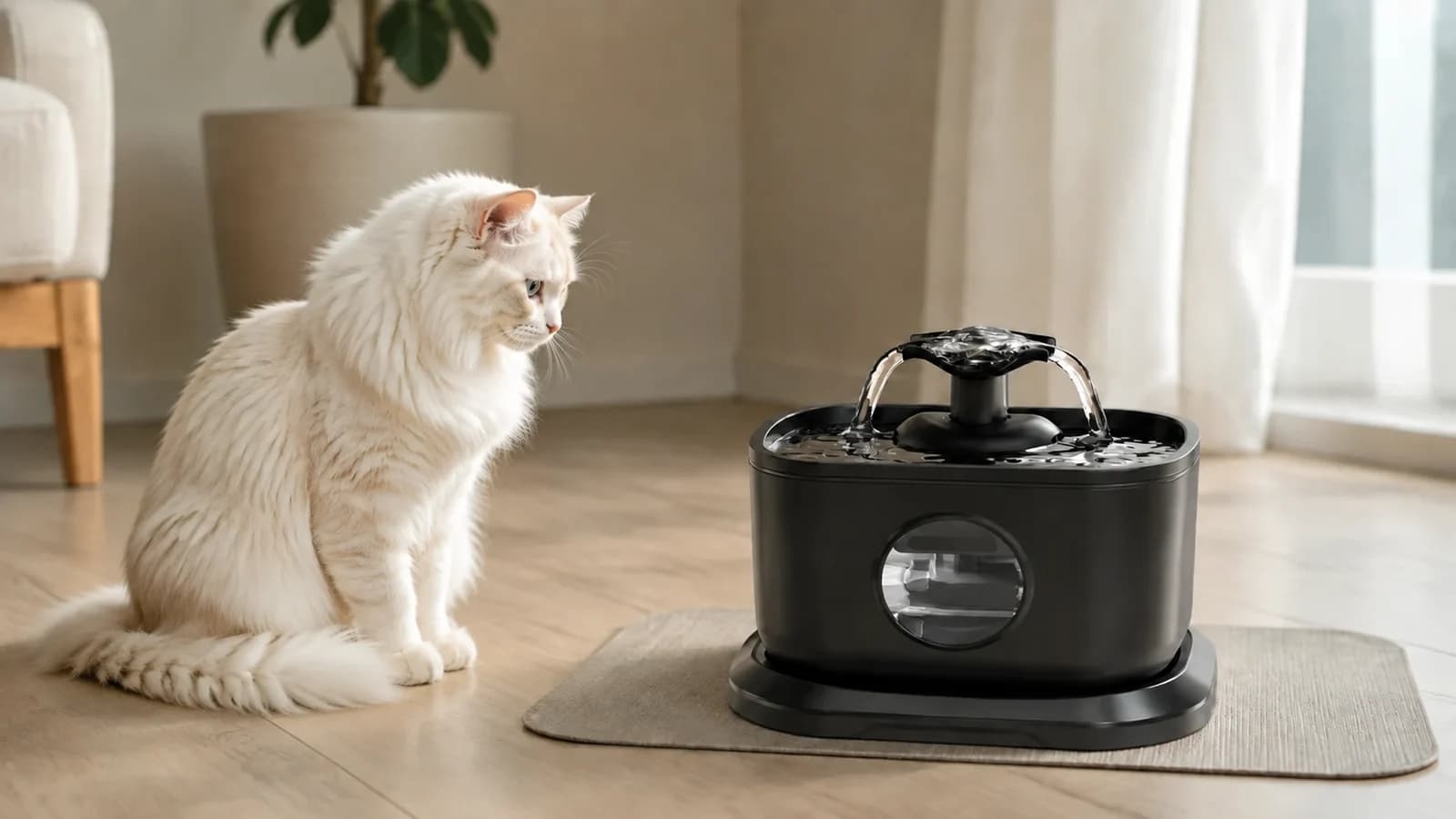
Turn on a tap and a cat may arrive to watch the stream, reach out a paw or take a drink. Another cat might barely look up. It is a familiar contrast, yet explanations for it often sound far more certain than the research allows.
Some cats may find running water interesting because it moves, makes sounds and catches the light. Those are plausible sensory cues. They do not establish that cats generally prefer to drink flowing water, or that a fountain makes every cat drink more.
When I compare fountain designs, I can examine the outlet shape, falling stream and sound where water meets the tray. What I cannot infer from those product details is what every cat naturally wants. This guide keeps that boundary between product observation and feline behavior.
Why Do Some Cats Like Running Water?
There is probably no single reason. Movement, sound and changing reflections may draw attention, while taste, temperature, location and familiarity could influence an individual cat’s choice. Research has not established a universal preference for running water or a consistent fountain effect on water intake.
The useful question is what your cat actually does: watches, plays, drinks occasionally or repeatedly chooses that source. Those observations support different conclusions.
Individual variation
Water-source studies found differing individual responses, without a consistent average intake benefit.
Sensory cues
Movement, sound, reflections and context may contribute. The main mechanism has not been isolated.
A universal fountain effect
Neither an instinctive preference in every cat nor reliably greater intake is demonstrated.
Do Cats Really Prefer Running Water?
Some individual cats do, but controlled comparisons have not established a species-wide preference. Small studies give us reasons to offer choices, rather than assume the same water presentation suits every cat.
| Study / comparison | Result | Limit of the finding |
|---|---|---|
| Grant 2010 · bowl vs fountain | 13 cats enrolled; 12 continued. Initial fountain intake was significantly higher; urine osmolality was not significantly different. Excluding one diet-inconsistent cat removed the significant intake difference. | The initial result was sensitive to a dietary inconsistency; the study did not explain sensory preference. |
| Pachel & Neilson 2010 · still vs flowing | Nine cats. Mean flowing-water consumption was slightly higher, but not statistically significant; individual differences were observed. | A short pilot study does not establish a group preference for flowing water. |
| Robbins et al. 2019 · still, circulating, free-falling | 14 of 16 cats completed. No significant group-level intake difference; three cats showed significant individual water-source preferences. | Different cats favored different comparisons, including still over circulating water. |
| Kosmal et al. 2026 · scoping review | 32 publications on feline water intake and hydration; its water-source discussion draws on the three comparisons above. Support for a general moving-water effect was insufficient. | These were not 32 fountain trials. The review does not identify one sensory cause of preference. |
For Grant, the excluded cat received added wet food during the bowl condition. Removing that dietary inconsistency mattered because food moisture can affect drinking. The initial increase should therefore not be quoted without the sensitivity analysis and urine findings.
The review covers literature from 1975–2025 and appears in the journal’s 2026 volume. Its broader scope should not be confused with the much smaller evidence base on water presentation.
What Does the Research Actually Tell Us About Running Water?
The evidence leaves room for individual preferences while failing to establish a dependable group benefit. “No significant difference” means the study did not establish a difference under its conditions; it does not prove every cat responds identically.
That distinction matters at home. A particular cat can repeatedly use one source even when a study average barely changes. Equally, a small preference study cannot tell you that most cats want fountains. Treat the results as a reason to observe the individual, not a population-wide rule.
A group result asks whether the tested format produces a dependable difference across the study population. An individual response asks what happened for one cat. Different responses can coexist within a similar average; the absence of a universal preference does not make an accepted fountain useless to a particular household.
The benefit may be another reliable drinking option. It is still possible for a cat to move some drinking from its bowl to the fountain without consuming more water overall. Preference tells you something about the choice of source; demonstrating increased intake requires accounting for water from the other sources too.
Does Moving Water Attract a Cat’s Attention?
It plausibly can. Cats can detect and discriminate motion, so a stream supplies changing visual information. That ability alone does not demonstrate a preference for drinking from it.
Berkley and colleagues’ movement-discrimination research tested cats’ responses to moving visual stimuli, not drinking choices. It supports the sensory ability, while leaving the proposed link to water attraction untested.
A fountain can produce ripples, a falling arc or a moving reflection. Any of these gives a cat something to inspect. Watching for a minute still tells you less about water-source choice than returning voluntarily to drink on several occasions.
Watching, following a stream with the eyes, approaching and reaching out a paw are all observable actions. None requires the cat to swallow water. For example, a cat might track a falling stream and then drink from its usual bowl. Record those actions separately from repeated drinking, so an interesting display is not mistaken for an accepted water source.
Attention
Does the cat watch or paw?Evidence of noticing or interaction.
Preference
Does it repeatedly choose to drink?Evidence about that source in that setup.
Intake
Does it consume more water overall?Requires measurement beyond visits.
Attention ≠ preference ≠ increased water intake. One outcome does not establish the next.
Does the Sound of Running Water Matter?
Sound may make a source noticeable, but the water-preference studies above did not isolate it as the reason for a cat’s choice. A tap also sounds different from a fountain.
In a fountain, distinguish water landing in the tray from motor hum or vibration through the floor. Changing the outlet or water level can alter that combination. An approach followed by a retreat is a useful observation, but it cannot identify which sound—or another feature—caused the response.
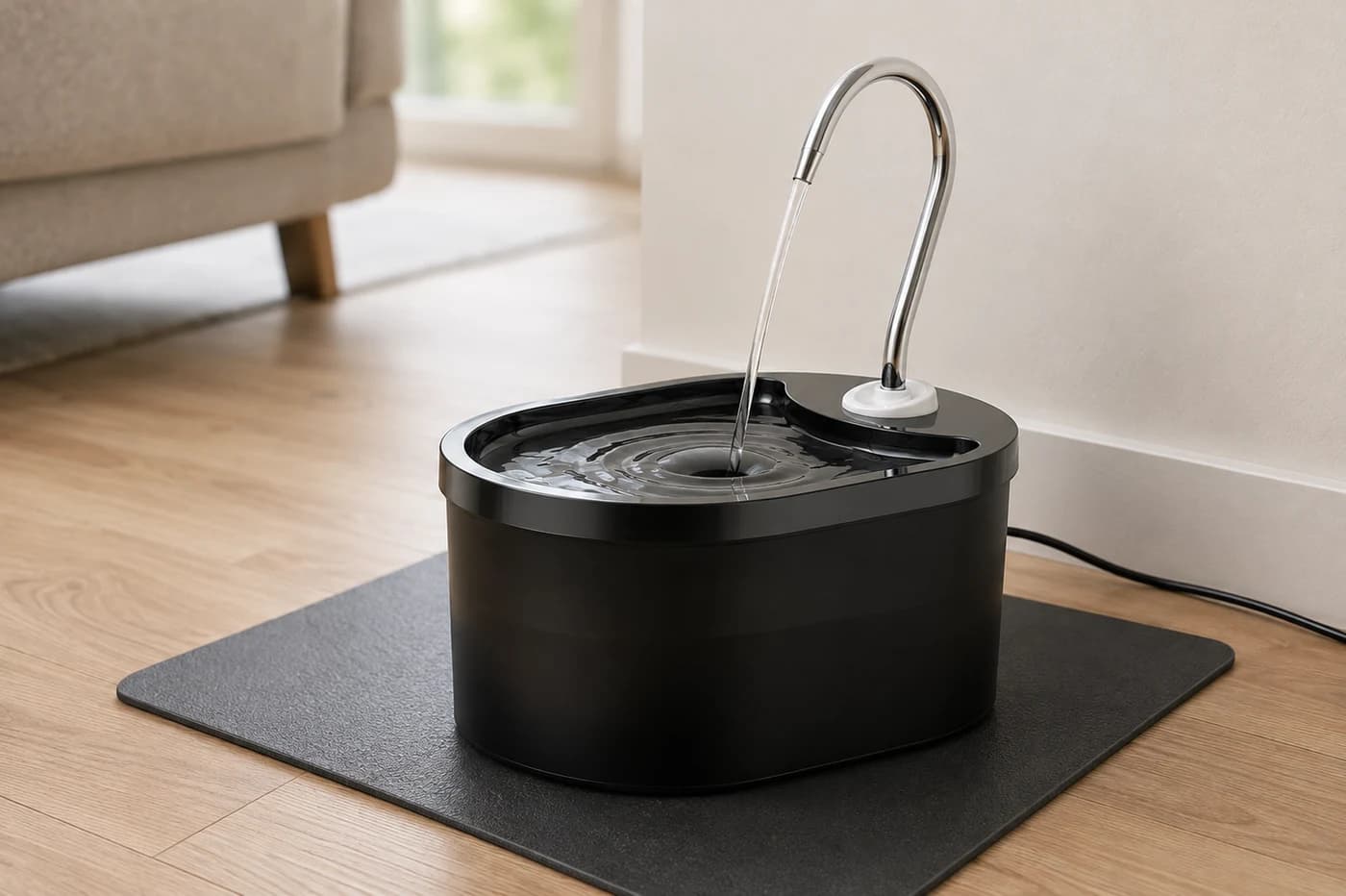
Are Ripples and Reflections Part of the Appeal?
They may add visual interest. Moving surfaces continually change highlights and patterns, but these have not been established as a universal reason cats choose a drinking source.
This does not mean still water is invisible to cats. If you investigate a possible visual preference, note lighting and reflections as trial variables. A photograph of a cat looking at a shiny tray cannot establish that reflection caused the interest.
Do Cats Prefer Running Water Because It Was Safer in the Wild?
That is a common evolutionary explanation, not an established mechanism behind domestic-cat fountain preference. The water-source studies do not demonstrate that cats recognize moving water as safer.
Cats Protection’s explanation connects the behavior with wild ancestors and the relative safety of running water. It is an understandable story, but ancestral plausibility and a direct test of domestic-cat choice are different kinds of evidence.
The biological reasoning is plausible: features associated with suitable water in an ancestral environment could have influenced behavior. But that possibility leaves several steps untested. It does not establish which cue a domestic cat responds to, whether that cue represents safety to the animal, or whether it explains choices across cats with different histories.
This narrative appears in Cats Protection’s article and in wider pet coverage, but repetition does not turn it into an experimentally demonstrated mechanism. Comparing a fountain with a bowl changes the whole presentation. To support the specific safety explanation, research would need to distinguish it from alternatives such as sensory interest, familiarity or location. The cited comparisons do not make that distinction.
Ancestral experience favored safer, moving water.
A direct demonstration that this explains domestic cats’ fountain choices.
Status: not established. This is different from proving the explanation false.
Calling the explanation unproven does not establish that it is false. It means we should avoid turning it into claims such as “your cat knows the bowl is contaminated.” The owner still needs to judge actual cleanliness.
Is Running Water Actually Fresher or Cleaner?
Not automatically. Circulation does not disinfect water or remove the need to wash the reservoir, tray and serviceable pump parts. A moving surface can look lively while the system still needs maintenance.
“Looks fresh” describes an impression; actual cleanliness depends on source water and what it contacts. The reservoir, wet surfaces, filter where fitted, and pump all form part of that path. A clear-looking stream does not reveal the condition of hidden surfaces or establish microbiological quality. Inspection, water refresh and the specified cleaning routine still matter. Moving water is not self-cleaning.
Freshly supplied tap water and recirculated reservoir water also follow different paths. Movement alone is therefore a poor comparison of their hygiene. A clean, regularly refreshed bowl remains a legitimate water source. Follow the model’s instructions and our fountain cleaning guide; do not use water motion as a cleanliness test.
Could Taste or Temperature Explain a Cat’s Choice?
They are reasonable individual variables to consider, rather than proven explanations for all faucet drinking. VCA’s practical guidance notes differences in cats’ responses to water taste, smell and temperature.
A tap visit changes several things together: the water may be cooler, the source is newly running, and the location differs from the bowl. That makes it difficult to credit temperature alone. Keep drinking water suitable and fresh; there is no need to invent a universal preferred temperature or add flavorings to test this idea.
What Changes When Water Starts Moving?
“Running water” includes quite different presentations. A shallow ripple, narrow stream and broad cascade change the visible water, landing area and possible drinking positions in different ways.
In product review, I would compare where the stream starts, how far it falls and which part of the tray remains accessible. Counting outlets misses those differences. A taller stream does not automatically create a more appealing drinking experience.
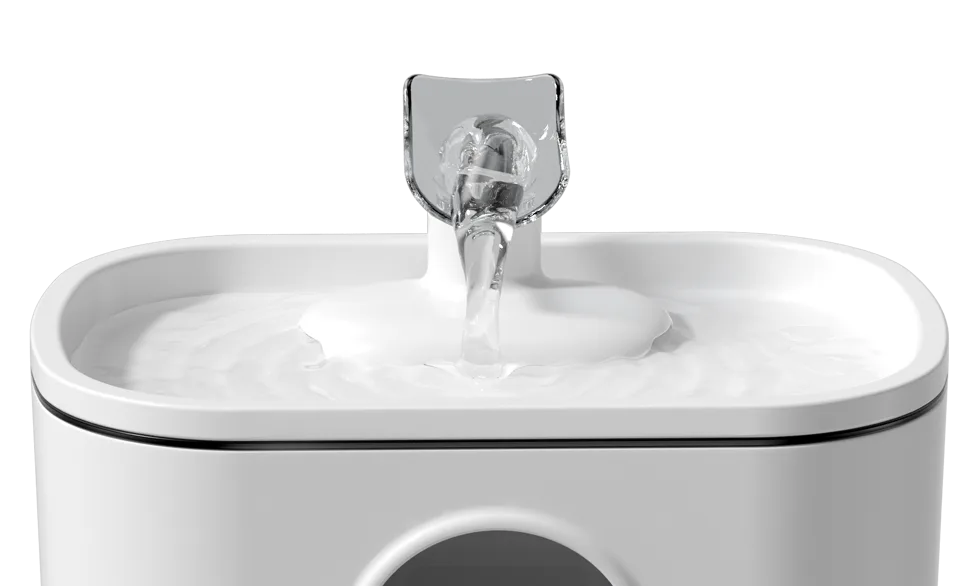
Spout A
Upright outlet with a falling stream
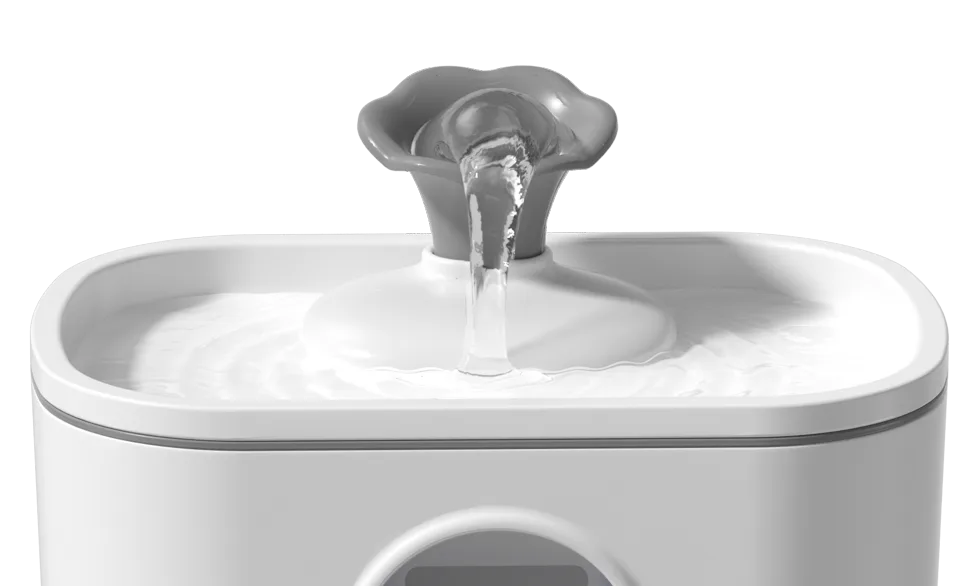
Spout B
Shaped outlet feeding a central stream
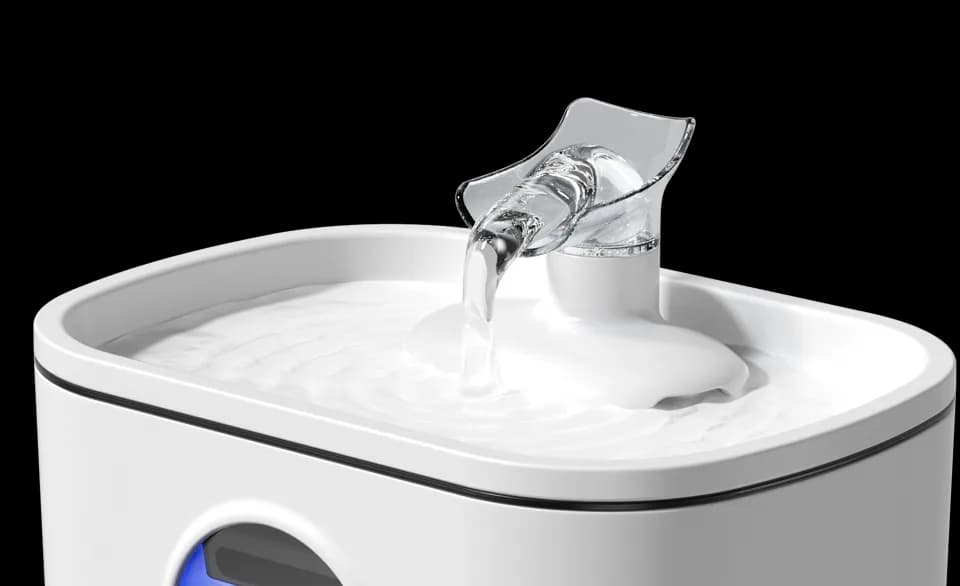
Spout C
Angled outlet changing the stream direction
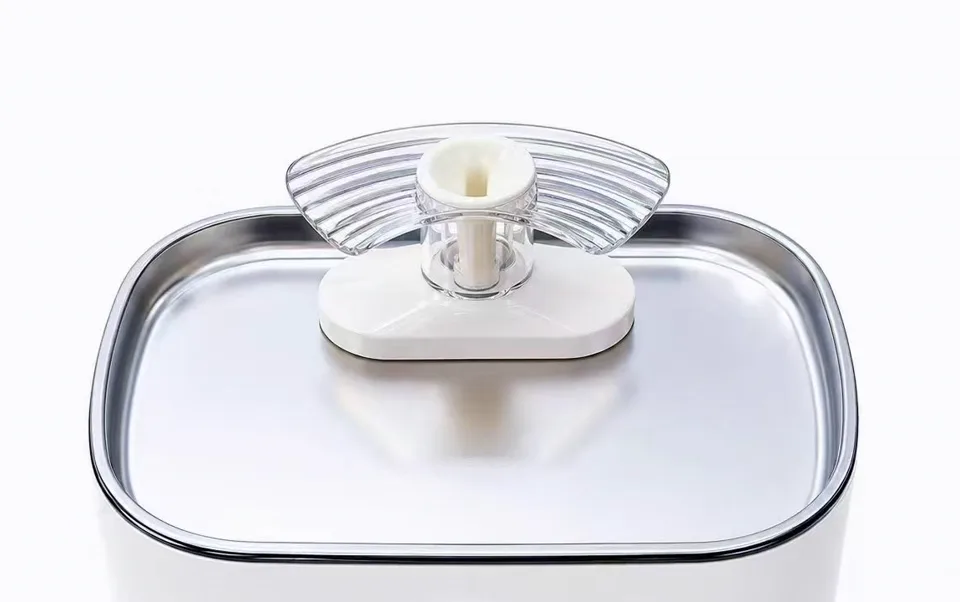
Spout D
Broad outlet geometry; shown without flow
Compare outlet, drop and landing area. These product examples do not rank feline preference.
These Fountelio product images show outlet configurations, not measured flow rates or preference rankings. Spout D shows its outlet and tray without a visible operating stream; it should not be used to infer how that stream behaves.
Timing is another variable. Continuous flow stays present; sensor-triggered flow starts under the exact model’s activation rules. A still image cannot reveal the delay, detection area or cycle duration. The cordless versus plug-in guide explains why power source and flow mode are separate decisions.
Why Does My Cat Stare at or Paw Running Water Without Drinking?
Watching or pawing shows interaction with the water; it does not, by itself, show a drinking preference. Exploration or play are possible interpretations, but the exact motivation cannot be read from that action alone.
Record whether the cat actually laps water and later returns to drink. A wet paw, a long visit or splashes around the tray should not be counted as increased intake. There is no need to turn every curious interaction into a hydration conclusion.
If My Cat Likes the Tap, Will It Automatically Like a Fountain?
No. The tap and fountain may share moving water while differing in almost everything around it. A positive response to one does not identify which feature the cat values.
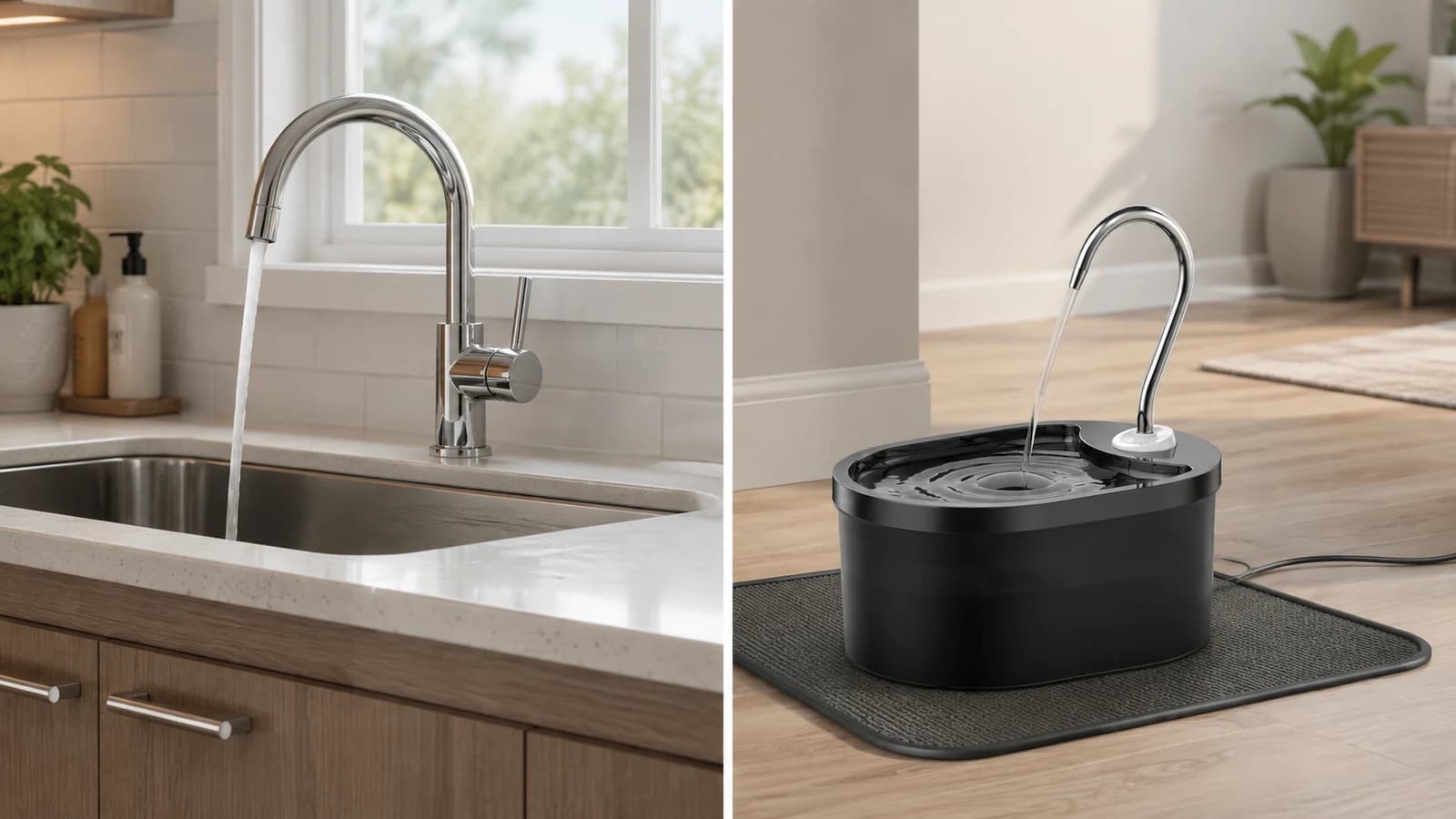
| Variable | Tap | Fountain |
|---|---|---|
| Water presentation | Flow set by the tap | Outlet, tray and pump shape the stream |
| Sound | Water impact and plumbing | Water impact plus possible pump vibration |
| Timing | Usually starts when a person opens it | Continuous, timed or model-specific sensing |
| Context | Sink height, location and routine | Different approach, drinking edge and placement |
If the cat ignores the fountain, investigate one difference at a time while keeping reliable water available. Start with the placement guide. For a fountain already being avoided, the adoption troubleshooting guide separates unfamiliarity from a change after previous use.
Why Do Some Cats Prefer Still Water?
A quiet, familiar bowl may simply be the source that cat accepts. The research does not justify treating still-water choice as a problem to overcome.
Familiarity, location and drinking surface are possible contributors, but repeated bowl use does not isolate any one explanation. Maintain that successful option rather than assuming more visible movement must be an improvement.
Does Every Cat Need a Water Fountain?
No. Cats need reliable access to suitable water; a fountain is one way to provide it. An accepted, clean bowl can continue to meet the household’s water-source needs.
If you are deciding whether the additional option is useful, our fountain versus bowl comparison covers the maintenance and ownership trade-offs. This behavior question does not require a product purchase as its answer.
Do Water Fountains Make Cats Drink More?
Not consistently across cats in the controlled comparisons reviewed here. An individual may use a particular source more, but that does not establish a reliable fountain effect for every cat.
Taken together, the studies offer no dependable shortcut from “moving” to “more.” Grant’s initial increase did not remain significant after the diet inconsistency was excluded, and urine concentration did not improve significantly. Pachel and Neilson’s slightly higher flowing-water average was not statistically significant. Robbins found individual preferences without a group intake difference. The 2026 review therefore treats a general moving-water benefit as insufficiently supported.
A fountain may still matter for a cat that prefers and repeatedly uses it. That is a reason to retain a successful option, not to promise the same increase for other cats. Nor does choosing it show whether drinking has increased overall or simply shifted away from another source.
Water-source use, total water intake and hydration status are separate measurements. Food moisture contributes too, and a reservoir can lose water through splashing or evaporation. More visits—or a lower tank level—cannot independently establish improved hydration. A fountain should not be presented as preventing urinary or kidney disease.
Why Don’t We Have a Clear Scientific Answer Yet?
The direct comparisons are few, small and conducted under differing conditions. They compare water systems more readily than they explain which sensory feature drives a choice.
Housing, diet, acclimation and the actual bowls or fountains differ between studies. Robbins used successive water-system periods, so its individual preferences were inferred from consumption across conditions, not a simultaneous choice between three nearby sources.
The populations also differ: Grant studied cats in their owners’ homes, Pachel and Neilson used shelter cats, and Robbins studied laboratory cats. Small samples from those settings cannot capture every combination of prior experience and preference. These are useful studies answering bounded questions, rather than a single interchangeable test repeated in every kind of home.
“Flowing water” is not one standardized treatment. Across designs and setups, movement may change alongside sound, water temperature, drinking height or location. A result for the complete setup cannot identify which feature mattered. Diet adds another complication: moisture in food contributes to total intake and can change how much a cat drinks separately. Those factors need to be recorded or controlled before attributing a change to flow alone.
A more informative mechanism study would vary sound or flow while keeping other features comparable. That is a research need, not something these findings have already settled. Absence of a general effect leaves both individual variation and unanswered questions.
How Can You Tell Whether Your Cat Actually Prefers Running Water?
Look for repeated voluntary drinking while another clean, reliable source remains available. Home observation can guide your setup, although it cannot reproduce a controlled intake or hydration study.
- Keep the familiar sourceProvide clean, reliable water throughout.
- Watch actual drinkingSeparate lapping from looking and pawing.
- Change one variableNote flow, location or another adjustment.
- Look for repeated useAcceptance is useful; intake remains a separate question.
For example, changing flow while also moving the fountain to a new room leaves two possible explanations for a different response. Keep a simple note of source, actual drinking, location and any change. Do not impose a fixed acceptance deadline or move every familiar resource for a cleaner comparison.
Offer a choice first. Never remove a clean water source your cat already reliably uses while introducing a fountain.
This is a conservative introduction approach, not a quotation from a veterinary guideline. Stop the preference exercise if overall drinking changes or the cat seems unwell.
When Can a New Interest in Running Water Be a Health Concern?
Curiosity about a tap alone does not diagnose illness. A sudden or persistent change in overall thirst or drinking, especially with altered urination, appetite or weight, deserves veterinary attention.
Veterinarian Sandra C. Mitchell’s PetMD guidance discusses increased thirst and when to contact a vet. If the cat is drinking much less from all sources or appears unwell, seek veterinary advice promptly; PetMD’s reduced-drinking guidance addresses that situation. Do not keep adjusting fountain settings as the only response.
What Should Brands Learn From Cat Water-Preference Research?
Describe the options a product offers, and keep preference or intake claims separate from hardware specifications. A visible stream is demonstrable; a universal benefit needs different evidence.
When comparing samples, I would document outlet geometry, water-impact sound, pump noise and activation timing before writing the product description. I would also check whether the manual helps an owner offer the fountain without removing an accepted source.
- Show flow styles clearly, without labeling one “what cats naturally prefer.”
- Identify which modes work in each power state.
- Explain cleaning access and water-level requirements.
- Separate operating demonstrations from animal studies.
Individual preferences vary
Offer more than one water presentation
Provide options without declaring one universally preferred.
A universal intake increase is not established
Do not promise guaranteed hydration
Keep product specifications separate from health outcomes.
Moving water takes different sensory forms
Show flow, outlet behavior and sound honestly
Describe actual operating conditions; a photo cannot demonstrate sound.
Context can influence a water-source choice
Provide realistic setup and introduction guidance
Account for placement and familiarity; keep an accepted source available.
Editorial implications of the evidence and design variables discussed above, not results of a Fountelio cat-preference experiment.
For the wider specification checklist, see how to choose a cat water fountain.
What Are the Most Common Questions About Cats and Running Water?
Do all cats like running water?
No. Individual responses differ, and a universal preference has not been established.
Does staring at a stream mean my cat is thirsty?
Not necessarily. Looking does not establish either drinking or an increase in thirst.
Is a fountain cleaner than a bowl?
Not because it circulates. The water source and maintenance of the entire container or system matter.
Should I replace the old bowl immediately?
Keep any clean source your cat reliably uses while offering the new option.
Does more pawing mean more water intake?
No. Pawing and splashing are not measurements of consumption.
Will a sensor fountain suit a tap-loving cat?
You cannot infer that from tap use. Activation timing and the rest of the setup vary by model.
Can I judge preference from one visit?
One visit offers little evidence of a stable choice. Observe repeated voluntary drinking without restricting alternatives.
Is the instinct explanation disproven?
No. It remains an explanation that has not been directly established by these water-source studies.
So Why Do Cats Like Running Water?
Some may find its sensory features interesting, and some choose to drink from it. We do not have one demonstrated explanation that fits every cat. The clearest practical lesson is to observe the individual and keep reliable water available.
I can compare how fountains present water. The cat’s repeated use tells the owner whether an option is being accepted; neither observation alone proves an increase in total intake. A fountain adds a way to access water, without deciding what every cat should prefer.
About This Guide
Written by Tony Kong, R&D Engineer at Fountelio. Product observations concern outlet geometry, flow presentation and operating behavior. Scientific interpretations are tied to the publications cited here; this guide is not a veterinary assessment.
Fountelio manufactures cat water fountains and has a commercial interest in the category. Product imagery illustrates design features, while the illustrative home scene is not evidence of a preference test. No product photo establishes a cat’s motivation, intake or health outcome.
Sources & References
- Kosmal et al. (2026). Scoping review of 32 publications on feline water intake, hydration and related outcomes. Journal of Animal Science, 104, skaf434.
- Grant (2010). Effect of water source on intake and urine concentration in healthy cats. Journal of Feline Medicine and Surgery, 12, 431–434.
- Pachel & Neilson (2010). Comparison of feline water consumption between still and flowing water sources: A pilot study. Journal of Veterinary Behavior, 5, 130–133.
- Robbins et al. (2019). Quantified water intake from still, free-falling and circulating water bowls. Journal of Feline Medicine and Surgery, 21, 682–690.
- Berkley, Warmath & Tunkl (1978). Movement discrimination capacities in the cat. Journal of Comparative and Physiological Psychology, 92, 463–473.
- VCA Animal Hospitals. Tips to encourage cats to drink more water. Practical taste and temperature guidance.
- Cats Protection. Why do cats love running water? Cited as an example of the common evolutionary explanation, not proof of that mechanism.
- Sandra C. Mitchell, DVM, DABVP / PetMD. Why Is My Cat Drinking a Lot of Water?
- PetMD. How to Get Cats to Drink Water. Veterinary guidance on reduced drinking.